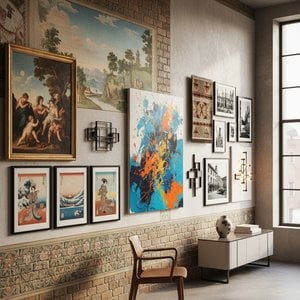
Gray Masterpieces: 10 Iconic Paintings & Timeless Home Decor Ideas
目录
Introduction
Gray—often perceived as a color of neutrality, melancholy, or even absence—possesses a remarkable power within the realm of art. It’s a tone that whispers rather than shouts, inviting contemplation and introspection. To explore paintings dominated by 'gray' tones is to delve into a world where subtlety reigns supreme, where emotion is conveyed not through vibrant hues but through nuanced shades and masterful manipulation of light and shadow. These works aren’t simply *about* gray; they use it as a vehicle for profound storytelling.
Historically, the use of grayscale in painting has ebbed and flowed with cultural currents. From the somber religious scenes of the medieval period—where limited pigments often resulted in muted palettes—to the dramatic chiaroscuro of the Baroque era, gray has served as a foundational element for expressing gravity, spirituality, and realism. The 19th century witnessed a renewed interest in atmospheric effects, particularly with the rise of Romanticism and Impressionism, leading artists to embrace grays and blues to capture fleeting moments and emotional landscapes. Later, modern masters explored grayscale’s potential for abstraction and psychological depth.
The enduring appeal of these paintings lies in their ability to transcend time and connect with viewers on a deeply personal level. They offer respite from the often-overwhelming intensity of color, allowing us to focus on form, texture, and the emotional weight carried within each brushstroke. These are not merely depictions of subjects; they are explorations of human experience—loss, longing, resilience, and the quiet beauty found in the everyday. The gray tones become a mirror reflecting our own inner worlds.
Over the following list, we will journey through ten iconic paintings where 'gray' takes center stage. Prepare to be captivated by works that demonstrate the extraordinary versatility of this often-underestimated color and discover why these masterpieces continue to resonate with audiences worldwide—a testament to the power of subtlety, emotion, and artistic vision.
The Child's Bath - Mary Cassatt
A quiet reverence hangs over The Child’s Bath by Mary Cassatt—a tender tableau of maternal care rendered in a symphony of soft grays, creams, and delicate pinks. Painted in 1893, this masterpiece isn't merely an image; it’s an intimate invitation into the private world of motherhood, a realm often excluded from the grand narratives of art history.
Cassatt’s genius lies in her ability to elevate the everyday—the simple act of bathing a child—to the level of profound artistic expression. Her Impressionistic brushwork, loose and vibrant, captures the fleeting quality of light and movement, imbuing the scene with an unparalleled sense of warmth and immediacy. The muted palette, dominated by these subtle gray tones, isn’t a lack of color but rather a deliberate choice to focus on form, texture, and emotional resonance.
This painting is irreplaceable within our list of Top 10 Famous Paintings Dominated by 'Gray' Tones because it represents a revolutionary shift in subject matter. Cassatt challenged conventional expectations, portraying women not as objects of desire but as active participants in their own lives and the lives of their families. The artwork’s enduring appeal speaks to universal themes of love, vulnerability, and the quiet strength inherent in domesticity.
Today, The Child's Bath continues to inspire a sense of calm and intimacy within modern interiors. Its soft color palette lends itself beautifully to serene bedrooms or nurseries, evoking feelings of peace and tranquility—a timeless reminder of the beauty found in simple moments and the enduring power of maternal affection. It’s a piece that invites contemplation, offering respite from the noise of the world and a gentle embrace of tenderness.
Daughters of Revolution - Grant Wood
A quiet stillness permeates Daughters of Revolution by Grant Wood—a painting that feels less like a portrait and more like a carefully preserved echo of American identity. Executed in 1932, this work transcends its Regionalist roots to become a subtly provocative commentary on history, memory, and the evolving role of women.
Wood’s masterful use of muted grays, earthy browns, and delicate creams creates an atmosphere of introspective calm. The composition—three figures flanking a reproduction of Emanuel Leutze’s Washington Crossing the Delaware —is deliberately balanced yet imbued with a quiet tension. This isn't simply observation; it’s a carefully constructed dialogue between past and present, tradition and modernity.
What elevates this painting to its place among the Top 10 Famous Paintings Dominated by 'Gray' Tones is Wood’s ability to layer symbolism within seemingly straightforward realism. The women’s stoic expressions, the teacup held by the central figure, even the choice of historical subject matter—all contribute to a complex narrative about American values and societal expectations.
Today, Daughters of Revolution continues to resonate with its understated elegance and thought-provoking themes. Its harmonious palette lends itself beautifully to modern interiors seeking a sense of calm sophistication. The painting’s quiet dignity invites contemplation, reminding us that even within the most familiar scenes, there are layers of history and meaning waiting to be discovered—a timeless testament to Wood's artistic vision.
Reflection with Two Children (Self-Portrait) - Lucian Freud
A profound silence hangs over Reflection with Two Children (Self-Portrait) by Lucian Freud—a painting that feels less like a depiction of figures and more like an excavation of the human psyche. Created in 1965, this work is a masterclass in introspective realism, offering an unflinching exploration of identity, familial relationships, and the weight of existence.
Freud’s masterful use of muted grays, olive greens, and subtle ochres creates an atmosphere of somber contemplation. The monumental figure of the artist dominates the canvas, his crossed arms suggesting both defensiveness and a profound sense of isolation. The two smaller figures flanking him—his children—appear almost as afterthoughts, hinting at emotional distance or the complexities of parenthood.
What elevates this painting to its place among the Top 10 Famous Paintings Dominated by 'Gray' Tones is Freud’s ability to convey such raw emotion through technique. The thick impasto, visible brushstrokes, and deliberate lack of idealization create a tactile quality that draws the viewer in, forcing an intimate confrontation with the artist’s inner world.
Today, Reflection with Two Children continues to resonate with its unsettling honesty and psychological depth. Its subdued palette lends itself beautifully to spaces seeking a sense of calm introspection—a reminder that even within moments of quietude, there can be profound emotional complexity. It’s a piece that invites contemplation, prompting us to confront our own vulnerabilities and the enduring mysteries of human connection.
Portrait of Jeanne Hebuterne - Amedeo Clemente Modigliani
There’s a haunting stillness within Portrait of Jeanne Hebuterne by Amedeo Modigliani—a painting that transcends mere representation to become a poignant reflection on love, loss, and the fragility of life. Painted in 1918, this work embodies the artist's signature stylistic grace and underlying melancholy, capturing his lifelong companion with an intimacy that feels both tender and profoundly sad.
Modigliani’s distinctive use of elongated forms—particularly in Jeanne’s neck and facial features—creates a unique, almost sculptural quality. This deliberate distortion isn't arbitrary; it’s a key element in conveying psychological depth and emotional resonance. The muted palette, dominated by soft grays, warm ochres, and subtle blues, further enhances the painting’s atmospheric quality.
This portrait earns its place among the Top 10 Famous Paintings Dominated by 'Gray' Tones not only for its artistic mastery but also for its historical context. Knowing the tragic fate of Jeanne Hébuterne—her suicide shortly after Modigliani’s death—deepens our understanding of the painting’s emotional power, transforming it into a lasting testament to their enduring love and shared hardship.
Today, Portrait of Jeanne Hebuterne continues to inspire with its quiet dignity and timeless beauty. Its subdued palette lends itself beautifully to modern interiors seeking a sense of calm contemplation—a reminder that even within moments of profound sorrow, there can be enduring grace and artistic expression. It’s a piece that invites reflection on the complexities of human relationships and the ephemeral nature of existence.
Impression, Sunrise - Claude Monet
A veil of mist and a whisper of twilight— Impression, Sunrise by Claude Monet captures not just a harbor scene but an entire mood, a fleeting moment suspended in time. Painted in 1873, this iconic work is more than the namesake of an artistic movement; it’s a revolutionary exploration of light, color, and perception.
Monet's masterful use of grays, blues, and subtle oranges creates an atmosphere of serene contemplation. The loose brushwork—a deliberate departure from academic precision—captures the shimmering quality of water and the ephemeral effects of dawn. This wasn’t about depicting a scene *exactly* as it appeared; it was about conveying the *impression* of light and color on the eye.
This painting earns its place among the Top 10 Famous Paintings Dominated by 'Gray' Tones because it fundamentally changed how we see. Monet’s innovative approach paved the way for modern art, challenging conventional notions of representation and prioritizing emotional experience over strict realism.
Today, Impression, Sunrise continues to inspire a sense of calm and tranquility within modern interiors. Its muted palette lends itself beautifully to spaces seeking a peaceful ambiance—a reminder that beauty can be found in the simplest moments and the fleeting wonders of nature. It’s a piece that invites reflection, prompting us to appreciate the subtle nuances of light and color that surround us.
Self-Portrait in the Green Bugatti - Tamara de Lempicka
Before a sleek expanse of chrome and emerald green, a gaze holds the weight of an era— Self-Portrait in the Green Bugatti by Tamara de Lempicka. Painted in 1925, this work isn’t merely a portrait; it's a distillation of Art Deco elegance, embodying the spirit of liberation and modernity that defined the Roaring Twenties.
Lempicka’s masterful use of muted grays, earthy tones, and bold accents—particularly the striking red of her lips—creates a visually arresting composition. The dynamic lines and smooth brushwork convey a sense of speed and confidence, while the geometric forms hint at both strength and sophistication.
This painting earns its place among the Top 10 Famous Paintings Dominated by 'Gray' Tones because it represents a pivotal moment in art history—a fusion of Cubist influences with neoclassical grace. It’s a celebration of female agency, portraying Lempicka not as an object of desire but as a powerful and independent woman navigating a rapidly changing world.
Today, Self-Portrait in the Green Bugatti continues to inspire with its timeless elegance and enduring appeal. Its sophisticated palette lends itself beautifully to modern interiors seeking a touch of glamour and intrigue—a reminder that art can be both beautiful and empowering, transforming spaces and emotions with equal grace.
Harbor in Normandy - Georges Braque
Before a fragmented expanse of sailcloth and weathered stone, a new way of seeing emerges— Harbor in Normandy by Georges Braque. Painted in 1909, this work isn’t simply a depiction of a coastal scene; it's a groundbreaking exploration of form and perspective that redefined the boundaries of modern art.
Braque’s masterful use of muted grays, ochres, and warm browns creates an atmosphere of quiet contemplation. The dynamic composition—a symphony of overlapping geometric shapes—invites viewers to deconstruct the traditional notion of representation. This wasn't about capturing a scene *exactly* as it appeared; it was about conveying its essence through fragmented planes and multiple viewpoints.
This painting earns its place among the Top 10 Famous Paintings Dominated by 'Gray' Tones because it represents a pivotal moment in art history—the birth of Cubism. Alongside Pablo Picasso, Braque pioneered this revolutionary movement, challenging conventional notions of realism and paving the way for abstract expression.
Today, Harbor in Normandy continues to inspire with its timeless elegance and intellectual depth. Its sophisticated palette lends itself beautifully to modern interiors seeking a touch of artistic intrigue—a reminder that art can be both beautiful and thought-provoking, transforming spaces and emotions with equal grace.
Chalk Cliffs on Rügen - Caspar David Friedrich
There’s a quiet reverence that emanates from Chalk Cliffs on Rügen by Caspar David Friedrich—a painting that captures not just a landscape but the very essence of human contemplation in the face of nature's sublime power. Painted in 1818, this iconic work embodies the spirit of German Romanticism, inviting viewers to lose themselves within its breathtaking vista.
Friedrich’s masterful use of muted grays, blues, and soft ochres creates an atmosphere of serene melancholy. The dramatic cliffs—plunging into a vast expanse of water—are juxtaposed with the delicate figures in the foreground, symbolizing humanity's humble place within the natural world.
This painting earns its place among the Top 10 Famous Paintings Dominated by 'Gray' Tones because it represents a pivotal moment in art history—a shift towards spirituality and emotional depth. The subtle symbolism—the figures representing faith, love, and hope—adds layers of meaning to the scene, inviting viewers to contemplate their own mortality and connection to something greater.
Today, Chalk Cliffs on Rügen continues to inspire with its timeless beauty and profound emotional resonance. At , we are proud to offer faithful reproductions that preserve the texture and emotion of this masterpiece—allowing you to bring a touch of Romantic serenity into your own home.
Venus, Cupid and Time (Allegory of Lust) - Agnolo Bronzino
A whisper of forbidden desire hangs in the air— Venus, Cupid and Time (Allegory of Lust) by Agnolo Bronzino. Painted in 1540, this work isn’t merely a depiction of mythological figures; it's a complex exploration of human passion, mortality, and the fleeting nature of beauty.
Bronzino’s masterful use of muted grays, deep blues, and vibrant purples creates an atmosphere of both elegance and unease. The intricate composition—a dance between intertwined figures and allegorical symbols—invites viewers to unravel its hidden meanings, reflecting the duality of love and its consequences.
This painting earns its place among the Top 10 Famous Paintings Dominated by 'Gray' Tones because it represents a pivotal moment in art history—the height of Mannerism. Its refined style and meticulous attention to detail continue to inspire artists and designers alike, embodying a timeless aesthetic that transcends generations.
Today, Venus, Cupid and Time (Allegory of Lust) continues to captivate with its enigmatic allure. At , we are proud to offer faithful reproductions that preserve the texture and emotion of this masterpiece—allowing you to bring a touch of Renaissance sophistication into your own space.
Bathers at La Grenouillere - Claude Monet
A shimmering haze of sunlight on water— Bathers at La Grenouillere by Claude Monet. Painted in 1869, this work isn’t merely a depiction of a summer afternoon; it's the very birth of Impressionism, capturing a fleeting moment of leisure and light with revolutionary brushstrokes.
Monet’s masterful use of muted grays, greens, and subtle washes of color creates an atmosphere of peaceful contemplation. The loose, broken brushwork dissolves forms into shimmering reflections, prioritizing the *impression* of the scene over precise detail—a radical departure from academic tradition.
This painting earns its place among the Top 10 Famous Paintings Dominated by 'Gray' Tones because it represents a pivotal moment in art history. It’s not just about what is depicted, but *how* it’s depicted—a celebration of light, atmosphere, and the beauty of everyday life.
Today, Bathers at La Grenouillere continues to inspire with its timeless elegance and joyful energy. At , we are proud to offer faithful reproductions that preserve the texture and emotion of this masterpiece—allowing you to bring a touch of Impressionistic serenity into your own home.
Conclusion
As the light fades on these ten masterpieces, we are left not with relics of the past, but with living presences—each canvas a testament to the enduring power of human creativity and emotion. These paintings, dominated by shades of gray yet brimming with life, remind us that beauty often resides in subtlety, in nuance, and in the quiet contemplation of the world around us.
To truly experience these works is not merely to admire them from afar, but to invite them into our lives—to allow their light, texture, and emotion to shape our spaces and inspire our days. They are echoes of past conversations, whispers of forgotten dreams, and invitations to connect with something deeper within ourselves.
At , we believe that art should be accessible to all, a source of daily inspiration rather than confined to museum walls. We are honored to offer hand-painted reproductions of these iconic works—faithful interpretations crafted with passion and care, allowing you to bring the timeless beauty of masterpieces like these into your own home.
Explore our full collection and discover the artwork that speaks to your soul. Let these paintings be more than just decorations—let them be companions on your journey, reminders of the grace and wonder that exists within the world, and within ourselves.