



Introduction
Imagine stepping into a world where verdant hues reign supreme—a realm painted not just with color, but with emotion, history, and the very essence of life itself. For centuries, artists have been captivated by the power of green, a shade intrinsically linked to nature, renewal, and the mysteries hidden within the earth. But it wasn’t until the 19th century, with the advent of synthetic pigments like cadmium green, that this color truly exploded onto canvases in unprecedented vibrancy and permanence.
Before cadmium green, artists relied on less stable greens derived from copper compounds or organic sources—colors prone to fading and shifting over time. The introduction of cadmium green unlocked a new level of luminosity and depth, allowing painters to capture the subtle nuances of foliage, water, and light in ways previously unimaginable. This breakthrough coincided with pivotal movements like Impressionism and Post-Impressionism, where artists sought to represent their subjective experiences of the world around them.
The artworks that embraced this newfound green weren’t merely aesthetic exercises; they were reflections of a changing society—a growing fascination with the natural world, a desire to break from academic traditions, and an exploration of the psychological impact of color. These paintings became visual embodiments of their time, capturing not only what was *seen* but also how it *felt* to be alive during periods of rapid industrialization, scientific discovery, and artistic innovation.
Today, these masterpieces continue to resonate with audiences because they tap into something deeply primal within us—a connection to the natural world, a longing for tranquility, and an appreciation for the beauty that surrounds us. They remind us of the power of art to transform our perceptions and offer new ways of seeing the familiar.
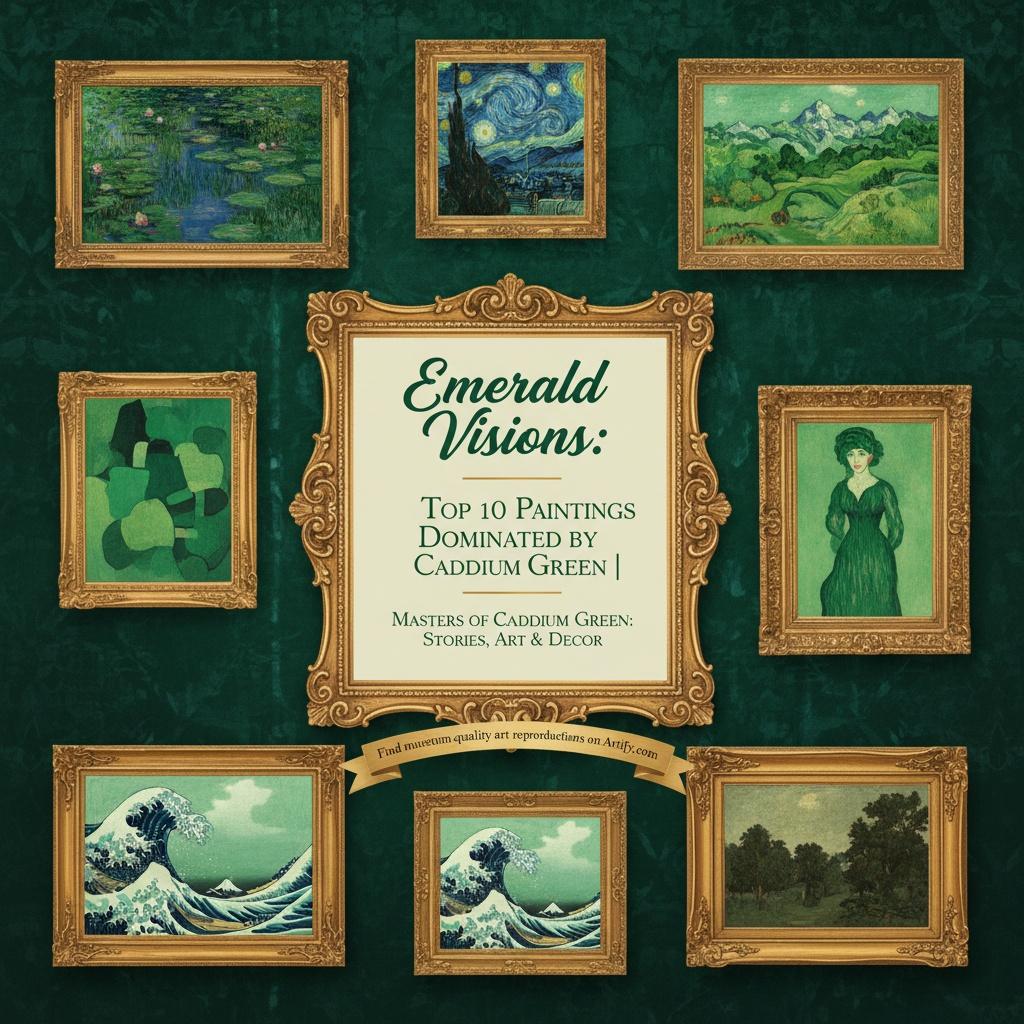
Join us as we embark on a journey through ten iconic paintings where cadmium green takes center stage—a celebration of color, history, and the enduring legacy of artistic vision.
Zorah standing, eremitaget - Henri Matisse
 Zorah standing, eremitaget - Henri Matisse
Henri Matisse’s ‘Zorah Standing, Eremitaget,’ painted in 1912 during his transformative sojourn to Morocco, isn't simply a portrait; it’s a declaration. A bold embrace of flattened forms and intensely saturated color—particularly the striking interplay between crimson and emerald green—this work embodies the Fauvist spirit: prioritizing emotional expression over strict representation.
Its inclusion in our ‘Top 10 Famous Paintings Dominated by Cadmium Green Tones’ stems from Matisse's revolutionary use of this pigment. Before, green often served as a supporting player; here, it *is* the subject, radiating vitality and anchoring the composition. The woman, Zorah, is not rendered with photographic accuracy but rather as an icon—a symbol of Moroccan culture filtered through Matisse’s unique sensibility.
The painting challenges us to reconsider how we perceive color itself. Is green merely a reflection of nature, or can it evoke feelings of serenity, mystery, and even power? The deliberate simplification of form, influenced by Japanese prints, paved the way for abstract art movements that followed. ‘Zorah Standing’ reminds us that beauty isn't found in imitation but in the artist’s ability to distill essence.
Imagine this artwork gracing a modern living space—a vibrant focal point sparking conversation and inviting contemplation. Or consider its influence when curating a collection, seeking pieces that prioritize bold color palettes and expressive abstraction. ‘Zorah Standing’ is more than just a painting; it's an invitation to experience the world anew.
Still Life with Five Bottles - Vincent Willem van Gogh
 Still Life with Five Bottles - Vincent Willem van Gogh
Vincent van Gogh’s ‘Still Life with Five Bottles,’ painted in 1884, offers a quiet intensity that belies its seemingly simple subject matter. More than just an arrangement of glass and earthenware, this work is a profound meditation on perception, texture, and the beauty found within everyday life—a cornerstone of his early artistic development.
Its place among our ‘Top 10 Famous Paintings Dominated by Cadmium Green Tones’ isn't about overt vibrancy, but rather the subtle power of muted greens to evoke a sense of stillness and contemplation. Van Gogh doesn’t *shout* with color; he whispers, using nuanced shades to create depth and atmosphere.
The thick impasto brushstrokes are key—they aren't merely applying paint but building form, mirroring the physicality of the bottles themselves. Notice how the light plays across their surfaces, revealing imperfections and lending a tactile quality to the scene. This attention to detail, rooted in Realism, is elevated by Van Gogh’s burgeoning Impressionistic sensibility.
Consider this painting as an invitation to slow down—to appreciate the quiet beauty of ordinary objects. Imagine it within a modern interior, perhaps paired with natural wood tones and soft lighting, creating a sanctuary for reflection. ‘Still Life with Five Bottles’ reminds us that art isn't always about grand gestures; sometimes, it’s found in the subtle poetry of everyday moments.
Park at Arles with the Entrance Seen through the Trees, The - Vincent Willem van Gogh
 Park at Arles with the Entrance Seen through the Trees, The - Vincent Willem van Gogh
To stand before Vincent van Gogh’s ‘Park at Arles with the Entrance Seen through the Trees’ is to be enveloped by a sense of sun-drenched tranquility—a fleeting moment captured in swirling brushstrokes and vibrant color. Painted during his most productive period in Arles, this work isn't simply a depiction of a park; it’s an embodiment of hope, connection, and the restorative power of nature.
Its inclusion within our ‘Top 10 Famous Paintings Dominated by Cadmium Green Tones’ speaks to Van Gogh’s masterful use of this pigment—not as a dominant hue, but as a vital thread weaving through the composition. The greens of the foliage aren't uniform; they shimmer and dance with light, creating an atmosphere that feels both real and dreamlike.
Van Gogh redefined beauty by focusing on emotional resonance rather than precise representation. This painting invites us to experience Arles as he did—a place of warmth, community, and artistic inspiration. The entrance seen through the trees isn’t just a physical gateway; it's a portal into Van Gogh’s soul.
At , we believe that great art should live *with* us, enriching our daily lives. Imagine ‘Park at Arles’ gracing your living space—a timeless reminder of the beauty found in simplicity and the enduring power of human connection. It's a conversation starter, a source of calm, and an invitation to see the world through the eyes of a master.
May Picture - Paul Klee
 May Picture - Paul Klee
 Paul Klee’s ‘May Picture,’ from his celebrated Magic Square series of 1925, isn't merely a painting; it’s a visual poem—a distillation of color, form, and the artist’s profound exploration of perception. Inspired by his travels to Tunisia, Klee fractured the landscape into geometric planes, creating a mosaic that extends beyond the canvas itself.
Its inclusion in our ‘Top 10 Famous Paintings Dominated by Cadmium Green Tones’ highlights Klee's subtle yet powerful use of this color. The greens aren’t monolithic; they exist within a vibrant tapestry of reds, blues, and yellows, creating a dynamic interplay that evokes the blossoming energy of springtime.
Klee wasn’t interested in replicating reality but rather in revealing its underlying structure—the hidden harmonies and rhythms that connect all things. This painting is a testament to his mastery of color theory, honed during his time at the Bauhaus, and his belief in art's ability to express abstract ideas.
Imagine ‘May Picture’ within a modern collection—a focal point sparking contemplation and inviting viewers to explore their own inner landscapes. It reminds us that beauty isn't found in perfection but in the playful arrangement of forms, colors, and emotions. A timeless piece for refined homes seeking artistic depth.
A Moment of Calm - Max Ernst
 A Moment of Calm - Max Ernst
 A hush falls over ‘A Moment of Calm’ by Max Ernst—a landscape not of reality, but of the subconscious. Painted in 1939, this work is a mesmerizing blend of abstracted forms and dreamlike imagery, where forests pulse with hidden life and birds take flight from fractured planes.
Its inclusion among our ‘Top 10 Famous Paintings Dominated by Cadmium Green Tones’ isn't about idyllic serenity; it’s about the power of green to evoke both tranquility *and* unease. The intermingling of forest greens, cobalt blues, and crimson reds creates a visual tension—a reflection of the turbulent times in which it was created.
Ernst's innovative use of frottage and collage techniques lends a unique texture to the painting, inviting viewers to lose themselves within its labyrinthine depths. The fragmented birds and humanoid figures hint at hidden narratives, prompting contemplation on the human condition and the mysteries of the natural world.
Imagine ‘A Moment of Calm’ adorning a modern study—a conversation starter that sparks introspection and invites a sense of quiet wonder. It's a reminder that beauty can be found in unexpected places, even within the shadows of uncertainty. A timeless piece for those who appreciate art with depth and psychological resonance.
Mrs. Sylvanus Bourne - John Singleton Copley
 Mrs. Sylvanus Bourne - John Singleton Copley
There’s a quiet dignity that emanates from John Singleton Copley’s ‘Mrs. Sylvanus Bourne,’ painted in 1766—a portrait not just of a woman, but of resilience, intelligence, and the enduring spirit of colonial America.
Its inclusion within our ‘Top 10 Famous Paintings Dominated by Cadmium Green Tones’ might seem surprising at first glance, yet it's the subtle interplay of greens—in Mrs. Bourne’s dress and the surrounding drapery—that anchors the composition and lends a sense of grounded realism. This isn’t a flamboyant display of color; it’s a sophisticated use of hue to convey character and social standing.
Copley's masterful attention to detail, from the texture of Mrs. Bourne’s fabric to the gentle expression in her eyes, elevates this portrait beyond mere likeness. She holds a book—a symbol of knowledge and refinement—and gazes directly at the viewer with an air of quiet confidence.
Imagine ‘Mrs. Sylvanus Bourne’ within a modern interior—a timeless focal point that evokes a sense of history, grace, and understated elegance. It's a reminder that true beauty lies not in extravagance but in the strength and dignity of the human spirit. A piece for those who appreciate art with depth and lasting significance.
Portret van de beeldhouwer Pier Pander (1864-1919), Thomas Cool, 1893 - 1894 - Thomas Cole
 Portret van de beeldhouwer Pier Pander (1864-1919), Thomas Cool, 1893 - 1894 - Thomas Cole
Before us hangs a portrait steeped in quiet contemplation—Thomas Cole’s ‘Portret van de beeldhouwer Pier Pander,’ painted between 1893 and 1894. It's not a grand, sweeping landscape for which Cole is renowned, but an intimate study of a fellow artist, a sculptor lost to time yet brought vividly back to life through brushstrokes.
Its inclusion in our ‘Top 10 Famous Paintings Dominated by Cadmium Green Tones’ lies in the subtle power of its palette. The greens—present in the background and perhaps hinted at within Pander's attire—create a sense of depth and grounding, allowing the sculptor’s gaze to take center stage.
Cole doesn’t simply depict Pander; he captures his essence—a man lost in thought, dedicated to his craft. The painting is a testament to the enduring power of artistic connection and the importance of preserving individual stories.
Imagine this portrait within a modern study or library—a quiet reminder of the creative spirit and the beauty found in introspection. It’s a piece that invites contemplation, encouraging us to slow down and appreciate the artistry around us. A timeless addition for those who seek meaning and serenity in their surroundings.
Damn my darling Doosra - Gareth Sansom
 Damn my darling Doosra - Gareth Sansom
Gareth Sansom’s ‘Damn my darling Doosra,’ from 2010, is a vibrant collision of worlds—a fragmented narrative that pulses with energy and raw emotion. It's not a painting in the traditional sense, but a dynamic collage that challenges our perceptions of form, identity, and the very nature of representation.
Its inclusion within our ‘Top 10 Famous Paintings Dominated by Cadmium Green Tones’ highlights Sansom’s fearless use of color—specifically the striking emerald greens that serve as a backdrop for this complex composition. These aren't merely aesthetic choices; they create a sense of depth and unease, drawing the viewer into the artwork’s labyrinthine depths.
Sansom blends Pop Art sensibilities with personal themes of mortality and memory, creating a work that is both visually arresting and intellectually stimulating. The fragmented figures and scattered text hint at hidden stories, inviting us to piece together our own interpretations.
Imagine ‘Damn my darling Doosra’ adorning a modern living space—a conversation starter that sparks curiosity and invites contemplation. It's a reminder that art can be bold, challenging, and deeply personal. At , we believe in making such powerful works accessible, allowing you to bring a touch of artistic innovation into your home.
Awa Province: Whirlpool at Naruto - Ando Hiroshige
 Awa Province: Whirlpool at Naruto - Ando Hiroshige
Stand before Ando Hiroshige’s ‘Awa Province: Whirlpool at Naruto,’ and you're immediately swept away by a sense of raw power—the ocean unleashed, waves crashing against the rocks in a dramatic display of nature’s force. Painted in 1853, this woodblock print isn’t merely a depiction of a landscape; it’s an embodiment of impermanence, energy, and the beauty found within chaos.
Its inclusion among our ‘Top 10 Famous Paintings Dominated by Cadmium Green Tones’ lies in the subtle yet vital role this color plays. The greens—present in the swirling waters and distant hills—create a sense of depth and movement, drawing the eye into the heart of the whirlpool.
Hiroshige masterfully captures the fleeting moment—the tide rushing through the strait, birds suspended in mid-flight, the foaming water frozen in time. This painting is a testament to his ability to evoke emotion through simplicity and precision.
Imagine ‘Awa Province’ within a modern interior—a calming yet invigorating focal point that reminds us of the power and beauty of the natural world. It's a piece that invites contemplation, encouraging us to embrace change and find serenity in the midst of life’s currents. A timeless addition for those who seek connection with nature.
Balzac - François Auguste René Rodin
 Balzac - François Auguste René Rodin
Auguste Rodin’s ‘Balzac’ isn't merely a sculpture; it’s a frozen moment of profound thought—a literary giant rendered not in marble perfection, but in the raw, textured form of a man consumed by his own creation.
Its inclusion within our ‘Top 10 Famous Paintings Dominated by Cadmium Green Tones’ might seem unexpected, yet it's the subtle patina—the greens and browns that accumulate on bronze over time—that lend this work its haunting beauty. These aren’t imposed colors; they are the result of years spent weathering the elements, mirroring Balzac’s own enduring legacy.
Rodin famously struggled with this commission for seven years, ultimately rejecting traditional portraiture in favor of a more abstract representation—a head emerging from a swirling mass of fabric. The sculpture embodies the author's inner world, his relentless pursuit of knowledge and his profound understanding of human nature.
Imagine ‘Balzac’ gracing a modern study or library—a powerful reminder of the creative spirit and the enduring power of literature. It’s a piece that invites contemplation, encouraging us to delve into our own thoughts and embrace the complexities of life. A timeless addition for those who appreciate art with depth and intellectual resonance.
Conclusion
As we conclude our journey through these ten masterpieces dominated by cadmium green, it’s important to remember that these paintings are more than just historical treasures—they are living presences. Each canvas holds a story, an emotion, a glimpse into the soul of its creator and the world in which it was born.
The subtle power of green, whether radiating vitality or whispering tranquility, has the remarkable ability to transform our perceptions and connect us to something deeper within ourselves. These artworks remind us that beauty isn’t found in perfection but in the imperfections, the textures, and the emotional resonance that each brushstroke conveys.
At , we believe that art should live *with* us—enriching our daily lives, sparking conversation, and inspiring creativity. We invite you to bring these timeless masterpieces into your own spaces, allowing their light and energy to fill your home with grace and wonder.
Explore our full collection of cadmium green-infused artworks and discover the piece that speaks to *your* soul. Let these paintings be a daily reminder of the enduring power of human creativity—a testament to the beauty, complexity, and profound mystery of life itself.



