


 效果预览
效果预览
 分享
分享 分享
分享
 详情
详情

 下载
下载
 相似作品
相似作品 X射线
X射线 幻灯片播放
幻灯片播放 统计数据
统计数据Capture of Joan of Arc
 Oil On Canvas
- WallArt
- Academic Art
 1847
1847- 19th Century
 53.0 x 72.0 cm
 冬宫博物馆 (Hermitage Museum)
 展开详情
展开详情
手工油画复制品
由我们的艺术家按需定制,为您提供您所选尺寸及画框的布面手工油画。 ( 切换至版画销售渠道 切换至数字图像销售渠道)




P118B $10

P118H $10

P118W $10

P438Z $10

P508JH $12

P508YH $12

P805H $10

P805Z $10

P919BZ $10

P919G $10

P919XJ $10

P959ZH $10

P968JZ $12

W106C $8

W218G $10

W218JH $8

W218Y $10

W307PJ $10

W316G $10

W316PJ $8

W316Y $10

W398PJ $8

W4111J $10

W500HY $15

W500JH $15

W692G $12

W849H $8

W940BG $15

W953PJ $8




从与原作比例一致的预设尺寸中进行选择。

您可以输入自定义尺寸,以适配特定的画框或空间。如果所选尺寸与原图比例不符,我们将通过裁剪作品或添加手绘元素来扩展画面。数字样稿将在制作开始前发送给您确认。
请注意,屏幕预览无法准确反映实际的裁剪或扩展效果,只有样稿才能真实呈现最终的构图。
虽然我们提供定制尺寸服务,但为了保留原作比例,建议您从预设列表中选择尺寸。
下单后,ArtsDot.com 团队将通过电子邮件联系客户获取具体要求,并提供效果预览图。


 玻璃选项仅适用于110厘米以下的尺寸。

Capture of Joan of Arc
复制材质
复制品尺寸
-


最终总价
$ 263
The Drama of Defeat: An Encounter with Joan of Arc
Adolphe Alexandre Dillens’s depiction of the Capture of Joan of Arc is not merely a historical record; it is a visceral tableau vivant, frozen at the apex of dramatic confrontation. The canvas pulses with the raw energy of conflict and the profound weight of destiny. At its heart stands the figure of Joan, clad in striking red, embodying both divine fervor and sudden vulnerability. She is surrounded, held by the sheer force of numbers—the English army closing in—creating an immediate sense of claustrophobic tension that pulls the viewer directly into the fray. Dillens masterfully captures the moment where heroism collides violently with overwhelming military might.
Technique and Compositional Power
Dillens, known for his precise draughtsmanship, employs a rich palette to heighten the emotional stakes of this scene. The composition is inherently dramatic, utilizing diagonals formed by the bodies of the soldiers and the implied lines of conflict to guide the eye across the narrative action. Observe the interplay between light and shadow; the illumination seems theatrical, spotlighting Joan while allowing the surrounding chaos—the drawn swords, the grim faces of the onlookers—to recede into deeper tones of struggle. His technique allows for both meticulous detail in the uniforms and weaponry, grounding the piece in historical reality, while simultaneously elevating it to the realm of high melodrama.
Historical Echoes and Symbolism
To stand before this painting is to confront a pivotal moment in French history. The capture itself was an event steeped in myth and political maneuvering. Artistically, however, Dillens transcends mere reportage. Joan symbolizes unwavering faith, the voice of conviction against entrenched power structures. Her subjugation here becomes a potent symbol for any struggle against overwhelming odds—a universal resonance that speaks to modern viewers as much as it did to his contemporaries. The contrast between her vibrant red attire and the muted, martial tones of her captors creates an immediate visual argument: the enduring spirit versus brute force.
An Emotional Resonance for the Modern Collector
For the collector or designer seeking a piece with narrative depth, this work offers unparalleled emotional resonance. It is art that demands contemplation, prompting dialogues about martyrdom, conviction, and the cost of belief. Reproducing such a powerful scene allows one to infuse a space—be it a grand hall or a richly decorated study—with intellectual gravity and dramatic flair. The Capture of Joan of Arc does not simply decorate; it narrates, inviting viewers to feel the tension in the air and ponder the enduring power found even in moments of apparent defeat.
相似艺术品


艺术家简介
Adolf Alexander Dillens (1821 - 1877)
Belgian painter and etcher, part of a family of artists. Adolf Dillens was born at Ghent in 1821, and received his formal training from his elder brother Hendrik Joseph Dillens (1812 - 1872) and studied at the academy in Ghent. Like his brother, Adolph specialized in genre scenes and portrait painting; however he was also an accomplished engraver and drawer. He spent a majority of his career working in Zeeland where he became known for his scenes of that region's daily life. At the end of his life Dillens turned to painting historical and military scenes from Flemish life, such as Enlistment in the Austrian Netherlands (Brussels, Musées Royaux des Beaux-Arts). He was a prolific and successful artist, who worked with facility and did not hesitate to repeat himself in order to satisfy collectors. Although his pictures lack originality, they are notable for their precise draughtsmanship, clear composition and rich colouring.- Early Life & Training: Dillens’s artistic inclination began early, nurtured by the influence of his brother, Hendrik Joseph Dillens, who was himself a respected painter. His formative years were spent honing his skills at Ghent Academy, absorbing classical techniques and establishing a foundation for his future endeavors.
- Zealand Landscapes & Genre Paintings: Dillens gained considerable renown for his depictions of Zeeland peasant life—a genre he pursued with unwavering dedication. These canvases capture the essence of rural existence, characterized by meticulous observation and expressive brushwork. Notable works include “Taking Toll at the Bridge” (of this picture he painted three versions) and “A Fair at Westcapelle,” which showcased at the Paris International Exhibition in 1855.
- Portraiture & Engraving: Dillens excelled as a portrait artist, producing evocative likenesses that conveyed both physical appearance and psychological nuance. His engravings complemented his paintings, demonstrating mastery of printmaking techniques and furthering his artistic vision. Among his portraits are “The Gossip at the Window” and “Asking in Marriage.”
- Historical Commissions & Exhibitions: Dillens accepted commissions to depict significant historical events—particularly military engagements—often portraying Flemish soldiers with dignity and realism. His paintings were prominently displayed at the London International Exhibition of 1862, cementing his reputation as a respected artist within Europe’s artistic circles.
- Legacy & Museums Collections: Dillens's oeuvre is housed in museums across Belgium, including Brussels Museum and Ixelles Museum, where visitors can admire his masterful landscapes and portraits—testaments to his enduring contribution to Belgian art history.
- “The Gossip at the Window”
- “Taking Toll at the Bridge” (of this picture he painted three versions)
- “Asking in Marriage”
- “A Fair at Westcapelle”
- “A Ball at Goes”
- “The Juggler”
- “Skaters”
- Bryan, Michael (1886). “Dillens, Adolf”. In Graves, Robert Edmund (ed.). Bryan's Dictionary of Painters and Engravers (A–K). Vol. I (3rd ed.). London: George Bell & Sons.
Influences
Dillens’s artistic style was profoundly shaped by the Romantic movement, particularly German Romanticism. Artists like Caspar David Friedrich and Eugène Delacroix served as inspiration for Dillens's exploration of dramatic landscapes and emotive narratives. He also absorbed elements from Neoclassical painting, evident in his meticulous attention to detail and idealized representations of human form—a stylistic duality that distinguishes his oeuvre.
adolphe alexandre dillens
1821 - 1877 , Belgium
艺术家简介
- Artistic Movement Or Style: German Romanticism
- Artists Who Influenced This Artist: ['Hendrik Dillens']
- Date Of Birth: 1821 Ghent
- Date Of Death: 1877 Brussels
- Full Name: Adolf Alexander Dillens
- Nationality: Belgian
- Notable Artworks:
- Capture of Joan of Arc
- The Gossip at the Window
- Place Of Birth: Belgium
相关文章

19th Century Masterpieces: 10 Paintings That Defined an Era | ArtsDot
Journey through 19th century art with ArtsDot! Explore 10 iconic paintings – from Monet & Renoir to Courbet – and discover the stories behind Romanticism, Realism & Impressionism. Find museum-quality reproductions for your home decor. Explore the full collection online!

Scenes of Daily Life: A Comprehensive Exploration of Genre Painting Through History
Explore the rich history of genre painting! Discover Dutch Masters & European artists who captured everyday life with stunning realism. Learn about symbolism, techniques & lasting influence.
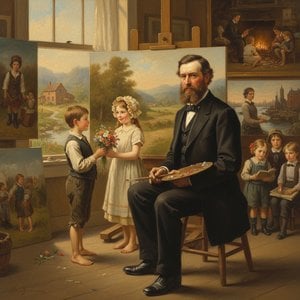
John George Brown: Capturing American Life & Sentiment in 19th-Century Genre Painting
Explore the captivating genre paintings of John George Brown, celebrated for his realistic depictions of 19th-century American life. Discover his legacy & find museum-quality reproductions at ArtsDot.

Thomas George Webster: Navigating Genre Boundaries & American Identity in 19th-Century Landscape Painting
Explore the captivating genre scenes of Thomas George Webster, a Victorian painter bridging British traditions with American themes. Discover his style, influences & legacy in 19th-century art history.

米罗大师25幅杰作:探索超现实主义的色彩与诗意 | ArtsDot
探索米罗大师25幅经典画作,领略超现实主义的色彩与诗意。深入了解每件作品背后的故事、艺术技巧和文化意义。ArtsDot.com提供高品质米罗油画复制品,为您的家居增添艺术灵感!立即在线探索完整系列。