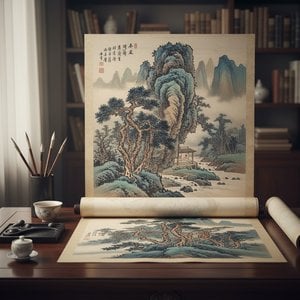
Zemin (Suiyang Shanren): A Life in Painting and Poetry
Name: Zemin, Suiyang Shanren (also known as Zhu Derun)
Origin: Henan Province, China
Born: 1294, Shangqiu, China
Died: 1365
Early Life and Career
Zemin was born in Suiyang (present-day Shangqiu), Henan Province. He later moved to Suzhou.
He held significant positions within the Yuan Dynasty government, serving as an editor at the national academy of history, academic director in Zhendong Province, and a supervisor in Jiangzhe Province.
Beyond his administrative roles, Zemin was recognized for his talents as both a painter and a poet.
Artistic Style and Influences
Painting: Zemin's landscape paintings are characterized by strong, bold brushstrokes inspired by Xu Daoning and Guo Xi. His landscapes typically feature distant mountains, sturdy peaks, and robust trees. A distinctive element is the depiction of mountain stones using cirrus-cloud brushstrokes and tree branches resembling crab claws. Notable works include "Pavilion of Elegant Plain," "Playing Lyre under the Trees," and "Boating on the Pine Creek."
Calligraphy: His calligraphy was heavily influenced by Zhao Mengfu and Wang Xizhi, demonstrating exceptional skill in this art form.
Poetry: Zemin was also a skilled poet, with many of his works reflecting landscapes and everyday life.
Wang Xizhi: Shaped Zemin’s calligraphic approach with a focus on fluidity and expressive brushwork.
Xu Daoning & Guo Xi: Provided inspiration for his bold and dynamic landscape painting techniques, particularly in the depiction of rocks and trees.
Zemin's artistic development involved synthesizing these influences to create a unique style that blended traditional elements with personal expression. He moved away from some earlier styles, reflecting the changing political and social climate of the Yuan Dynasty.
Legacy and Historical Significance
Zemin’s work represents a significant contribution to Chinese art during the Yuan Dynasty, a period marked by upheaval and transition.
His paintings offer insights into the literati's response to political instability, often reflecting themes of retreat and nostalgia.
He is remembered for his innovative approach to landscape painting, combining different styles and techniques to create evocative and expressive compositions.
Zemin’s legacy continues to inspire artists and art enthusiasts, demonstrating the enduring power of Chinese artistic traditions.
Від редакції ArtsDot.com
Короткий тест
У кожному запитанні лише одна правильна відповідь.
Запитання 1:
What dynasty did Zemin (Suiyang Shanren) primarily work within?
Запитання 2:
Which artistic styles heavily influenced Zemin's calligraphy?
Запитання 3:
What is a characteristic feature of Zemin’s landscape paintings regarding tree branches?
Explore the legacy of Xie Zhiliu, a master of Chinese ink wash painting & prominent figure in modern art. Discover his techniques, influences, and contributions to literati tradition. A guide for discerning collectors.
Explore the captivating world of Pu Xinyu (Puru), the last great literati painter. Discover his imperial heritage, masterful ink wash techniques & enduring legacy – a valuable addition to any discerning art collection.
Відкрийте для себе світ вишуканих сімейних портретів, створених за традиційними техніками старого майстерства. Індивідуальні замовлення, збереження родинної історії та інвестиція в мистецтво. Зверніться до експертів!
Чи все ще поширюється авторське право на роботи Zhu Derun?
Ні, роботи цього художника є суспільним надбанням.
Скільки картин Zhu Derun представлено на ArtsDot.com?
1
Яка картина Zhu Derun має найвищий рейтинг на ArtsDot.com?
Returning from a Visit
Скільки років прожив(ла) Zhu Derun?
71 years (1294–1365)
Коли і де народився/народилася Zhu Derun?
1294, Henan, People's Republic of China
Хто такий Zhu Derun?
Zemin (Suiyang Shanren): A Life in Painting and Poetry
Name: Zemin, Suiyang Shanren (also known as Zhu Derun)
Origin: Henan Province, China
Born: 1294, Shangqiu, China
Died: 1365
Early Life and Career
Zemin was born in Suiyang (present-day Shangqiu), Henan Province. He later moved to Suzhou.
He held significant positions within the Yuan Dynasty government, serving as an editor at the national academy of history, academic director in Zhendong Province, and a supervisor in Jiangz
До якого художнього періоду належав(ла) Zhu Derun?