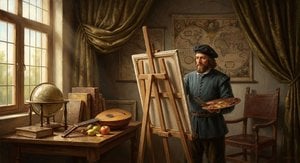
Nicolaes Maes (1634 - 1693): A Life Immersed in Dutch Light and Shadow
Nicolaes Maes, a name resonating softly within the pantheon of Dutch Golden Age masters, was born in Dordrecht in January 1634 into a world brimming with mercantile prosperity and artistic ferment. His father, Gerrit Maes, a successful cloth merchant and soap boiler, provided a comfortable upbringing, allowing young Nicolaes to pursue his burgeoning talent for painting. While early instruction came from a local artist of modest renown, the pivotal moment in Maes’s development arrived when he journeyed to Amsterdam around 1648 and entered the workshop of Rembrandt van Rijn. This apprenticeship proved transformative, imbuing him with an enduring appreciation for the dramatic interplay of light and shadow – *chiaroscuro* – and a masterful command of color that would define his early works. The influence was so profound that initial paintings, such as depictions of biblical scenes rendered with life-size figures and rich, glowing hues, were often mistakenly attributed to Rembrandt himself. These formative years laid the groundwork for a career marked by both technical brilliance and an intimate understanding of human emotion.Early Years and Rembrandt’s Influence
Nicolaes Maes's artistic journey began under the tutelage of Samuel van Hoogstraten, a former pupil of Rembrandt who resided in Dordrecht between 1648 and 1651. Although Van Hoogstraten’s instruction was modest, it instilled in Maes a foundational understanding of drawing techniques—a skill that would prove invaluable throughout his subsequent career. More significantly, however, was Maes's immersion in Rembrandt’s studio in Amsterdam. During this period, he absorbed the master’s revolutionary approach to painting – specifically, his masterful manipulation of *chiaroscuro*, the dramatic contrast between light and dark—which fundamentally shaped Maes’s artistic vision. This influence extended beyond mere technique; Rembrandt instilled in Maes a profound sensitivity to capturing the emotional essence of his subjects, fostering an ability to convey psychological depth through subtle gestures and expressions. As a result, early paintings bearing Maes's signature often evoked comparisons with Rembrandt’s oeuvre, highlighting the indelible mark left by this formative relationship.From Biblical Scenes to Domestic Genre
Maes initially produced religious paintings characterized by monumental scale and luminous color palettes—a stylistic hallmark of Rembrandt’s work. These canvases showcased a remarkable command of perspective and anatomical accuracy, reflecting Rembrandt's meticulous attention to detail. However, recognizing the evolving tastes of his patrons and driven by an innate inclination toward realism, Maes gradually shifted his focus towards domestic genre scenes—paintings depicting everyday life within Dutch households. This stylistic transition marked a significant departure from Rembrandt’s grand narratives but retained the vibrant colorism he had absorbed during his apprenticeship. He meticulously observed the rituals and routines of ordinary citizens – women spinning wool, reading scripture, preparing meals – translating these observations into canvases brimming with warmth and authenticity. These paintings weren't merely representations of daily life; they were imbued with a palpable sense of atmosphere and emotion—a testament to Maes’s ability to capture the nuances of human experience.The Art of Lacemaking and Artistic Innovation
A particular fascination captivated Maes’s artistic imagination: lacemaking. He embarked on numerous variations of this intricate craft, transforming delicate lace patterns into stunning visual compositions. These paintings demonstrated not only technical skill but also a keen eye for detail—capturing the subtle textures and folds of lace with breathtaking precision. Maes's innovative approach to genre painting distinguished him from many of his contemporaries, establishing him as a pioneer in portraying domestic interiors with unprecedented realism and psychological insight. His canvases became celebrated for their ability to evoke a sense of tranquility and beauty—reflecting the humanist ideals prevalent during the Dutch Golden Age.A Portraitist’s Legacy
Around 1656 Maes transitioned into portraiture, adopting a style characterized by refined elegance and psychological depth. He skillfully captured the likenesses and personalities of prominent Amsterdam citizens—often employing oval formats to emphasize dignity and composure. Like Rembrandt before him, Maes meticulously studied anatomy and facial expressions, striving to convey not only physical resemblance but also subtle nuances of character. His portraits stand as enduring monuments to artistic excellence—testaments to Maes’s ability to transform individuals into compelling subjects for visual contemplation. Notable works include “Portrait of Gerard Röver,” demonstrating his mastery of *chiaroscuro* and capturing Röver's dignified bearing with remarkable accuracy. He continued to refine his technique throughout his career, producing a prolific output that cemented his reputation as one of the most accomplished portrait painters of his time. Nicolaes Maes passed away in Amsterdam in December 1693, leaving behind a legacy of artistic innovation and unwavering devotion to capturing the beauty and complexity of human experience—a testament to the enduring power of Rembrandt’s influence and Maes's own singular vision.Запитання та відповіді
На які періоди поділено кар'єру Nicolaes Maes?
Кар'єра Nicolaes Maes розгортається період за періодом на сторінці Хроніка: це горизонтальна часова шкала творів, згрупованих за розділами різних етапів кар'єри.
Як я можу переглянути всі роботи, створені Nicolaes Maes?
З усіма роботами Nicolaes Maes на цей вебсайт можна ознайомитися на сторінці Усі витвори мистецтва митця.
Звідки родом Nicolaes Maes?
Nicolaes Maes народився у Нідерланди.
Скільки творів Nicolaes Maes доступно для перегляду?
Ви можете переглянути 170 творів мистецтва творів Nicolaes Maes на сторінці Усі витвори мистецтва.
До якого історичного періоду належить творчість Nicolaes Maes?
Nicolaes Maes працював у період — Ранньомодерна епоха. Цей період визначає місце творчості митця в історії.
Де і в якому році народився/народилася Nicolaes Maes?
Nicolaes Maes народився/народилася в Дордрехт, у 1634 році.
У якому місті та країні народився/народилася Nicolaes Maes?
Nicolaes Maes народився/народилася у Дордрехт, Нідерланди.