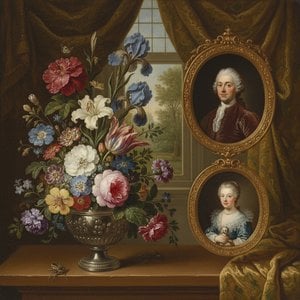
1695 - 1743

Короткі факти

  • Typical colors:
    • espresso
    • gray
  • Born: 1695, Prague, Czech Republic
  • Museums on this site:
    • Національна галерея Праги
    • Баварські державні художні колекції
    • Регіональна галерея в Лібереці
  • Art period: Early Modern
  • Color intensity: monochromatic
  • Nationality: Czech Republic
  • Died: 1743

The Quiet Presence of Jan Kašpar Hirschely

Born in Praha, Jan Kašpar Hirschely lived a life that left behind a specific, focused mark on the art of the early eighteenth century. His existence, spanning from 1695 to 1743, was rooted in the Czech lands, moving through the streets of Praha until his death in the same city. He worked during a period when the weight of mortality was a frequent subject for those who held a brush, and his own hand found its way to the small, intimate surface of copper.

His work often dealt with the heavy themes of existence. In 1727, he produced The scene with death´s head, Vanitas, a piece that uses the stillness of objects to speak of what remains when life departs. This work, currently held in the Regional Gallery in Liberec, is painted in oil on copper, a choice of material that demands a certain precision and a steady hand.

Technique and Symbolism

When looking closely at his compositions, one sees a deliberate arrangement of shapes. He did not rely on chaotic movement, but rather on a careful balance of the organic and the static. In his 1727 work, the soft, curving lines of flowers and trees meet the hard, unmoving presence of a skull and a vase. This intersection of the living and the inanimate creates a tension that requires little explanation.

The physical scale of his output suggests a private, contemplative experience. His paintings are small, measuring approximately 22,8 x 17,3 CM. Such dimensions invite a viewer to lean in, to observe the fine details of the overlapping lines and the way light settles on a surface. It is a way of working that favors the quiet observation of detail over the grand scale of public spectacle.

Короткий тест

У кожному запитанні лише одна правильна відповідь.

Запитання 1:
What was Jan Kašpar Hirschely's nationality?
Запитання 2:
In which city was Jan Kašpar Hirschely born?
Запитання 3:
In what year was the artwork 'The scene with death´s head, Vanitas' created?
Запитання 4:
What medium was used for the painting 'The scene with death´s head, Vanitas'?
Запитання 5:
Where is the collection of 'The scene with death´s head, Vanitas' located?

Питання та відповіді

Чи можу я переглянути роботи Jan Kašpar Hirschely за кольоровим спектром?

Колірний спектр для Jan Kašpar Hirschely — це сторінка, на якій роботи митця впорядковані за кольорами.

Де і в якому році народився/народилася Jan Kašpar Hirschely?

Jan Kašpar Hirschely народився/народилася в Prague у 1695 році.

Де я можу побачити колірну палітру робіт Jan Kašpar Hirschely?

Геном палітри Jan Kašpar Hirschely — це сторінка, що представляє колірний профіль усього творчого дорослого цього митця.

Чи можу я відвідати віртуальний музей творів Jan Kašpar Hirschely?

3D-музей Jan Kašpar Hirschely — це сторінка, на якій роботи митця представлені у віртуальній тривимірній галереї.

До якого історичного періоду належить творчість Jan Kašpar Hirschely?

Jan Kašpar Hirschely працював у період Early Modern. Цей період визначає місце творчості митця в історії.

Чи можу я переглянути роботи Jan Kašpar Hirschely за тематикою?

Роботи Jan Kašpar Hirschely можна переглянути за тематикою на сторінці Атлас тематик митця.

Під якими ще іменами відомий Jan Kašpar Hirschely?

Jan Kašpar Hirschely також відомий під іншими іменами: Caspar Hirschely, Johann Kaspar Hirscheli, Caspar Hirscheli, J. C. Hirschely, Gaspar Hirscheli.

Скільки творів Jan Kašpar Hirschely представлено в каталозі?

Ви можете переглянути 16 творів мистецтва творів Jan Kašpar Hirschely на сторінці Усі роботи митця.

Чи можу я переглянути роботи Jan Kašpar Hirschely за художніми напрямами?

Мистецькі напрями, у яких працював(ла) Jan Kašpar Hirschely, можна переглянути на сторінці Усі художні напрями, де твори згруповані за напрямами.