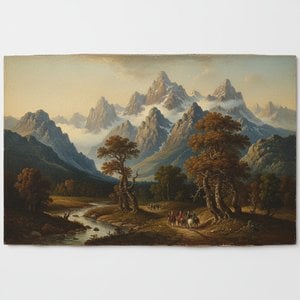
The Alpinist of the Canvas: The Life and Legacy of Gabriel Loppé
In the golden age of nineteenth-century exploration, few figures embodied the romantic union of physical courage and artistic sensitivity as profoundly as Gabriel Loppé. Born in 1825 into a family defined by the precision of engineering, Loppé’s life was destined to transcend the structured boundaries of his heritage. His journey was not merely one of aesthetic pursuit but an audacious expedition into the very heart of the sublime. As a painter, photographer, and mountaineer, he did more than simply document the mountains; he pioneered a new way of seeing, establishing himself as the foundational father of the peintres-alpinistes school—a movement that sought to capture the raw, breathing essence of the high Alps.
Loppé’s artistic awakening was a moment of pure serendipity. At the age of twenty-one, while climbing a modest peak in the Languedoc, he stumbled upon a group of painters sketching on the summit. This chance encounter ignited a lifelong passion, leading him to Geneva where he sought the guidance of the renowned Swiss landscapist, Alexandre Calame. While often associated with the tutelage of masters like Calame and Francois Diday, Loppé possessed a fiercely independent spirit. He cultivated an almost entirely self-taught style, one that eschewed the rigid formalities of the academy in favor of a spontaneous, atmospheric depth that could only be achieved through direct, visceral engagement with the landscape.
Mastery of the High Altitudes
What truly set Loppé apart from his contemporaries was his refusal to remain in the safety of the valley. He became the first painter to work at extreme altitudes during climbing expeditions, treating the treacherous glaciers and jagged peaks not as distant subjects, but as his primary studio. His legendary expeditions to Grindelwald and his more than forty ascents of Mont Blanc allowed him to translate the dynamic energy of the mountains onto canvas with unparalleled authenticity. He did not merely paint the scenery; he painted the experience of the ascent—the biting cold, the shifting light, and the overwhelming scale of the granite giants.
His technical approach was characterized by a remarkable ability to capture the ephemeral qualities of mountain weather. Through his oil sketches, Loppé mastered the interplay of light and shadow, creating works that felt as though they were breathing with the mist and snow. This dedication to realism and atmosphere earned him immense respect among the international climbing community. As the first foreigner admitted to the prestigious Alpine Club in London, he became a bridge between the artistic salons of Paris and the rugged expeditions of the English mountaineers, whose demand for his work helped cement his reputation as the unrivaled "Court painter" of the Chamonix valley.
A Visionary Beyond the Brush
As his career progressed into his later years, Loppé’s thirst for innovation led him toward the burgeoning medium of photography. He approached the camera with the same experimental vigor he brought to his canvases, becoming a pioneer in photographic techniques such as long exposure. This fascination with light and time allowed him to document the alpine world with a new level of scientific and artistic precision, further blurring the lines between documentation and fine art. His work remains a vital historical record of a vanishing era of mountaineering, capturing the majesty of the Mont Blanc massif before the modern age transformed its solitude.
The historical significance of Gabriel Loppé lies in his ability to merge two seemingly disparate worlds: the physical struggle of the climber and the contemplative stillness of the artist. His legacy is found in every brushstroke that captures a swirling cloud over the Grandes Jorasses and in every photograph that freezes the crystalline beauty of a glacier. He remains an enduring symbol of the sublime, reminding us that the greatest art is often found at the very edge of human endurance.