Dieric Bouts the Younger (1415–1475): A Master of Detail and Spiritual Resonance
Dieric Bouts the Younger, a name resonating within the annals of Early Netherlandish painting, emerged from a lineage steeped in artistic practice. Born around 1415 in Leuven, Belgium, he inherited not merely a profession but a legacy—that of his father, Dieric Bouts the Elder, a master whose influence would subtly yet profoundly shape the younger artist’s trajectory. While details surrounding Dieric the Younger's formative years remain elusive, it is understood that he blossomed within a family environment where artistry was not simply a skill, but a way of life. Leuven itself, a vibrant center of commerce and intellectual exchange, provided a fertile ground for his development. The city’s burgeoning humanist spirit and its position as a crucial crossroads in the Burgundian Netherlands undoubtedly exposed him to diverse artistic currents. It is believed that he further honed his skills through study under Rogier van der Weyden, one of the most celebrated painters of the era, absorbing the master's refined techniques and emotionally charged style. This apprenticeship proved pivotal, laying the foundation for Bouts’s own distinctive approach to religious narrative and portraiture.
Early Life and Artistic Training
Information about Dieric Bouts the Younger’s early life is scarce, mirroring a common characteristic of artists from this period—a tendency toward privacy regarding personal matters. However, it is established that he was born in Leuven, a city renowned for its scholastic tradition and burgeoning artistic patronage. His father, Dieric Bouts the Elder, was already an accomplished painter, demonstrating a dedication to craftsmanship that would undoubtedly permeate his son’s artistic education. The Elder's workshop served as a crucible of artistic innovation, fostering experimentation with new techniques and stylistic approaches—a legacy that profoundly shaped Dieric’s formative years. Crucially, Bouts undertook formal training under Rogier van der Weyden, arguably the most influential painter of his time. Van Eyck’s meticulous realism and expressive dynamism had already revolutionized Flemish art, establishing a precedent for portraying human emotion with unprecedented accuracy. By immersing himself in Van der Weyden's studio, Bouts absorbed not only technical mastery but also a deeply ingrained aesthetic sensibility—a commitment to conveying spiritual truth through visual representation that would characterize his entire artistic career.
Innovation in Perspective and Religious Narrative
Dieric Bouts the Younger distinguished himself not through radical departures from established conventions, but through a subtle yet significant evolution of existing techniques. He wasn’t driven by flamboyant displays of innovation; rather, he possessed an astute understanding of spatial representation and a unique sensitivity to religious symbolism. This is perhaps most evident in his masterpiece, *The Last Supper*, the central panel of the *Altarpiece of the Holy Sacrament* (1464). While earlier depictions often focused on the dramatic tension surrounding Judas’s betrayal, Bouts shifted the emphasis towards the sacred act of consecration. Christ is portrayed not as a figure embroiled in conflict, but as a priest performing a solemn ritual—a deliberate choice that underscores the theological significance of the Eucharist. More groundbreaking still was his innovative use of perspective. He employed a single vanishing point, a technique borrowed from Italian Renaissance artists, to create a sense of depth and realism previously unseen in Northern painting. This wasn’t merely a technical feat; it served to draw the viewer into the scene, fostering a more intimate connection with the sacred event unfolding before them. The meticulous attention to detail—the drapery folds, the facial expressions, the subtle nuances of gesture—reflects Van Eyck's influence and demonstrates Bouts’s unwavering dedication to capturing the essence of human experience within a religious context.
Notable Works: A Synthesis of Tradition and Vision
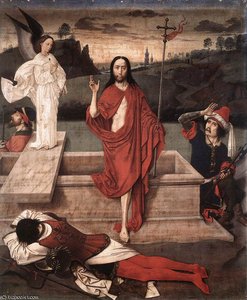
Bouts’s artistic output encompassed a diverse range of subjects—from devotional panels depicting the Virgin and Child to imposing justice panels commissioned for Leuven’s town hall. These works reveal his mastery of composition, color, and detail, as well as his ability to imbue even the most traditional themes with a sense of quiet dignity and spiritual resonance. Among his most celebrated achievements is *The Last Supper*, undoubtedly his magnum opus. As mentioned previously, Bouts's masterful manipulation of perspective—a technique championed by artists like Jan van Eyck—transformed the depiction of this iconic biblical scene. The single vanishing point directs the viewer’s gaze towards a central focal point, enhancing the dramatic impact and conveying a profound sense of solemnity. Alongside *The Last Supper*, Bouts produced several other significant works, including *Triptych of the Virgin's Life* (Prado), *Deposition Altarpiece* (Granada), and *Justice Panels* (Leuven Town Hall). Each piece exemplifies his distinctive artistic style—characterized by meticulous observation, expressive brushwork, and a harmonious blend of color palettes. Furthermore, *The Davis Madonna*, housed in the Royal Museums of Fine Arts of Belgium, showcases Bouts’s ability to convey tenderness and maternal love through subtle gestures and expressions—a testament to his profound understanding of human emotion.
Legacy and Influence
Dieric Bouts the Younger stands as a pivotal figure within the history of Early Netherlandish painting—a conduit between the stylistic innovations of Van Eyck and Weyden and the burgeoning artistic sensibilities of the Renaissance. His pioneering use of perspective, though not fully embracing Italian principles, nonetheless established a precedent for future generations of Flemish painters to explore spatial representation with greater confidence. Beyond his technical achievements, Bouts’s unwavering commitment to conveying spiritual truth through visual art cemented his place as one of the era's foremost artists. He inspired countless successors to emulate his meticulous attention to detail and his profound sensitivity to religious symbolism—a legacy that continues to resonate within the artistic canon today. His work remains a beacon of Flemish artistic excellence, demonstrating the enduring power of tradition blended with visionary innovation.