The Evolution of Light and Form
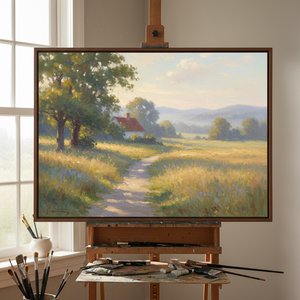
In the quietude of Kolding, Denmark, the foundations of a visual language begin to take shape. Born in 1901, Christian Daugaard enters the Royal Danish Academy of Fine Arts, where the influence of Ejnar Nielsen shapes his early perception. The years between 1923 and 1925 are formative, a period of rigorous study that precedes a return to his hometown. Here, the canvas captures the stillness of domestic life and the rolling landscapes of the surrounding Danish countryside. His early palette is restrained, dominated by light yellows and ochre tones that anchor his work in a specific, earthy reality.
A shift occurs as the years progress. The muted tones of his youth give way to a more assertive use of color. The landscapes undergo a structural transformation, moving toward a style that approaches Cubism. This is not a sudden rupture but a gradual sharpening of the world into more defined, geometric components. The soft light of his early years hardens into something more deliberate and structured.
A Shift Toward the Amager Coast
The move to Kastrup on the island of Amager marks a significant change in both subject and atmosphere. The flat, expansive surroundings of the island offer a new way to observe the interplay of light and season. The landscape becomes a vessel for studying how light shifts across a horizontal plane, changing the mood of the terrain from dawn to dusk. This period of observation is marked by several key developments in his technical approach:
- The transition from heavy oils to the fluidity of bright watercolours.
- A movement toward Expressionist sensibilities in his later years.
- A focus on the atmospheric qualities of the Danish seasons.
His later works embrace a different kind of intensity. The structured, Cubist-leaning compositions of his middle period evolve into bright, expressive watercolours. The precision of his earlier studies is replaced by a more immediate, emotional application of pigment, capturing the fleeting essence of the landscape rather than its rigid geometry.
Recognition and Legacy
The trajectory of his career is marked by significant institutional recognition within the Danish art community. These honors reflect a lifetime of dedicated observation and technical evolution. In 1955, he is awarded the Eckersberg Medal, followed much later, in 1990, by the Thorvaldsen Medal. These accolades cement his place in the history of Danish painting, moving from the student of Nielsen to a master of his own evolving style. His works find their way into permanent collections, including the Statens Museum for Kunst and the Statens Kunstfond, ensuring that his interpretations of the Danish landscape endure.