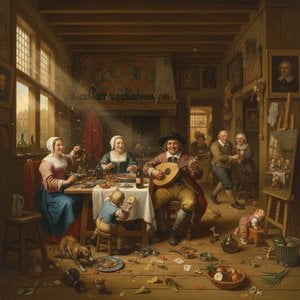
Adriaen Jansz van Ostade: A Master of Dutch Genre Painting
Adriaen Jansz van Ostade (1610 – 1685) stands as a pivotal figure in the history of Dutch Golden Age art, renowned for his unflinching depictions of everyday life—primarily scenes of peasant communities and tavern gatherings—that captured the spirit of his era with remarkable realism and psychological insight. Unlike many of his contemporaries who favored grand narratives or idealized portraits, Ostade focused on portraying ordinary people engaged in commonplace activities, offering a uniquely intimate glimpse into Dutch society during its zenith.
- Early Life & Training: Born in Haarlem to Jan Hendricx van Eyndhoven and Janneke Hendriksdr., Ostade’s artistic inclinations were nurtured by his father's profession as a tapestry weaver. He received formative instruction from Frans Hals, a celebrated portraitist whose loose brushwork style profoundly impacted young Ostade’s technique. However, he quickly diverged from Hals’s aesthetic sensibilities, forging his own distinctive path.
- Distinctive Style: Ostade's artistic hallmark was meticulous detail combined with subtle chiaroscuro—the dramatic interplay of light and shadow—creating a palpable sense of atmosphere within his canvases. He possessed an extraordinary ability to render textures convincingly, from the rough weave of peasant clothing to the weathered surfaces of rural buildings. This dedication to realism distinguishes him from other artists of his time.
- Major Works & Achievements: Among Ostade’s most celebrated paintings is “Saying Grace” (c. 1660), housed at the Cleveland Museum of Art, which exemplifies his masterful command of composition and emotive expression. Similarly captivating is “A Laughing Peasant” (1634), a small but powerfully evocative piece residing in the Kremer Collection, Amsterdam. Ostade’s prolific output included numerous tavern scenes—such as *The Tavern Scene with Musicians*—that vividly documented social customs and interactions.
- Influences & Legacy: Ostade's artistic development was significantly shaped by Frans Hals’s influence initially, but crucially, he absorbed lessons from Adriaen Brouwer, whose focus on low-life subjects mirrored Ostade’s own commitment to portraying the realities of rural existence. His work anticipated developments in later movements like Impressionism and Realism, establishing him as a cornerstone of Dutch artistic heritage.
Ostade's meticulous observation of human behavior—particularly expressions of emotion—contributed significantly to his enduring appeal. He skillfully conveyed psychological nuances within seemingly simple scenes, elevating the mundane into moments of poignant beauty and capturing the essence of human experience with unparalleled sensitivity. His legacy continues to inspire artists today who strive for authenticity and emotional resonance in their creations.