


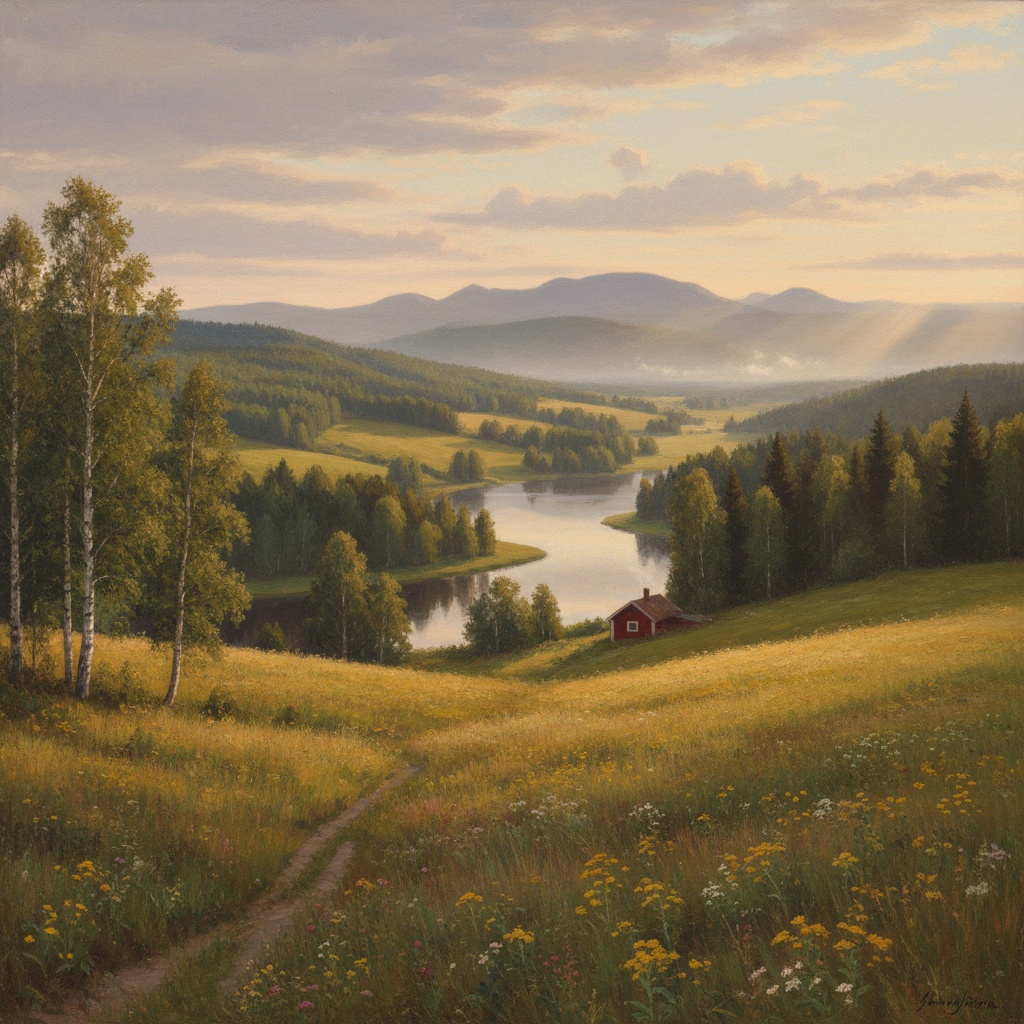
Early Life & Artistic Foundations: Breaking from Academy Tradition
Johan Krouthén (2 November 1858 – 19 December 1932) was a Swedish artist. He broke away from the traditions of the Swedish Academy, turning to Realism and Idealism. Immediately after his studies, he spent a few months in Paris and in Denmark where he...
Johan Krouthén, born in 1858 in Linköping, Sweden, represents a fascinating shift within the Nordic art landscape of the late 19th century. His story isn’t one of immediate acclaim or effortless talent, but rather a deliberate forging of a new path—a rejection of the rigid constraints imposed by the Swedish Academy and an embrace of artistic principles that prioritized observation and emotional resonance over strict academic doctrine. The Krouthén family possessed a lineage rooted in craftsmanship – generations of pewterers – perhaps instilling in the young Johan an early appreciation for meticulous detail and skillful execution, qualities that would later define his paintings. However, it was an apprenticeship with Svante Leonard Rydholm, a photographer and artist, at the age of fourteen that truly ignited his passion, providing foundational skills in both visual representation and the burgeoning medium of photography. His subsequent enrollment at the Royal Swedish Academy of Arts in Stockholm proved pivotal, yet ultimately unsatisfying. While mastering drawing, portraiture, and landscaping techniques, Krouthén found himself increasingly chafing against the prescribed curriculum, a sentiment shared by contemporaries like Anders Zorn and Oscar Björck. This collective discontent culminated in a symbolic act of defiance – a joint decision to leave the Academy rather than compromise their artistic vision.
The Influence of Skagen & Naturalism on Krouthén’s Palette
Following his departure from the Academy, Krouthén briefly ventured to Paris, then the epicenter of artistic innovation. However, it was a summer sojourn to Skagen, Denmark in 1883 that proved transformative. The Skagen colony, comprised of artists from Denmark, Norway, and Sweden, championed an artistic Naturalism focused on capturing the raw beauty of everyday life and the fleeting effects of light. Unlike the idealized historical or mythological scenes prevalent elsewhere, the Skagen painters turned their attention to the rugged coastline, the local fishermen, and the simple rhythms of coastal existence. Krouthén’s time in Skagen wasn't about replicating weathered faces; instead, he focused on the landscapes themselves – the vast, desolate beaches of Grenen, rendered with a newfound sensitivity to atmospheric conditions and subtle color variations. This experience marked a turning point, instilling in him a commitment to portraying nature not as it *should* be, but as it *was*, imbued with authenticity and emotional truth. The influence is visible in his muted tones and the growing emphasis on capturing the transient qualities of light—a hallmark that would become central to his signature style.
Capturing the Serenity of Swedish Landscapes: A Study in Realism and Idealism
 Dunes
DunesDiscover 'Dunes' by Johan Krouthén (1883), a serene Impressionistic landscape of a Swedish beach. Explore its muted tones & atmospheric brushwork – a captivating piece.
Upon returning to Sweden, Krouthén dedicated himself to depicting the serene beauty of his homeland. His landscapes weren’t grand vistas designed to inspire awe; rather, they were intimate portrayals of gardens, fields, and coastal scenes—quiet moments captured with remarkable precision and a growing sense of poetic idealism. Paintings like ‘Dunes’ (1883) exemplify this approach: the soft, diffused light, the subtle gradations of color in the sand, and the overall feeling of tranquility evoke a deep connection to nature. However, Krouthén wasn't merely a recorder of reality; he actively sought to *improve* upon it. He began incorporating elements of Idealism into his work, subtly enhancing colors, refining compositions, and imbuing scenes with a sense of harmony and balance that transcended mere representation. This delicate interplay between Realism and Idealism is what sets Krouthén apart—a commitment to truthfulness tempered by an artistic sensibility that sought beauty and emotional resonance above all else.
Portraits and Interiors: Intimacy, Light, and the Depiction of Local Life
 johan krouthén
Explore the serene landscapes & portraits of Johan Krouthén, a Swedish artist who broke from tradition to capture realism & idealism in his paintings.
While landscapes remained a central focus throughout his career, Krouthén also excelled in portraiture and interior scenes. These works offer a fascinating glimpse into the lives of local people—often members of Linköping’s burgeoning middle class. His portraits weren't about capturing social status or outward appearances; instead, they focused on conveying personality and inner life. He achieved this through meticulous attention to detail – the subtle play of light across faces, the careful rendering of clothing textures, and a deliberate avoidance of ostentation. Interiors, similarly, were not showcases of wealth but rather intimate studies of domesticity—often featuring passive figures engaged in quiet contemplation. The painting ‘Librarian Segersteen in his home’ (1886) is particularly noteworthy; it depicts the librarian surrounded by his art collection, including works by Krouthén himself, creating a layered composition that speaks to the importance of culture and intellectual pursuits. The inclusion of other artworks within the scene adds depth and context, revealing not only Segersteen's tastes but also Krouthén’s own artistic influences.
Krouthén's Technique: Brushwork, Color Theory & Atmospheric Perspective
Krouthén’s mastery lay in his subtle yet sophisticated technique. His brushwork was characterized by a delicate layering of paint—creating textures that were both realistic and evocative. He wasn’t interested in bold impasto or dramatic strokes; instead, he favored a more nuanced approach, blending colors seamlessly to create atmospheric effects. His understanding of color theory was evident in his careful selection of palettes – often muted tones punctuated by subtle highlights. This technique allowed him to capture the fleeting qualities of light and shadow with remarkable accuracy. Furthermore, Krouthén demonstrated a keen awareness of atmospheric perspective—the way objects appear less distinct and more bluish as they recede into the distance. This skill was particularly evident in his landscapes, where he created a sense of depth and realism by accurately depicting the effects of air and moisture on distant forms. The painting ‘Elias Erdtman Painting’ (1890) beautifully illustrates this technique—the dappled light filtering through trees, the serene pathway receding into the distance, all rendered with a masterful understanding of color and atmosphere.
Legacy and Influence: Krouthén’s Place in Swedish Art History
Johan Krouthén's contribution to Swedish art lies not in revolutionary innovation but rather in his consistent pursuit of beauty, authenticity, and emotional resonance. He successfully bridged the gap between Realism and Idealism, creating landscapes and portraits that were both truthful and poetic. While he faced challenges making a living from his art, particularly early in his career, he persevered through innovative means—organizing art lotteries and accepting private commissions. His paintings gained recognition for their delicate technique, subtle color palettes, and ability to capture the serene beauty of the Swedish countryside. Though perhaps not as widely celebrated as some of his contemporaries, Krouthén’s work continues to resonate with audiences today, offering a glimpse into a quieter, more contemplative vision of 19th-century Sweden. His dedication to portraying nature at its best—skillfully and accurately—remains an enduring testament to his artistic talent and unwavering commitment to his craft. Explore the world of Johan Krouthén further with ArtsDot, where high-quality reproductions allow you to experience the beauty of his masterpieces firsthand.


