

Echoes of Antiquity: Exploring Themes & Techniques in Classical Painting
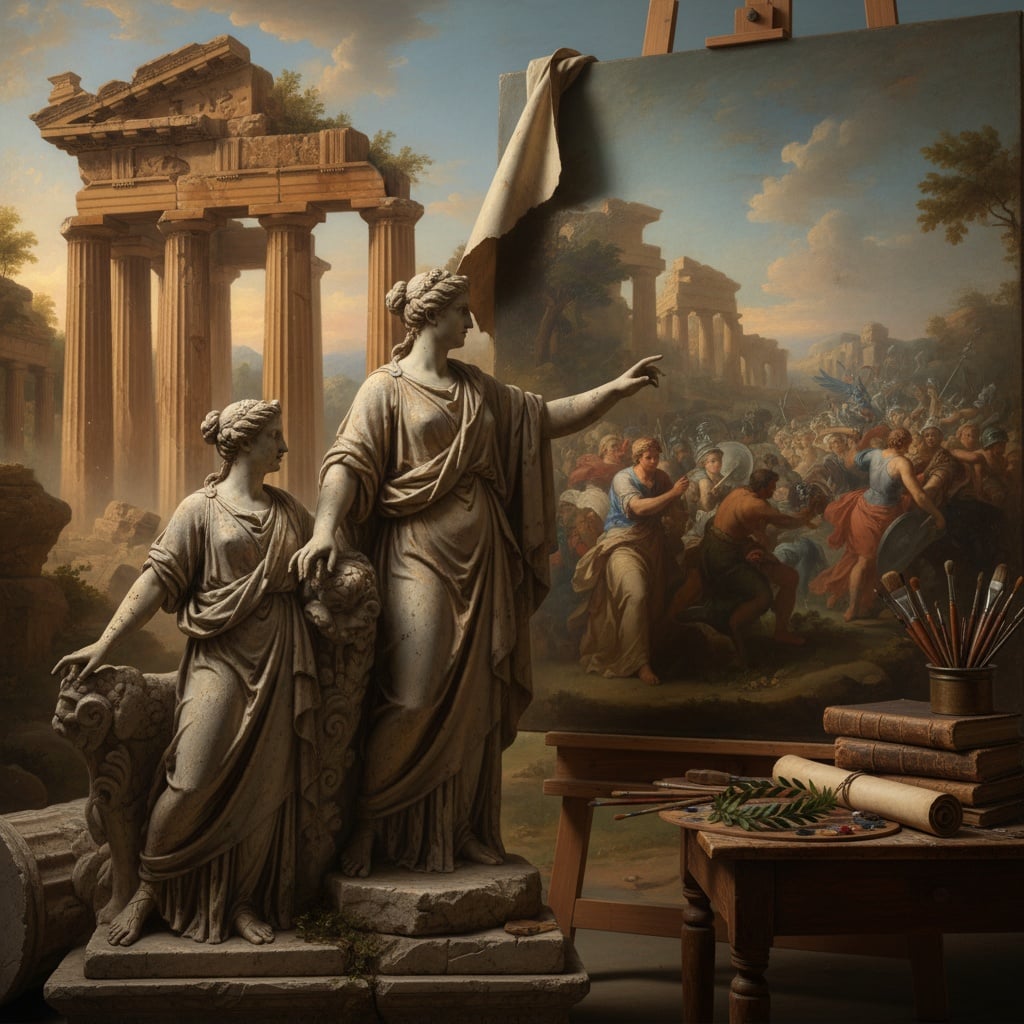
Зміст
The Foundations of Form: Ancient Greek Approaches to Representation
Ancient Greek art is the visual and applied arts, as well as the architecture, produced by the Hellenes or Greek peoples from the start of the Iron Age to the Hellenistic period, ending with Roman conquest of Greece at the Battle of Corinth in 146 BC...
The story of classical painting begins not with brushstrokes, but with a profound philosophical quest – the pursuit of ideal form. Ancient Greece, from roughly the 8th century BCE onwards, didn’t merely *depict* reality; it sought to understand and elevate it. Early Greek art, particularly in sculpture, laid the groundwork for what would become a defining characteristic: naturalism tempered by idealized proportions. Figures weren't copied slavishly from life but were refined according to mathematical ratios believed to embody perfect beauty. This pursuit extended to painting, though surviving examples are tragically scarce – primarily existing as vase paintings and Roman copies of frescoes. These fragments reveal a fascination with narrative, often drawn from mythology and heroic tales, rendered with increasing sophistication in depicting anatomy, drapery, and emotional expression. The emphasis wasn’t simply on *what* was painted but *how* it conveyed virtue, power, and the human condition. The development of techniques like foreshortening – hinting at three-dimensionality even on a two-dimensional surface – demonstrates an early understanding of perspective, albeit rudimentary compared to later innovations. Artists like Apollodorus Skiagraphos, though known only through descriptions, pioneered the use of shading (“skiagraphia”) to create volume and depth, foreshadowing techniques that would flourish centuries later.
Renaissance Revival: Reinterpreting Classical Ideals in Painting
Renaissance art (1350 – 1620) is the painting, sculpture, and decorative arts of the period of European history known as the Renaissance, which emerged as a distinct style in Italy in about AD 1400, in parallel with developments which occurred in phi...
The Renaissance, meaning “rebirth,” was precisely that – a conscious revival of classical art and learning after the medieval period. Italian artists, beginning around 1400, didn’t simply copy ancient works; they absorbed them, analyzed them, and synthesized them with contemporary innovations. Humanism, a philosophical movement emphasizing human potential and achievement, profoundly influenced artistic subject matter. Religious themes remained prevalent, but were often infused with classical allusions and a newfound focus on individual emotion and psychological realism. Figures like Leonardo da Vinci epitomized this shift. His *Adoration of the Magi*, for example, isn’t just a biblical scene; it's a complex exploration of human interaction, perspective, and symbolic meaning. The rediscovery of linear perspective – attributed to Brunelleschi – revolutionized painting, allowing artists to create convincingly realistic spaces. This period also saw a renewed interest in anatomy, driven by dissection and observation, resulting in more accurate and lifelike depictions of the human body. Artists began experimenting with new mediums, most notably oil paint, which allowed for greater subtlety of color and blending than previous techniques.
Chiaroscuro: Mastering Light and Shadow for Dramatic Effect
In art, chiaroscuro (English: kee-AR-ə-SKOOR-oh, -SKURE-, Italian: [ˌkjaroˈskuːro]; lit. 'light-dark') is the use of strong contrasts between light and dark, usually bold contrasts affecting a whole composition. It is also a technical term used by ...
Central to the Renaissance’s artistic advancements was the technique of chiaroscuro, Italian for “light-dark.” Initially employed by da Vinci, it evolved into a powerful tool for creating dramatic effect and emotional intensity. Chiaroscuro isn't merely about contrasting light and shadow; it’s about using those contrasts to model form, create depth, and direct the viewer’s eye. The technique relies on a strong understanding of how light interacts with surfaces – highlights, mid-tones, shadows, and reflected light all play crucial roles. However, it was Michelangelo Merisi da Caravaggio who truly mastered chiaroscuro, pushing it to its extreme in works like *A Philosopher* (available through ArtsDot.com). Caravaggio’s paintings are characterized by stark contrasts – figures emerging from deep darkness illuminated by a single, often unseen light source. This technique, known as tenebrism, heightened the emotional impact of his scenes and imbued them with a sense of realism and immediacy. The use of shadow wasn't simply aesthetic; it became symbolic, representing mystery, doubt, and even spiritual struggle.
Symbolism & Narrative: Unveiling Hidden Meanings in Classical Compositions
Classical painting was rarely just about surface appearances. Beneath the depictions of gods, heroes, and biblical scenes lay layers of symbolism and narrative complexity. Artists meticulously incorporated allegorical figures, objects with hidden meanings, and compositional elements designed to convey specific messages. For example, Nicolas Poussin’s *Rinaldo and Armida* (a stunning piece available from Dulwich Gallery through ArtsDot.com) is not simply a depiction of a romantic encounter; it's an exploration of themes like love, betrayal, and the dangers of temptation. The landscape itself isn’t merely background scenery but contributes to the overall narrative mood. Understanding these symbolic layers requires knowledge of classical mythology, literature, and philosophy. Artists often drew inspiration from Ovid’s *Metamorphoses* or Virgil’s *Aeneid*, embedding their paintings with references that would have been readily understood by contemporary audiences. The careful arrangement of figures, the use of color, and even the direction of gaze all contributed to the overall storytelling effect.
Foreshortening & Perspective: Creating Illusionistic Space
The ability to create a convincing illusion of three-dimensional space on a two-dimensional surface was a defining achievement of classical painting. Linear perspective, rediscovered in the Renaissance, provided artists with a mathematical framework for achieving this effect – converging lines meeting at a vanishing point on the horizon. However, perspective wasn’t simply about technical accuracy; it also served compositional purposes, directing the viewer’s eye and creating a sense of depth and realism. Equally important was foreshortening, the technique of depicting objects or figures as if they are receding into space. This required a keen understanding of anatomy and perspective to avoid distortions. Artists like Luca Signorelli demonstrated mastery of both techniques in his frescoes, creating dynamic compositions that drew viewers into the scene. The skillful use of foreshortening not only enhanced realism but also added drama and emotional impact.
The Enduring Legacy: How Classical Techniques Continue to Inspire
The influence of classical painting extends far beyond the Renaissance. Its techniques – chiaroscuro, perspective, symbolism, and anatomical accuracy – continue to inspire artists today. From Rembrandt’s masterful use of light and shadow to the dramatic compositions of Baroque painters like Rubens, the legacy of classical art is evident in countless works across centuries. Even modern artists have drawn inspiration from classical themes and styles, reinterpreting them in new and innovative ways. The pursuit of ideal form, the exploration of human emotion, and the power of narrative remain central to artistic expression. ArtsDot.com offers a unique opportunity to connect with this enduring legacy, providing high-quality reproductions of masterpieces that allow you to experience the beauty and complexity of classical painting firsthand. Whether you’re seeking a stunning oil painting for your home or a custom reproduction of a favorite artwork, our team of skilled artists is dedicated to bringing these timeless works to life.
Пов'язані статті

Echoes of Sorrow: Exploring Melancholy in Art History – Themes, Techniques & Emotional Resonance
Explore the captivating world of melancholy in art history! Discover iconic paintings by Goya, Rossetti & Friedrich, analyze techniques, and understand the emotional resonance that makes these masterpieces timeless. Expert insights at ArtsDot.


Antonio da Correggio: Innovation, Illusionism & the Poetics of Grace in Renaissance Painting
Explore the revolutionary art of Antonio da Correggio, a master of Renaissance illusionism and chiaroscuro. Discover his frescoes, mythological paintings & lasting influence on Baroque art. Expert analysis & key works featured.

The Eloquent Darkness: Exploring Shadow as Subject, Symbolism & Technique in Art History
Explore the captivating history of shadow in art! Discover chiaroscuro & tenebrism techniques used by masters like Caravaggio & Rembrandt. Uncover symbolism, emotional impact & enduring legacy with ArtsDot.

Illuminating Shadows: A Comprehensive Exploration of Chiaroscuro Technique in Art History
Explore the captivating world of chiaroscuro! Discover its history, masters like Caravaggio & de La Tour, and enduring influence on art. A comprehensive guide for enthusiasts.

