
- Головна

- Статті
- Charles Bird King: Capturing Native American Dignity Through Portraiture & Cultural Exchange
Charles Bird King: Capturing Native American Dignity Through Portraiture & Cultural Exchange
Зміст
The McKenney & Hall Commission: A Vision for Preserving Indigenous Cultures
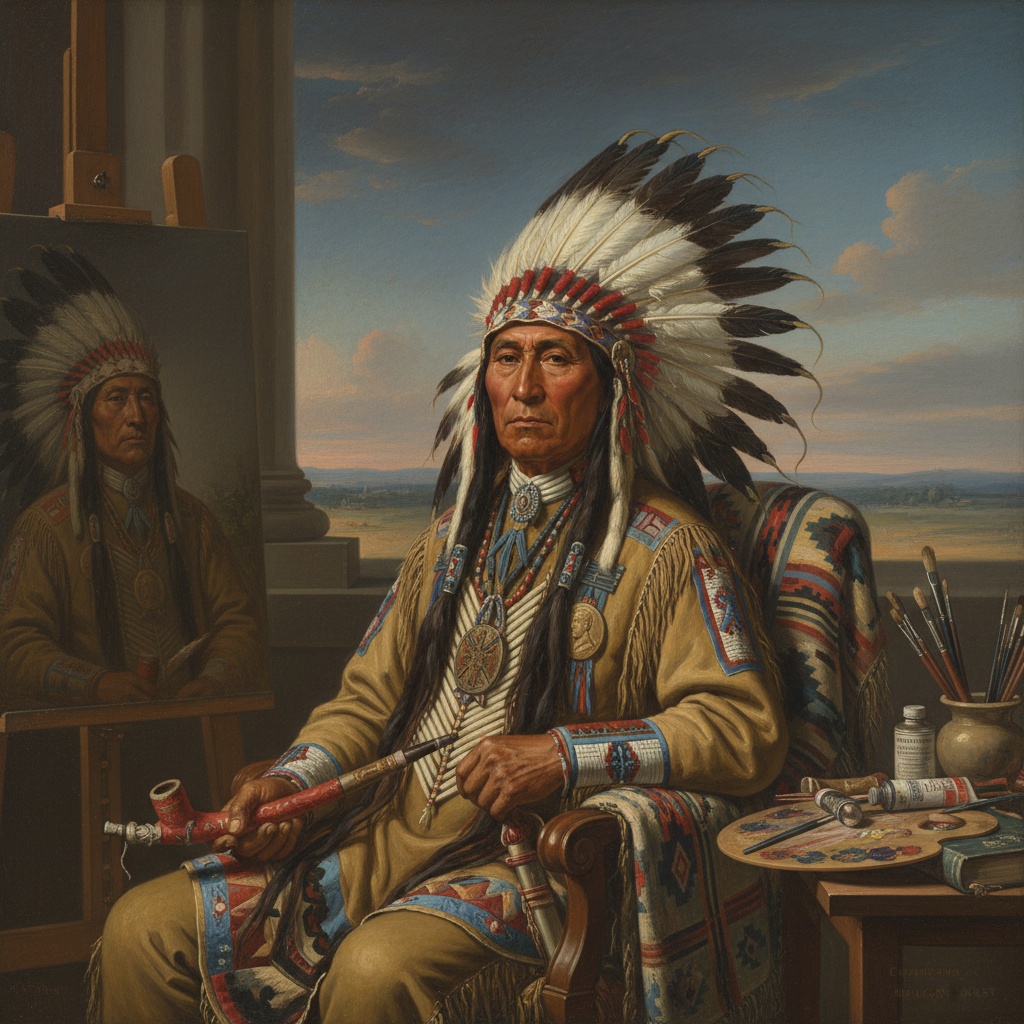
In the early decades of the 19th century, as the United States aggressively expanded westward, a remarkable project was conceived within the halls of government in Washington D.C. Thomas McKenney, Superintendent of Indian Trade, envisioned something beyond mere documentation—a deliberate attempt to capture the likenesses and preserve the memory of prominent Indigenous leaders who journeyed to negotiate with the burgeoning nation. This wasn’t simply about recording faces; it was a complex undertaking steeped in political ambition, nascent anthropological curiosity, and a desire, however flawed, to acknowledge a culture facing inevitable transformation. McKenney understood that these encounters were pivotal moments, and he sought to create a lasting record before the traditional ways of life vanished. He engaged Charles Bird King, a respected portraitist who had studied under Benjamin West in London, to execute this ambitious series.
King’s commission wasn't born from purely artistic motives; it was fundamentally tied to the political landscape of the time. The portraits were intended to serve as tools for diplomacy and public relations, showcasing the “civilized” aspects of Indigenous life while simultaneously asserting American authority. Yet, McKenney’s personal fascination with Indigenous cultures transcended these pragmatic goals. He believed in honoring the dignity and intelligence of the individuals he encountered, a sentiment that subtly infused the project with a sense of respect rarely seen in governmental endeavors of the era. The resulting collection, initially intended as a visual archive for policymakers, would later become a cornerstone of American art history.
Charles Bird King's Artistic Style: Dutch Influences and Portrait Realism
Charles Bird King’s artistic approach was deeply rooted in the traditions of European portraiture, particularly those of 17th-century Holland. His seven years studying under Benjamin West at the Royal Academy provided a solid foundation in classical techniques, but it was his exposure to Dutch masters—artists renowned for their meticulous realism and mastery of light—that truly shaped his distinctive style. King’s portraits are characterized by an extraordinary attention to detail: the texture of clothing, the subtle nuances of facial expression, and the precise rendering of adornments all speak to a dedication to capturing verisimilitude. This commitment extended beyond mere physical likeness; he sought to convey a sense of character and presence in each subject.
Unlike many American portraitists of his time who favored grand, idealized compositions, King’s work possessed a quiet intimacy. He eschewed elaborate backgrounds and dramatic poses, instead focusing on the sitter's face and upper body. This deliberate simplicity allowed for a more direct connection between viewer and subject. The influence of Dutch *trompe l'oeil*—the art of deceiving the eye—is evident in his ability to create remarkably lifelike textures and surfaces. While King’s style was undeniably influenced by European traditions, he adapted it to suit the unique challenges of portraying Indigenous individuals, often incorporating elements of their clothing and regalia with sensitivity and accuracy.
Beyond Likeness: Representing Status, Diplomacy, and Identity in the Portraits
The portraits commissioned by McKenney were never simply objective representations; they were carefully constructed images designed to convey specific messages about status, diplomacy, and Indigenous identity. The very act of sitting for a portrait was itself a significant gesture—a demonstration of cooperation and willingness to engage with American authorities. King meticulously documented the clothing, ornaments, and ceremonial objects worn by his subjects, providing valuable insights into their cultural practices and social hierarchies. These details weren’t merely decorative; they were integral to understanding each leader's position within their tribe.
The portraits also served as powerful tools for negotiation. By presenting Indigenous leaders in a dignified light, McKenney hoped to foster trust and facilitate peaceful treaties. However, the inherent power dynamics of the situation cannot be ignored. The act of being portrayed by an American artist, within the confines of Washington D.C., subtly reinforced American dominance. Furthermore, King’s portraits often presented his subjects in Western attire or with symbols of American authority, raising questions about the extent to which they accurately reflected Indigenous self-representation. The careful balance between respect and control is a defining characteristic of this remarkable series.
A Complex Legacy: Examining Historical Context and Contemporary Perspectives
Charles Bird King’s Indian portraits occupy a unique and often contested space within American art history. While celebrated for their artistic merit and historical significance, they are also subject to critical scrutiny in light of contemporary understandings of colonialism and Indigenous representation. The project was undeniably shaped by the political agenda of the time—an agenda that ultimately led to the forced removal and displacement of countless Indigenous peoples. It’s crucial to acknowledge this context when interpreting these portraits.
Today, scholars are re-examining King’s work through a more nuanced lens, questioning the extent to which his representations accurately reflect Indigenous perspectives. While McKenney harbored genuine respect for the individuals he encountered, his project was ultimately driven by governmental interests. The portraits can be seen as both a testament to Indigenous dignity and a product of colonial power dynamics. Understanding this complexity is essential for appreciating the full historical weight of King’s legacy. It's important to remember that these images were created *of* people, not necessarily *with* them in complete control of their own narrative.
The Lost Gallery & Rediscovering King’s Work Through Lithographs
Tragically, the original oil portraits by Charles Bird King suffered a devastating fate. In 1865, a fire swept through the Smithsonian Institution, destroying most of the collection. Only a handful of paintings were salvaged, leaving behind a profound sense of loss for art historians and Indigenous communities alike. However, the legacy of King’s work was preserved thanks to the efforts of Thomas McKenney and James Hall, who commissioned Henry Inman to create hand-colored lithographs based on the original portraits.
These lithographs, published in their three-volume *History of the Indian Tribes of North America* between 1837 and 1844, became a vital source for scholars and collectors. While they lack the texture and depth of the original oils, they offer invaluable insights into King’s artistic techniques and the appearance of his subjects. The lithographs allowed these portraits to reach a wider audience, ensuring that the memory of these Indigenous leaders would endure despite the destruction of the gallery. Today, surviving copies of McKenney & Hall's publication are highly prized artifacts, offering a glimpse into a pivotal moment in American history.
Collecting Charles Bird King: Investing in a Significant American Narrative
For collectors seeking to acquire pieces of American art with both historical and aesthetic significance, the works of Charles Bird King represent a compelling opportunity. While original oil paintings are exceedingly rare due to the 1865 fire, hand-colored lithographs from McKenney & Hall’s publication remain accessible and highly sought after. These prints not only showcase King's artistic skill but also serve as tangible links to a complex and often overlooked chapter in American history.
Investing in Charles Bird King is more than simply acquiring a beautiful artwork; it’s about preserving a cultural narrative, supporting Indigenous scholarship, and acknowledging the enduring legacy of these remarkable individuals. When considering a purchase, provenance—the documented history of ownership—is particularly important. At ArtsDot.com, we offer expert guidance on sourcing authentic prints and understanding their historical context. Our team can assist with appraisal, framing, and display options to ensure your investment is both aesthetically pleasing and historically informed. Explore our collection today and discover the captivating world of Charles Bird King’s portraits—a testament to a bygone era and a powerful reminder of the enduring spirit of Indigenous cultures.
Пов'язані статті

Antonio Zeno Shindler: A Pioneer of Cross-Cultural Portraiture in Early Modernism
Explore the life & work of Antonio Zeno Shindler, a pivotal figure in early modernist portraiture. Discover his unique style, anthropological collaborations, and lasting impact on cultural representation. Expert analysis for discerning collectors.

George Catlin: Witnessing & Representing Indigenous Life on the American Frontier
Explore the captivating art of George Catlin, renowned for his vivid portraits & landscapes documenting Native American life on the frontier. Discover a vanishing world through stunning paintings and historical context.

