

Beyond Impressionism: Exploring the Emotional Depth of Post-Impressionist Painting
Зміст
The Seeds of Rebellion: From Impressionism’s Light to New Visions
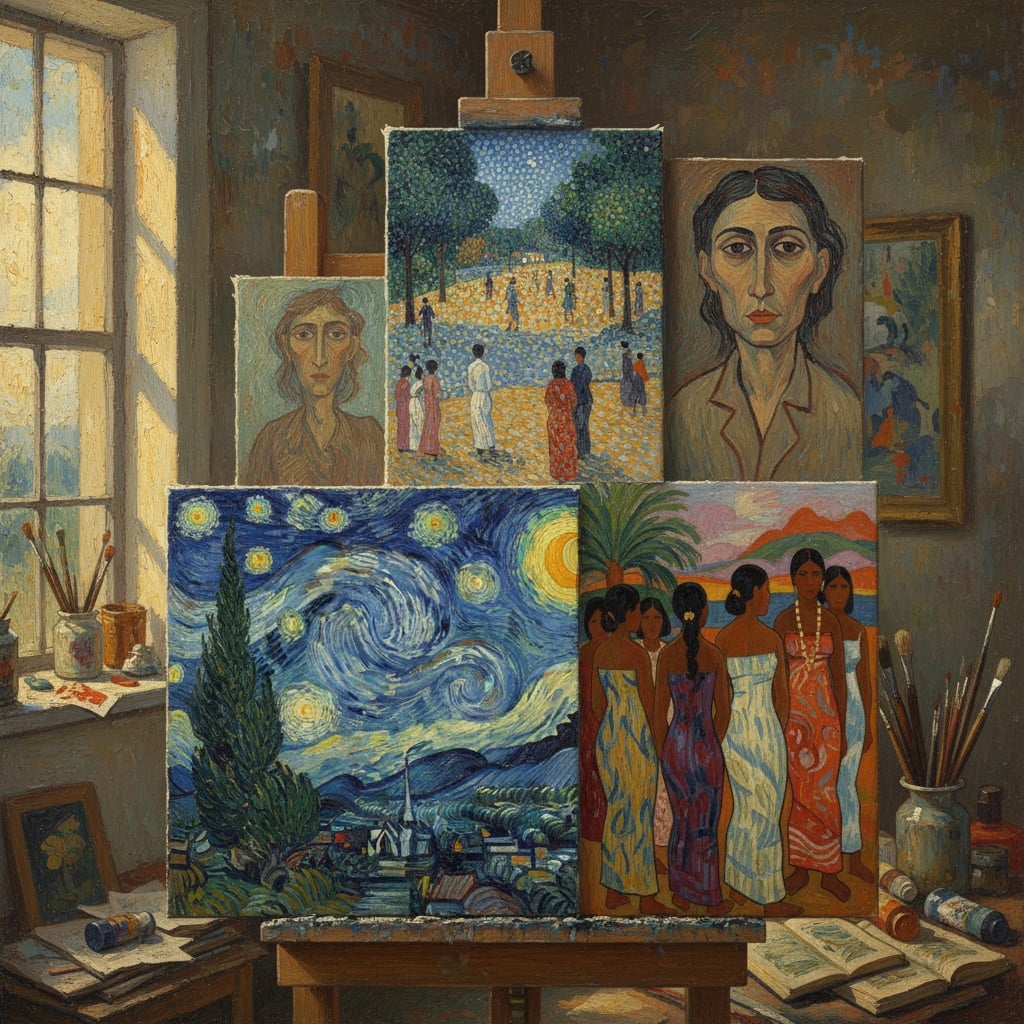
Post-Impressionism (also spelled Postimpressionism) was a predominantly French art movement which developed roughly between 1886 and 1905, from the last Impressionist exhibition to the birth of Fauvism. Post-Impressionism emerged as a reaction agains...
The late 19th century witnessed a seismic shift in the art world, born not from complete rejection but from a nuanced dissatisfaction with the fleeting beauty captured by the Impressionists. While artists like Monet and Renoir dedicated themselves to portraying the ephemeral qualities of light and atmosphere, a new generation began to question whether this pursuit alone was sufficient. They sought something more—a deeper exploration of emotion, structure, and the very essence of perception. This questioning marked the genesis of Post-Impressionism, a movement less defined by a unified style than by a shared desire to transcend the limitations of its predecessor. It wasn’t about abandoning Impressionism entirely; rather, it was about building upon its foundations while forging new paths toward personal expression and enduring artistic significance.
The Impressionists had liberated color from its traditional role as a descriptive tool, but Post-Impressionist painters like Paul Cézanne felt this freedom lacked a certain solidity. He famously declared his intention to “make of Impressionism something solid and durable,” a statement that encapsulates the movement’s core ambition. This desire for permanence wasn't merely about technical skill; it was rooted in a philosophical quest to understand the underlying structure of nature itself, to reveal the geometric forms hidden beneath the surface of appearances.
Cézanne's Structural Revolution: Building Form and Foreshadowing Cubism
 Still life with compotier,1879-80, collection mr. an
Cézanne's 'Still Life with Compotier' (1879-80) showcases his innovative approach to color & composition, exemplifying Post-Impressionism. Explore the vibrant fruit still life!
Paul Cézanne’s impact on the development of modern art is almost immeasurable. He approached painting not as a means of replicating reality, but as a process of constructing it anew. His still lifes, such as Still Life with Compotier (1879-80), are not simply depictions of fruit; they are meticulously orchestrated arrangements of form and color, where each object is rendered as a collection of planes and angles. He reduced natural forms to their essential geometric components—cylinders, spheres, and cones—a technique that would profoundly influence the Cubists who followed.
Cézanne’s landscapes, particularly his series of paintings depicting Mont Sainte-Victoire, demonstrate a similar preoccupation with structure. He didn't aim to capture a single, fleeting impression of the mountain; instead, he sought to represent its underlying solidity and permanence through repeated studies from various viewpoints. This emphasis on multiple perspectives was revolutionary, challenging traditional notions of spatial representation and paving the way for a more fragmented and abstract approach to painting.
His brushwork, though seemingly deliberate, wasn’t about precise detail but rather about conveying the sensation of form and volume. The subtle modulations in color and tone create a sense of depth and solidity that transcends mere optical realism. Cézanne's work is not simply *about* apples or mountains; it’s about the act of seeing itself, about the artist’s struggle to translate three-dimensional reality onto a two-dimensional canvas.
Van Gogh’s Emotional Landscape: Color, Brushwork, and Inner Turmoil
 portrait of henri gasquet
Explore Paul Cézanne's 'Portrait of Henri Gasquet,' a captivating Post-Impressionist masterpiece showcasing innovative brushstrokes & contemplative mood. A pivotal work bridging Impressionism and Cubism.
While Cézanne sought structure, Vincent van Gogh pursued emotional intensity. His paintings are not windows into the world but rather portals into his own turbulent inner life. Unlike the Impressionists' objective observation of light, Van Gogh used color as a vehicle for expressing his deepest feelings—anxiety, loneliness, and an overwhelming sense of connection to nature.
His iconic brushwork – thick, swirling strokes that seem to writhe with energy – is inseparable from the emotional content of his paintings. Portrait of Henri Gasquet (1890), for example, isn’t merely a likeness of a friend; it's a powerful depiction of human vulnerability and psychological depth. The vibrant colors and expressive brushstrokes convey a sense of intimacy and empathy that transcends mere representation.
Van Gogh’s landscapes are equally charged with emotion. Starry Night (1889), perhaps his most famous work, is not a realistic depiction of the night sky; it's a visceral expression of awe, wonder, and existential longing. The swirling stars and cypress trees seem to pulse with life, reflecting Van Gogh’s own inner turmoil and spiritual yearning.
Gauguin’s Symbolic Journeys: Primitivism, Spirituality, and Synthetism
Paul Gauguin, like Van Gogh, rejected the constraints of conventional realism in favor of a more symbolic and expressive approach. However, his pursuit of emotional depth led him down a different path—a journey to distant lands in search of primal authenticity and spiritual renewal.
Gauguin’s time in Tahiti profoundly influenced his art. He sought to escape the perceived decadence of European civilization by immersing himself in Polynesian culture, believing that its simplicity and spirituality held the key to a more authentic way of life. His paintings from this period are characterized by bold colors, flattened forms, and simplified compositions—a style known as Synthetism.
The Vision after the Sermon (1888), exemplifies Gauguin’s symbolic approach. The painting depicts a group of Breton women witnessing a religious vision, but it's not a literal representation of an event; rather, it's a stylized and emotionally charged interpretation of faith and spirituality. He deliberately rejected naturalistic perspective in favor of a more decorative and expressive style, emphasizing the underlying symbolism of the scene.
Seurat and Neo-Impressionism: The Science of Perception and Pointillist Technique
Georges Seurat took a radically different approach to Post-Impressionism, grounding his art in scientific principles rather than emotional expression. He believed that color could be used to create optical effects based on the laws of perception, meticulously studying theories of light and color mixing.
Seurat developed a technique known as Pointillism—the application of tiny dots of pure color that blend optically when viewed from a distance. Sunday Afternoon on the Island of La Grande Jatte (1884-86), is his masterpiece, showcasing this meticulous method. The painting isn’t about capturing a fleeting impression; it's about creating a luminous and harmonious composition through the precise arrangement of color.
While seemingly detached and analytical, Seurat’s work wasn’t devoid of emotion. His paintings evoke a sense of stillness and contemplation, inviting viewers to engage with the interplay of light and color on a purely visual level. Neo-Impressionism represents a fascinating intersection of art and science, demonstrating the power of systematic observation and experimentation.
The Enduring Legacy: Post-Impressionism's Influence on Modern Art
Post-Impressionism wasn’t a unified movement with a single aesthetic goal. Instead, it was a constellation of individual artists—Cézanne, Van Gogh, Gauguin, and Seurat—each pursuing their own unique vision while challenging the conventions of Impressionism. This diversity is precisely what makes Post-Impressionism so significant.
The movement laid the groundwork for many of the major art movements that followed, including Fauvism, Cubism, Expressionism, and Surrealism. Cézanne’s emphasis on structure influenced the Cubists' fragmentation of form, while Van Gogh’s emotional intensity paved the way for Expressionist painters like Edvard Munch and Ernst Ludwig Kirchner. Gauguin’s symbolic approach inspired a generation of artists to explore themes of spirituality and primitivism.
Today, Post-Impressionist paintings continue to captivate audiences with their beauty, emotion, and intellectual depth. They remind us that art is not simply about replicating reality; it's about interpreting it, expressing it, and ultimately, transforming it. At ArtsDot.com, we are dedicated to making these masterpieces accessible to all, offering high-quality reproductions that capture the essence of these iconic works and allow you to experience the enduring legacy of Post-Impressionism in your own home.
Пов'язані статті

Beyond Impressionism: Exploring Emotional Depth & Formal Innovation in Post-Impressionist Art
Explore the profound emotional depth & formal innovations of Post-Impressionism with our expert guide. Discover Cézanne, Van Gogh, Gauguin & more. Learn about art history, collecting, and investing in this pivotal movement.


