

 Переглянути в інтер'єрі
 Надіслати як листівку
 Поділитися
 Детальніше

 Завантажити
 Схожі експонати
 Рентгенівське дослідження
 Слайд-шоу
Nasturtiums
 Acrylic On Canvas
- WallArt
- Academic Realism
 1903
1903- 19th Century
 716.0 x 1010.0 cm
 Національна галерея Австралії
 Читати далі
Олійная репродукція ручної роботи
Написана вручну олією на полотні у вашому розмірі та рамі, виготовлена на замовлення нашими художниками. ( Замовити принт Купити цифрове зображення)




P118B $10

P118H $10

P118W $10

P438Z $10

P508JH $12

P508YH $12

P805H $10

P805Z $10

P919BZ $10

P919G $10

P919XJ $10

P959ZH $10

P968JZ $12

W106C $8

W218G $10

W218JH $8

W218Y $10

W307PJ $10

W316G $10

W316PJ $8

W316Y $10

W398PJ $8

W4111J $10

W500HY $15

W500JH $15

W692G $12

W849H $8

W940BG $15

W953PJ $8




Обирайте з наших стандартних розмірів, що відповідають оригінальним пропорціям твору мистецтва.

Ви можете вказати власні розміри, щоб репродукція ідеально підійшла до конкретної рами або інтер'єру. Якщо вибраний вами розмір не відповідає пропорціям оригіналу, ми або обріжемо полотно, або доповнимо картину додатковими елементами, промальованими вручну. Цифровий макет буде надіслано вам на затвердження перед початком виробництва.
Зверніть увагу, що попередній перегляд на екрані не відображає фактичне обрізання або розширення зображення. Тільки макет точно покаже остаточну композицію.
Хоча ми можемо виготовити виріб у нестандартному розмірі, для збереження оригінальних пропорцій рекомендуємо обирати варіанти зі встановленого списку.
Після оформлення замовлення команда ArtsDot.com зв'яжеться з клієнтом електронною поштою для отримання інструкцій та надасть попередній макет
Доставка по всьому світу () за 3–4 тижні замість стандартних 5 тижнів. (14 Серпень). Без жодних компромісів у якості.

Безкоштовна експрес-доставка по всьому світу

Високоякісне лляне полотно

Повне страхове покриття доставки

Гарантія відшкодування митних зборів

Гарантія точного відтворення кольорів

Політика повернення протягом 60 днів (лише у разі виявлення дефектів)

Гарантія повернення 100% коштів

Пропозиція на оптові замовлення
 Скляний варіант доступний лише для розмірів до 110 см

Nasturtiums
Матеріал репродукції
Розмір репродукції
-


Підсумкова вартість
$ 263
Опис твору
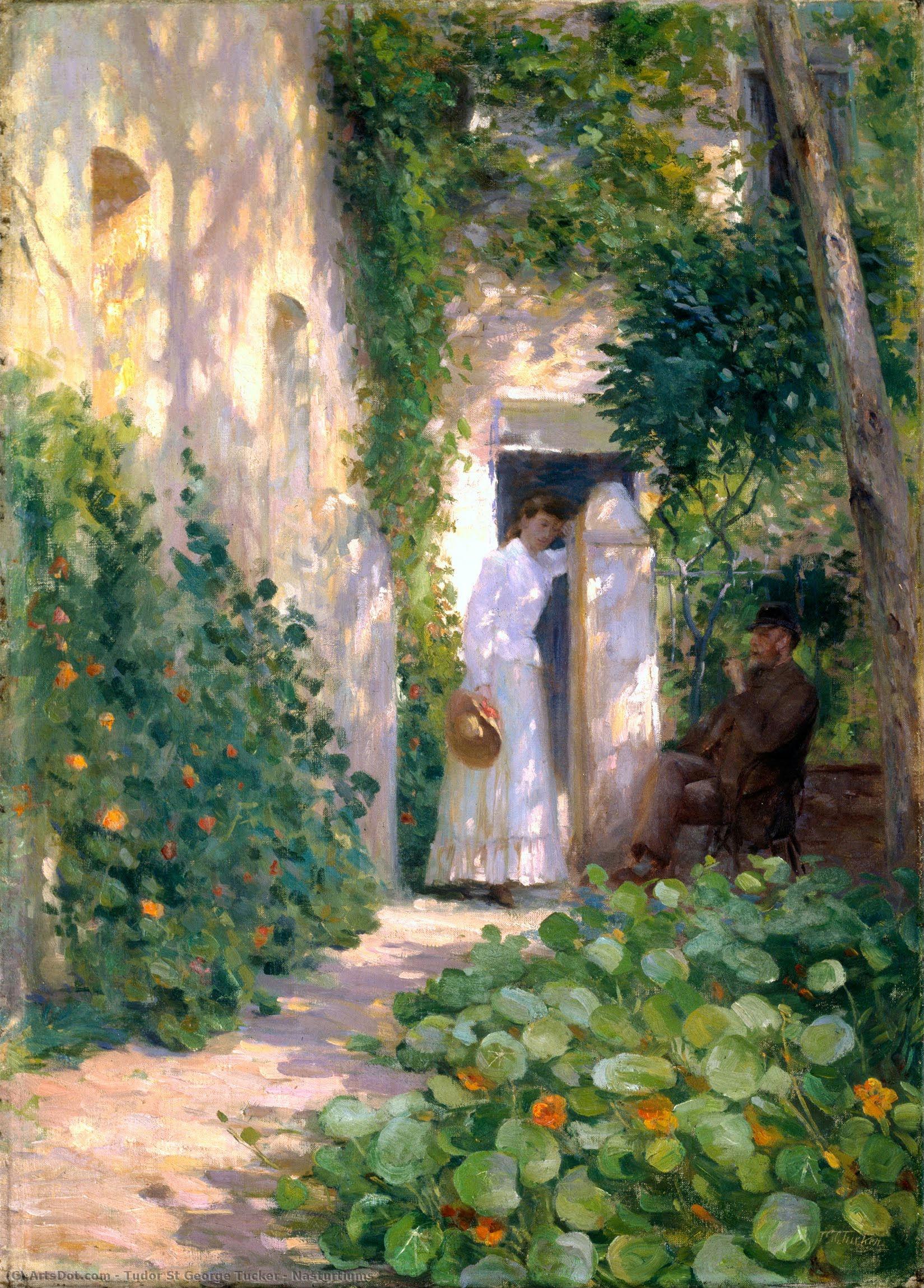
A Moment of Quiet Contemplation: Tudor St George Tucker’s ‘Nasturtiums’
Tudor St George Tucker's “Nasturtiums,” painted in 1903, is more than just a depiction of a sun-drenched courtyard garden; it’s a poignant exploration of human connection and isolation rendered with remarkable sensitivity. This large-scale canvas (716 x 1010 cm) immediately draws the viewer into its luminous world, dominated by the vibrant explosion of nasturtiums that cascade across the foreground. The painting's power lies not just in its technical brilliance – a testament to Tucker’s mastery of light and color – but also in the subtle narrative it conveys: a sense of quiet sadness and unspoken distance between two figures posed within this idyllic, yet ultimately melancholic, setting.
- The Painter's Vision: Tucker, a British expatriate who spent formative years in Australia, forged a unique artistic path. His return to Europe after a period in Melbourne saw him embrace a style markedly different from the prevailing academic trends. He deliberately eschewed the overly polished and idealized portraits favored by contemporaries like Frederic Leighton, opting instead for a more gestural and immediate approach.
- Technique & Materials: The brushwork is distinctly loose and expressive, particularly evident in the rendering of the nasturtiums themselves – each bloom seemingly bursting with life. Tucker’s use of white paint is notable; he employed it liberally, creating a luminous effect that contrasts sharply with the dark shadows cast by the towering cream walls of the courtyard. This technique, combined with his skillful manipulation of light and shade, imbues the scene with a palpable sense of atmosphere.
A Window into the Victorian Era
"Nasturtiums" firmly places itself within the context of late Victorian painting – an era characterized by a fascination with both landscape and portraiture. The figures themselves are posed in the tradition of academic art, reminiscent of 19th-century ideals of beauty and grace. However, Tucker subverts these conventions through his deliberate choice of subject matter and his emotionally charged portrayal of the two individuals. The older man, smoking thoughtfully, and the woman leaning against the doorway evoke a sense of timelessness, while their lack of direct engagement with each other underscores the painting’s underlying melancholy.
- The Courtyard as Stage: The enclosed courtyard garden itself is a crucial element. The towering walls, designed to block out the sky and create a sheltered space, heighten the sense of intimacy and isolation. This architectural feature not only frames the scene but also contributes to the painting’s overall mood – a feeling of being trapped within one's own thoughts or emotions.
- Tucker’s Influences: Tucker’s artistic journey reflects his diverse influences. His time at the National Gallery School in Melbourne exposed him to the techniques of artists like E. Phillips Fox, who championed a more modern and expressive approach to painting. This influence is evident in Tucker's willingness to experiment with color and brushwork, while still retaining a respect for traditional compositional principles.
Symbolism and Emotional Resonance
The seemingly simple subject matter of “Nasturtiums” is laden with symbolic meaning. The vibrant nasturtiums themselves – known for their peppery flavor – can be interpreted as representing both beauty and bitterness, joy and sorrow. Their abundance suggests a fleeting moment of pleasure, while their placement in the foreground draws attention to the emotional distance between the two figures. The dappled sunlight filtering through the foliage adds another layer of complexity, creating an atmosphere of ambiguity and uncertainty.
- Separation and Longing: The composition subtly conveys a sense of separation and longing. The diagonal path leading to the figures emphasizes their isolation, while their lack of direct eye contact suggests a profound emotional disconnect.
- Tucker’s Legacy: Tucker's work represents a significant contribution to Australian art history, bridging the gap between Victorian landscape painting and the emerging modernist movement. His paintings continue to be admired for their technical skill, psychological depth, and evocative atmosphere.
A Timeless Masterpiece – Recreated
ArtsDot offers a meticulously crafted hand-painted reproduction of Tudor St George Tucker’s “Nasturtiums,” allowing you to experience the full impact of this remarkable artwork in your own space. This faithful recreation captures every nuance of Tucker's original vision, from the luminous quality of the paint to the expressive brushwork. Perfect for collectors, interior designers seeking a touch of Victorian elegance, or anyone captivated by the beauty of nature and human emotion, this reproduction is an investment in art that will endure for generations.
Схожі твори мистецтва


Біографія митця
The Luminous Legacy of Tudor St George Tucker
Tudor St George Tucker (1862-1906) remains a captivating figure in the late Victorian art world, an artist whose brush captured the delicate intersection of light, landscape, and human emotion. Born in Finchley, Middlesex, to a family with deep colonial ties to India, Tucker’s life was a journey of movement and artistic discovery. Though his path was marked by what he himself described as a "very painful & up-hill struggle," his dedication to the craft led him from the academic rigor of London to the vibrant, sun-drenched landscapes of Australia. His work serves as a bridge between the structured traditions of European academies and the burgeoning Impressionistic spirit that would soon define much of the Southern Hemisphere's artistic identity.
His formal education provided the bedrock upon which his unique style was built. Between 1883 and 1887, Tucker studied at the National Gallery School under the guidance of George Frederick Folingsby. It was during these formative years that he mastered the nuances of draughtsmanship, earning prestigious prizes for his drawings. This period instilled in him a profound respect for tonal harmony and atmospheric perspective—elements that would later allow him to render the Australian bush with such evocative clarity. His early exhibitions with the Victorian Academy of Arts signaled the arrival of a talent capable of blending technical precision with a sensitive, almost poetic, observation of nature.
European Refinement and the Parisian Influence
The trajectory of Tucker’s career took a transformative turn in 1887 when he departed for Europe, seeking to immerse himself in the heart of the international art scene. This period was defined by intense intellectual exchange and collaboration. Alongside the notable E. Phillips Fox, Tucker navigated the prestigious halls of the Académie Julian and later studied under Gérôme at the École des Beaux-Arts in Paris. His success in these rigorous environments was undeniable, marked by the achievement of a gold medal that solidified his standing among his peers.
Beyond the classroom, Tucker sought inspiration in the plein air traditions of the French countryside. His participation in the Étaples Art Colony allowed him to experiment with light and texture in ways that moved beyond mere academic realism. It was here that he produced one of his most significant early works, 'A Picardy Shrimp Fisher', a piece that earned him a debut at the Salon de la Société des Artistes Français in 1891. This exposure to French Impressionistic techniques—specifically the focus on spontaneous light and gestural brushwork—would later infuse his Australian landscapes with a luminous, breathing quality that set him apart from more traditional landscape painters.
A Synthesis of Portraiture and Landscape
Upon returning to Melbourne in 1892, Tucker brought with him a sophisticated European sensibility that helped shape the local artistic community. He became an integral part of the Melbourne School of Art, contributing to a movement that sought to capture the unique light and atmosphere of the Australian continent through a modern lens. His oeuvre is characterized by a beautiful duality: the ability to render the rugged, expansive grandeur of the landscape alongside the intimate, psychological depth of his portraiture.
In his later works, such as the 1903 masterpiece 'Nasturtiums', one can witness the full maturation of his style. The painting showcases a poignant domestic scene where vibrant flora and soft, luminous light converge to create a sense of serene beauty. His portraits of women often possess a quiet, soulful elegance, frequently featuring delicate textures and a mastery of color that reflect his training in Paris. Through his ability to weave human presence into the natural world, Tucker created a body of work that is both deeply personal and historically significant, leaving behind a legacy of grace and atmospheric brilliance.

Tudor St George Tucker
1862 - 1906 , United Kingdom
Короткі факти
- Artistic Movement Or Style: Australian Impressionism
- Artists Or Movements Influenced By This Artist: ['E Phillips Fox']
- Artists Who Influenced This Artist: ['George Frederick Folingsby']
- Date Of Birth: April 28, 1862
- Date Of Death: December 21, 1906
- Full Name: Tudor St George Tucker
- Nationality: English
- Notable Artworks:
- Nasturtiums
- Ina Gregory
- Place Of Birth: London, United Kingdom
Пов'язані статті

Топ-10 шедеврів пейзажу: мистецтво природи в інтер'єрі від ArtsDot
Відкрийте для себе 10 найвідоміших пейзажів в історії мистецтва! Ван Гог, Моне та інші майстри. Репродукції картин високої якості від ArtsDot – натхнення для вашого дому. Дослідіть колекцію онлайн!

25 шедеврів Кацусіки Хокусая: мистецтво Японії для вашого дому | ArtsDot
Відкрийте 25 культових робіт Кацусіки Хокусая! Гравюри укійо-е, легендарна "Хвиля", пейзажі Фудзі та неймовірний світ японського мистецтва. Репродукції картин преміум-класу для вашого дому на ArtsDot.com.

Топ-10 шедеврів романтичного пейзажу: мистецтво, що захоплює дух | ArtsDot
Відкрийте для себе 10 шедеврів романтичного пейзажу! Каспар Давид Фрідріх, Тернер та інші майстри. Історія мистецтва, емоційні кольори природи та ідеї декору з ArtsDot.com. Дослідіть колекцію онлайн!

Giclée Prints: Archival Quality & Aesthetic Nuances for the Discerning Collector
Explore the world of giclée prints with ArtsDot. Learn about archival quality, aesthetic nuances & investment potential. Expert guidance for discerning art collectors seeking museum-quality reproductions and lasting value.

Evocations of Place: A Historical Journey Through Landscape Art
Explore the rich history of landscape art with ArtsDot. Discover renowned artists, movements like Impressionism & Romanticism, and expert guidance for collecting timeless pieces. Find your perfect serene escape today!

