Early Life, Family and Training
Vilhelm Behm was born on 23 February 1859 in Ervalla församling, Sweden. He came from the Behm family, a lineage rooted in Gävle. His early years provided the foundation for a career defined by a commitment to the solid traditions of landscape painting. He did not chase fleeting trends, focusing instead on the technical rigor required to capture the Swedish environment.
His formal training began at the Art Academy in Stockholm, where he studied from 1879 to 1885. This period established his technical competence and grounded his approach in the academic standards of the time. Seeking to expand his perspective beyond Swedish borders, he moved to Paris, studying there between 1889 and 1890. This international exposure refined his ability to handle light and color, preparing him for the atmospheric landscapes that would define his professional output.
Technique and Style
Behm’s evolution is marked by a decisive shift in both palette and intent. His early output aligns with the plein-air realism of the 1880s, characterized by a fine, blond value painting. This period focused on the immediate observation of light, utilizing a lighter touch to capture the nuances of the Swedish landscape. It was a technical exercise in clarity and subtle tonal shifts before his style matured into something more heavy and deliberate.
By the 1890s, the artist moved toward national romanticism. This transition replaced his earlier lightness with a stronger mood and a deeper colorite. He developed a preference for copper-red tones, moving away from the pale washes of his youth toward a more saturated, atmospheric approach. His focus narrowed to the middle Swedish landscape, specifically targeting the transitional qualities of spring break and the fleeting, low-angled light of twilight. He captured these specific moments not through abstraction, but through a solid, realistic application of color that prioritized the emotional weight of the environment.
Key Works and Collections
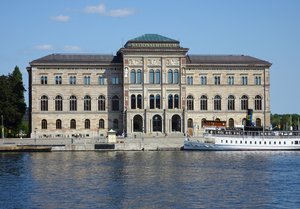
Behm’s presence in major Swedish institutions confirms his standing within the tradition of landscape painting. The Nationalmuseum in Stockholm holds a significant portion of his output, including the 1900 work Vinterdag and the 1917 painting Vinterafton. His ability to capture specific atmospheric conditions is evident in the collection's holdings, which also include Strawstack, Landscape Study, Sjöbod, Trosa Archipelago, Archipelago Jetty, Cottage in Autumn Mood, and Winter Evening. These works demonstrate a consistent focus on the Swedish landscape and the nuances of light.
Beyond Stockholm, his reach extends to other regional collections that preserve his specific approach to color and light. The Gothenburg Art Museum maintains Marsafton, painted in 1904. Additionally, the Norrköping Art Museum holds his paintings titled Landscape and Farm. These pieces represent the tangible remains of a career dedicated to the observation of the natural world, specifically the middle Swedish landscape during periods of seasonal transition and twilight.