


1


Kasım 2026 tarihinde güncellendi · popülerlik puanımıza göre sıralanmıştır (her bir eser için aramalar, ziyaretler ve siparişler) · 3 eser Viggo Rørup kataloğumuzda
Özetle
Viggo Rørup tarafından yapılmış en ünlü eser The Artist's Wife Reading (1949)'dir. Bu eseri Kopenhag şehrindeki Statens Museum For Kunst içinde bulabilirsiniz. Listede sıradaki isimler The Artist's Wife Sewing (1948) ve Forest Path (1949). Kataloğumuzda Viggo Rørup tarafından yapılmış 3 eser bulunmaktadır; bu rehber, her bir eserin yılı, bulunduğu müze ve hikayesiyle birlikte en çok bilinen 3 parçayı seçip sunmaktadır.
Bu sayfadaki tabloların büyük bir kısmına ev sahipliği yapan müze.
| Müzeler | Şehir | Viggo Rørup Eserleri | Bu listedeki tablolar |
|---|---|---|---|
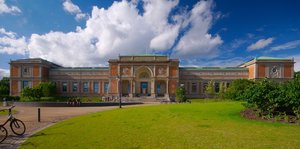 Statens Museum For Kunst |
Kopenhag | 3 | The Artist's Wife Reading, The Artist's Wife Sewing, Forest Path |
1948 ile 1949 arası: burada tarihli her Viggo Rørup eseri sadece 2 yıla sığdırılmıştır. Yıllara göre inceleyin.
Eserleri görmek için bir yıl seçin.

Listenin başında Statens Museum For Kunst, Kopenhag, The Artist's Wife Reading (1949) yer alıyor. Hemen ardından ise The Artist's Wife Sewing (1948) ve Forest Path (1949) geliyor.
46 yaşında. Viggo Rørup, 1903 yılında doğmuştur ve The Artist's Wife Reading, 1949 yılına aittir.
Kataloğumuzda 1948 ile 1949 tarihleri arasında değişen, Viggo Rørup tarafından yapılmış 3 eser bulunmaktadır.
Çoğunu Statens Museum For Kunst (Kopenhag) içerisinde bulabilirsiniz. Yukarıdaki müze listesi tüm detayları içermektedir.
1949 döneminde, diğer tüm zamanlardan daha fazla: Bu sayfadaki 3 eserin 2 tanesi o döneme aittir, bunların içinde The Artist's Wife Reading adet bulunmaktadır.
Buradaki en eski eser The Artist's Wife Sewing (1948); en yeni eser ise The Artist's Wife Reading (1949).
Statens Museum For Kunst, Kopenhag bünyesinde yer alan The Artist's Wife Reading, The Artist's Wife Sewing ve Forest Path dahil olmak üzere, bu sayfada 3 adet eser görebilirsiniz.
Viggo Rørup enters the scene in Kalundborg, Denmark, born on 12 September 1903. His path leads toward the formal rigor of the Royal Danish Academy of Fine Arts. Between 1927 and 1930, he undergoes his professional training within the academy's walls. He studies under the guidance of Ejnar Nielsen and Sigurd Wandel, absorbing the technical foundations that will define his early years as a painter.
Life and art become intertwined in 1937. He marries the artist Ellen Krause, a woman who shares his vocation. The union forms a partnership of creators, as she becomes known as Ellen Krause Rørup. This connection places him firmly within a circle of fellow painters, anchoring his personal life to the professional landscape of the Danish art scene.
In 1927, the landscape of northwestern Zealand begins to shift as Viggo Rørup moves into a house in Kårup Bakker. This move places him at the heart of the Odsherred Painters, an artists' colony that would define much of his professional life. He enters this circle as one of the first members, joining a group that includes Karl Bovin and Kaj Ejstrup. The community settles into the local terrain, turning their backs on the abstract movements of the city to focus on the immediate reality of the Danish countryside.
His connection to these circles deepens through both professional and personal ties. In 1937, he marries the artist Ellen Krause, who is also a member of the Odsherred Painters. Their lives and work become intertwined within this specific geographic and creative enclave. Beyond the local colony, Rørup maintains a presence in the broader Danish art scene. From 1942, he is a member of the Corner artists association, exhibiting alongside other established figures. His influence extends into the administrative side of the art world through his role as a board member of Kunst for varer.
The early works of Viggo Rørup carry a heavy, dark quality. During this initial phase, his focus remains fixed on the human form, working primarily as a figure painter. This concentration on portraits and people persists until 1940, when his artistic scope begins to shift toward the natural world.
A pivotal change occurs following a period spent in France. The influence of the French landscape and light transforms his approach; the somber tones of his youth give way to a brighter palette and more intense colors. This shift marks a transition from his earlier preoccupation with figures toward a broader interest in landscapes and still lifes. His brushwork begins to form a complex webbing of light and shade, moving toward an impressionistic style that occasionally approaches pointillism.
The 1950s bring a period of movement. Rørup travels extensively through Europe, visiting England, Italy, Greece, and Morocco. These excursions serve as a source of constant visual input, as he produces a vast collection of drawings and sketches across various countries. His work remains tied to the observation of his surroundings, whether through the structured composition of a still life or the shifting light of a landscape.
The early works of Rørup carry a heavy, somber quality, defined by a dark palette. This gravity shifts abruptly following his time in France. The influence of the Impressionists transforms his approach, replacing shadows with a bright, intense application of color. He begins to construct a complex webbing of light and shade across the canvas, moving away from the muted tones of his youth toward a more luminous execution.
By the 1940s, his technique settles into a distinct Impressionistic mode. The brushwork becomes more deliberate, at times approaching the structured application of Pointillism. This evolution marks a departure from the strict naturalist painting favored by the Odsherred Painters, even as he remains tied to their focus on the landscape. His compositions capture the interplay of light through a fragmented, rhythmic application of pigment.
The public debut of Viggo Rørup occurs in 1928 at the Kunstnernes Efterårsudstilling. This early appearance marks the beginning of a career that moves through the Danish art scene, eventually finding a place at Charlottenborg. His presence in the exhibition circuit extends far beyond the borders of Denmark. His canvases travel to Rostock, Stockholm, and Ukraine, reaching audiences across Northern and Eastern Europe.
His later output remains tied to the landscape of his home. One significant work, Rødvinsselskabet (1967), resides within the collection of the Odsherreds Kunstmuseum. This piece, alongside his other compositions, reflects the shift in his visual language that occurred after his travels. His work continues to be a point of interest for regional museums, such as when Rødvinsselskabet was featured in the Hverdagen er en fest exhibition at the Odsherreds Museum.
