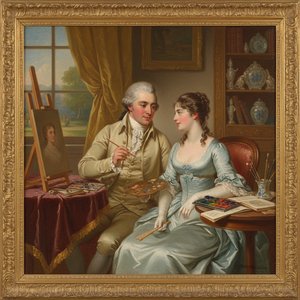
The Master of Scottish Baroque: The Life and Legacy of Richard Waitt
In the twilight of the seventeenth century, amidst the burgeoning artistic identity of Scotland, a painter emerged who would capture the very soul of an era defined by political upheaval and aristocratic splendor. Richard Waitt, born in Edinburgh on January 24, 1684, was more than a mere chronicler of faces; he was a virtuoso of the Baroque style, capable of translating the complex tensions of the Jacobite Succession Crisis onto canvas. His life, though shrouded in the typical silences of eighteenth-century archival records, reflects a journey from the decorative arts to the heights of prestigious portraiture, leaving behind a visual legacy that resonates with both psychological depth and technical brilliance.
The foundations of Waitt’s artistry were laid through rigorous apprenticeship, a period that shaped his ability to manipulate light and shadow with profound intent. While some accounts suggest he was taught by John Scoular, the influence of John Michael Ruffinelli—a Venetian painter—is deeply etched into the DNA of his work. From this lineage, Waitt inherited the grand traditions of the Baroque: the dramatic use of chiaroscuro, the pursuit of idealized forms, and a meticulous devotion to texture. This training allowed him to transcend the simple task of recording likenesses, enabling him to sculpt figures out of darkness and imbue his subjects with an almost palpable presence.
A Canvas of Nobility and Character
As Waitt’s reputation grew, so did the scale of his ambitions. He transitioned from a decorative painter focused on the delicate nuances of still lifes to a sought-after portraitist for the Scottish elite. His career was marked by an extraordinary ability to navigate the social hierarchies of his time, securing commissions from some of the most influential families in Scotland. Through his brush, the Earls of Wemyss and Ellesmere and Lord Keith were transformed into enduring icons of dignity and power.
What distinguishes Waitt’s oeuvre is not merely the opulence of the attire he depicted, but his profound sensitivity to the human condition. His portraits are characterized by:
- Psychological Nuance: A rare ability to capture the inner character and emotional state of his sitters, moving beyond superficial beauty to reveal a nuanced interiority.
- Technical Precision: A smooth, precise brushwork that achieved remarkable realism in the rendering of fine fabrics, lace, and skin tones.
- Dramatic Composition: The masterful use of light to create a sense of movement and theatricality, a hallmark of the Venetian-influenced Baroque style.
One of his most intimate glimpses into his own artistic consciousness is found in his Self Portrait from circa 1728. In this work, we see the artist not just as a craftsman, but as a storyteller, presenting himself alongside his tools and creations, bridging the gap between the creator and the subject.
Historical Significance and Enduring Impression
The historical weight of Richard Waitt’s work lies in its role as a visual record of a transformative period in Scottish history. As the nation grappled with the political tremors of the Jacobite era, Waitt provided a sense of continuity and grandeur. His paintings of figures such as Provost Cuthbert, Lord Keith, and Charles, Ninth Lord Elphinstone serve as windows into the social fabric of the early eighteenth century, documenting the faces of those who shaped the destiny of the realm.
Though his life came to an end in 1732, the impact of his artistry remains undiminished. Waitt’s ability to marry the dramatic flair of Continental Baroque with a uniquely Scottish sensibility ensured his place in the pantheon of great portrait painters. He did not merely paint the aristocracy; he immortalized their era, capturing the fleeting elegance of a world on the brink of profound change.
Soru & Cevap
Richard Waitt adlı sanatçıya ait incelemek için kaç adet sanat eseri mevcut?
Tüm Eserler sayfasında Richard Waitt imzalı 15 sanat eseri eseri inceleyebilirsiniz.
Richard Waitt hangi tarihi dönemde eser vermiştir?
Richard Waitt, Early Modern döneminde çalışmalarını sürdürmüştür. Bu dönem, sanatçının faaliyetlerini tarihsel bir bağlama oturtur.
Richard Waitt için kronolojik bir döküm mevcut mu?
Richard Waitt sanatçısının Kronoloji sayfası, sanatçının eserlerini kariyer dönemlerine göre gruplandırılmış bölümler halinde kronolojik sırayla sunan, kaydırmaya duyarlı bir zaman çizelgesidir.