The Master of the Swedish Portrait: The Life and Legacy of Bernhard Österman
In the golden era of European portraiture, few names captured the quiet elegance and psychological depth of the Swedish aristocracy as gracefully as Gustaf Bernhard Österman. Born on January 11, 1870, in the tranquil parish of Västra Vingåker, Österman’s journey from a small Swedish province to the vibrant, light-filled studios of Paris is a testament to a profound artistic vocation. Alongside his twin brother, Emil, Bernhard emerged from a family rooted in craftsmanship—the son of a dye master—to become a central figure in the late 19th and early 20th-century art scene. His early years were marked by a rigorous preparation at the Tekniska skolan, driven by a desire to follow his brother’s footsteps into the prestigious Royal Swedish Academy of Fine Arts. It was here, between 1892 and 1895, that the foundations of his technical mastery were laid, as he honed his ability to translate the human spirit onto canvas through meticulous observation and a burgeoning command of light.
While his early academic training leaned toward the grand narratives of history painting, Österman’s true destiny lay in the intimate realm of the portrait. This transition was not merely a change in subject matter but a profound evolution in artistic intent. Seeking to expand his horizons beyond the borders of Sweden, he embarked on a transformative period of travel between 1897 and 1901, traversing the cultural landscapes of the Netherlands, Belgium, France, Italy, and Germany. These journeys exposed him to the diverse textures of European life and the sophisticated techniques of continental masters. However, it was his move to Paris that truly ignited his international success. In the heart of the art world, Österman found the freedom to refine a style that blended classical precision with a modern, atmospheric sensibility, eventually earning him membership in the prestigious Société Nationale des Beaux-Arts.
A Tapestry of Light and Elegance
The work of Bernhard Österman is characterized by an exquisite ability to weave together texture, light, and character. His portraits are rarely mere likenesses; they are evocative studies in status, emotion, and the ephemeral beauty of a moment. One can observe this most strikingly in his larger-than-life compositions, such as Temptation, where he utilizes the theatrical setting of a Venetian ridotto to explore themes of seduction and social intrigue. In such works, the artist demonstrates a breathtaking command over material reality—the shimmering sheen of a golden gown, the delicate intricacy of black patterned lace, and the soft, globular glow of lanterns that illuminate a masked noblewoman. His use of light does more than provide visibility; it creates a sense of drama and psychological depth, pulling the viewer into the private worlds of his subjects.
Beyond the grand theatricality of his Venetian scenes, Österman’s repertoire includes deeply personal works that reflect his connection to his roots and family. His portraits of loved ones, such as Hilda Österman, showcase a different facet of his talent: a capacity for capturing calm sophistication and quiet intimacy. This versatility—moving from the opulent, historical atmosphere of European high society to the tender, domestic realism of Swedish life—is what defines his unique contribution to the era. His technical skill was further enriched by private studies in etching under the guidance of Axel Tallberg, an influence that likely contributed to the refined line work and tonal complexity found throughout his oil paintings.
Recognition and Historical Significance
The career of Bernhard Östiente was marked by a series of prestigious accolades that solidified his standing within the international art community. His ability to captivate audiences was recognized far beyond Scandinavia, earning him medals at the Louisiana Purchase Exhibition in 1904, the Munich Fine Art Exhibition in 1905, and the Baltic Exhibition in 1914. These honors were accompanied by significant exhibitions in major cultural hubs such as London, Philadelphia, and Washington, D.C., ensuring that his vision of Swedish elegance reached a global stage. His professional life was also defined by high-level service to his nation; his appointment as a hovintendent at the Royal Court of Sweden and later as an överintendent (curator) speaks to the immense respect he commanded within the Swedish institutional framework.
Today, the legacy of Bernhard Österman lives on through the enduring presence of his works in some of the world's most esteemed collections. His paintings serve as vital historical documents, capturing the fashion, social hierarchies, and aesthetic ideals of a bygone era. The preservation of his artistic output is ensured by institutions such as:
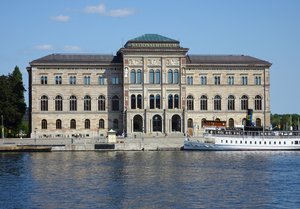
- The Nationalmuseum in Stockholm, which holds significant examples of his portraiture.
- The Gothenburg Museum of Art, showcasing his mastery of form and color.
- The Sörmlands Museum in Nyköping, where his widow, Hilda, donated much of his remaining work.
- Uppsala University and Skokloster Castle, which house pieces that reflect his connection to Swedish heritage.
As we look back upon his life, from the streets of Stockholm to the studios of Paris, we see an artist who successfully bridged the gap between tradition and modernity. Bernhard Österman did not merely paint faces; he painted the very essence of an era, leaving behind a luminous trail of canvases that continue to enchant the modern eye with their timeless grace.