
- Ana Sayfa

- Makaleler
- William Herbert Allen: Capturing Atmospheric Light & the Essence of American Impressionism
William Herbert Allen: Capturing Atmospheric Light & the Essence of American Impressionism
İçindekiler
Early Life & Artistic Foundations: From Surrey Landscapes to Royal College Training
William Herbert Allen (1863–1943) was an English landscape watercolour artist whose career spanned more than 50 years from the 1880s to the 1940s. He was invariably referred to as "W. H." rather than by his given name. Born 14 September 1863 in West ...
William Herbert Allen, invariably known as “W.H.” rather than by his given name, emerged from a distinctly English artistic milieu in the latter half of the 19th century. Born in West Brompton, London, in 1863, his roots lay in the picturesque countryside of Alton, Hampshire – a landscape that would indelibly shape his artistic vision. This early connection to the rolling hills and pastoral scenes of Surrey wasn’t merely geographical; it was formative, instilling within him a deep appreciation for the subtleties of light, atmosphere, and the quiet beauty of rural life. Allen's path led him to the Royal College of Art in 1884, a pivotal moment that provided both technical grounding and exposure to the burgeoning artistic currents of the time. While the Academy emphasized traditional skills, it was under the influence of Thomas Armstrong, a disciple of William Morris and the Arts and Crafts movement, that Allen’s aesthetic sensibilities truly began to coalesce. This early training fostered a commitment to observation, meticulous detail, and an appreciation for craftsmanship – qualities that would define his work throughout his prolific career.
The Farnham School of Art Years: A Director's Influence on Regional Identity
 william herbert allen
Explore the evocative landscapes & historical narratives of William Herbert Allen’s photography. A significant figure in American West imagery, his work captures a bygone era.
In 1889, Allen assumed the directorship of the Farnham School of Art in Surrey, a position he held for nearly two decades until his retirement in 1927. This wasn’t simply an administrative role; it was a transformative period where Allen became a central figure in shaping the artistic landscape of the region. He didn't merely teach technique but cultivated a deep understanding and appreciation for the local environment, encouraging students to find beauty in the everyday scenes surrounding them. His influence extended beyond the classroom, fostering a sense of community among artists and promoting the depiction of West Surrey’s traditions and people. Allen’s commitment to preserving the character of the countryside coincided with a period of rapid industrialization, making his work particularly poignant – a visual record of a way of life on the cusp of change. He commissioned Harold Falkner to design “Strangers Corner”, his home in Tilford Road, which became both a studio and a testament to his dedication to local architecture and preservation.
Mastering Impressionism: Brushwork, Color, and the Pursuit of Atmospheric Perspective
 Wikipedia: American Impressionism
American Impressionism was a style of painting related to European Impressionism and practiced by American artists in the United States from the mid-nineteenth century through the beginning of the twentieth. The style is characterized by loose brushw...
While firmly rooted in traditional techniques, Allen’s work increasingly embraced the principles of Impressionism. He wasn't a radical innovator like Monet or Renoir; rather, he adapted the style to his own sensibilities, focusing on capturing the fleeting effects of light and atmosphere. His paintings are characterized by loose brushwork – not haphazardly applied, but deliberate strokes that convey texture, movement, and the play of sunlight across surfaces. Allen’s palette often featured muted tones, creating a sense of serenity and tranquility, though he was equally adept at employing brighter contrasting colors to evoke specific moods or highlight particular details. Crucially, Allen mastered aerial perspective, skillfully rendering distance through subtle shifts in color saturation and contrast – distant objects appearing paler and bluer as they receded into the horizon. This technique, evident in works like “Snailslynch Kilns by the Wey, Farnham”, creates a remarkable sense of depth and realism.
Beyond Surrey: Allen’s Continental Travels and Expanding Subject Matter
 The Minstrel
Discover 'The Minstrel' by William Herbert Allen – an impressionistic landscape painting of a serene Italian villa & fountain. Explore romanticism & visible brushstrokes in this captivating artwork.
Allen's artistic journey wasn’t confined to the English countryside. Numerous trips to continental Europe broadened his horizons and introduced new subject matter into his repertoire. While Italy proved particularly inspiring, influencing works like “The Minstrel” with its depiction of a serene villa and fountain, he also painted scenes from other parts of Britain and beyond. These travels weren't merely about acquiring picturesque motifs; they were opportunities to refine his technique, experiment with different approaches to light and color, and deepen his understanding of artistic traditions. His ability to seamlessly integrate these influences into his existing style demonstrates a remarkable versatility and intellectual curiosity. Even when depicting foreign landscapes, Allen retained his characteristic focus on capturing the essence of place – the unique atmosphere, the quality of light, and the subtle details that defined each location.
A Legacy in Watercolors: Themes of Tradition & a Bygone Era
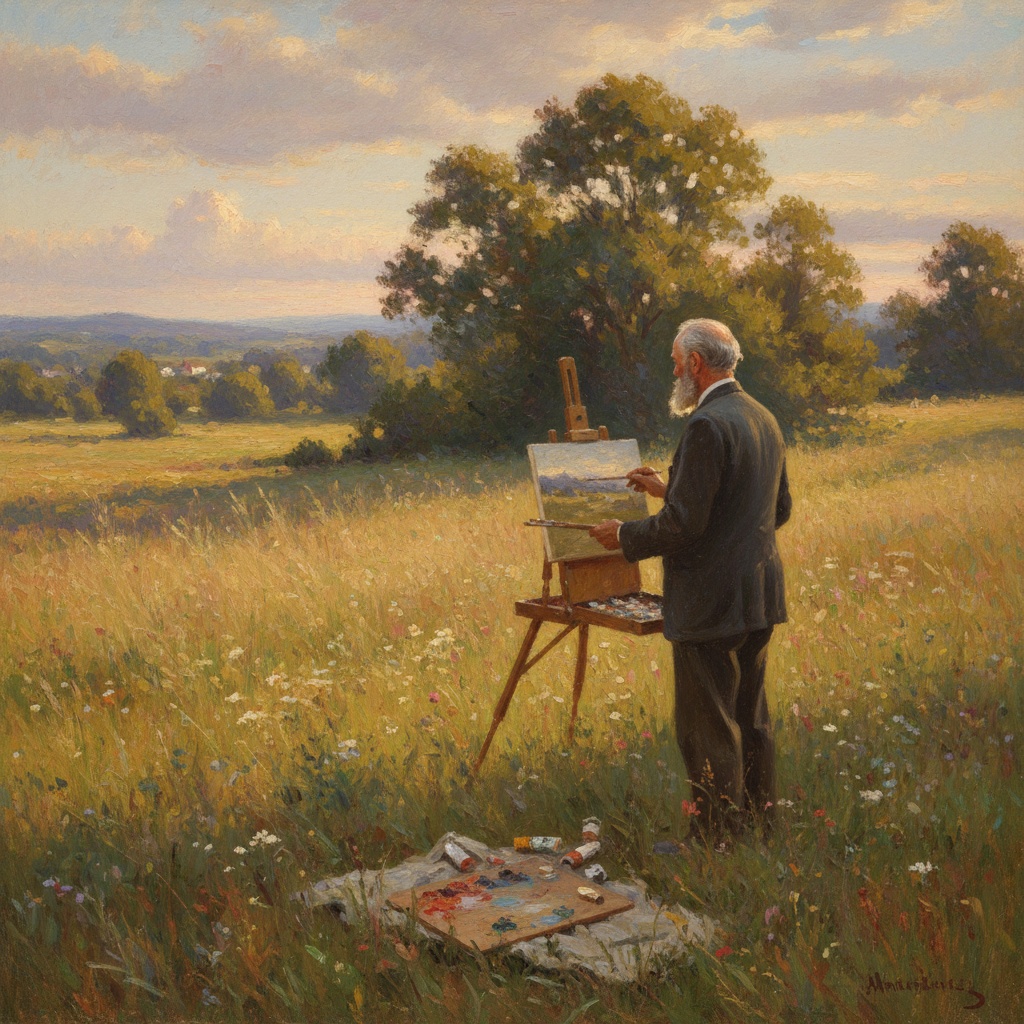
Throughout his fifty-year career, William Herbert Allen produced an astonishing number of watercolors, chalk sketches, and pencil drawings – thousands of works documenting the landscapes, traditions, and people of West Surrey and North-east Hampshire. His paintings weren’t simply aesthetic exercises; they were acts of preservation, capturing a way of life that was rapidly disappearing. Allen's self-portrait reveals a confident man, embodying the traditional studio artist, yet his broader oeuvre speaks to a deeper engagement with the world around him. He embraced many styles and techniques from vivid watercolours to more traditional oils, but always returned to his core themes: the beauty of nature, the dignity of rural life, and the importance of preserving cultural heritage. Today, Allen’s work offers a valuable glimpse into a bygone era, reminding us of the power of art to capture not just what is seen, but also what is lost. Discover more about William Herbert Allen and explore his captivating collection at ArtsDot.com.
İlgili Makaleler

Albert Charles Lebourg: A Study in Atmospheric Impressionism & Rural France
Explore the serene landscapes of Albert Charles Lebourg, a master of the Rouen School Impressionists. Discover his atmospheric paintings of the Seine and enduring legacy in 19th-century French art.

Maxime Maufra: Capturing Atmospheric Luminosity in Post-Impressionist Landscapes
Discover the captivating landscapes of Maxime Maufra, a key figure in Post-Impressionism. Explore his mastery of light, atmosphere & connection to the Pont-Aven School. Learn about collecting his work at ArtsDot.

Ephemeral Visions: Exploring the History & Emotional Resonance of Watercolor Painting
Explore the captivating history of watercolor painting, from ancient techniques to modern masters like Kandinsky & Blake. Discover essential artists, collecting tips & the emotional power of this luminous medium. Expert insights for art enthusiasts.

Ephemeral Echoes: Exploring the Aesthetic & Historical Significance of Vintage Watercolor Painting
Explore the captivating world of vintage watercolor painting! Discover its rich history, techniques, influential artists & collecting tips. Expert insights for enthusiasts and collectors at ArtsDot.

Ephemeral Visions: Exploring the Artistic Legacy & Contemporary Practice of Watercolor Painting
Explore the captivating world of watercolor painting! Discover its rich history, essential techniques, influential artists & collecting tips. A comprehensive guide for art enthusiasts from ArtsDot.

