The Rise of SAMO: Basquiat’s Early Provocations & New York Roots
 Jean-Michel Basquiat
Explore the raw energy & social commentary of Jean-Michel Basquiat's neo-expressionist paintings. From NYC graffiti to museum masterpieces, discover his iconic style and legacy.
Jean-Michel Basquiat exploded onto the art scene with a force rarely witnessed, yet his origins weren't in the hallowed halls of academia but on the vibrant, often chaotic streets of 1970s New York City. Before the gallery shows and international acclaim, there was SAMO© – an enigmatic tag scrawled across Lower Manhattan, a collaborative project with Al Diaz that served as Basquiat’s initial foray into public discourse. SAMO wasn't merely graffiti; it was poetic intervention, cryptic pronouncements challenging societal norms and questioning the very fabric of urban life. These weren’t random acts of vandalism but carefully constructed epigrams designed to provoke thought, often laced with biting social commentary and a nascent exploration of identity. The energy of this period – a confluence of disco, punk, hip-hop, and street culture – fundamentally shaped Basquiat's artistic vocabulary. He absorbed the city’s pulse, its raw edges and intellectual currents, transforming them into a unique visual language that would soon captivate the art world.
The Lower East Side was a crucible of creativity, and Basquiat thrived within it. He wasn’t simply observing; he was actively participating in a dialogue with the city itself. This early work laid the foundation for his later paintings, establishing a preoccupation with language, symbolism, and the power dynamics inherent in urban spaces. The anonymity afforded by SAMO allowed him to experiment freely, developing a distinctive style characterized by bold lines, fragmented text, and an almost primal energy that would become his signature.
Neo-Expressionism & The Rejection of Minimalism: Contextualizing Basquiat's Style
Neo-expressionism is a style of late modernist or early-postmodern painting and sculpture that emerged in the late 1970s. Neo-expressionists were sometimes called Transavantgarde, Junge Wilde or Neue Wilden ('The new wild ones'; 'New Fauves' would be...
By the early 1980s, the art world was undergoing a seismic shift. The cool detachment of Minimalism and Conceptual Art – movements that prioritized ideas over aesthetics – had begun to wane, giving way to a renewed interest in emotional expression and subjective experience. This resurgence found its voice in Neo-Expressionism, a style characterized by intense subjectivity, rough handling of materials, and a return to figuration. Basquiat emerged as one of the movement’s most compelling figures, though his work defied easy categorization.
While sharing common ground with other Neo-Expressionists – artists like Julian Schnabel and David Salle – Basquiat brought a unique perspective informed by his background in graffiti and his engagement with African American culture. He rejected the pristine surfaces and intellectual rigor of previous movements, embracing instead a raw, visceral aesthetic that mirrored the energy of the streets. His canvases are often described as ‘talking,’ layered with text, symbols, and images that create a dynamic, almost chaotic composition. This deliberate fragmentation wasn’t simply stylistic; it reflected his interest in deconstructing established narratives and challenging conventional notions of beauty and representation. The influence of German Expressionism is palpable – the distorted figures, bold colors, and emotional intensity all echo the work of artists like Emil Nolde and Ernst Ludwig Kirchner – but Basquiat infused this legacy with a distinctly American sensibility.
Deconstructing Identity: Race, Class, and the Black Experience in Basquiat’s Work
 Untitled (ernok)
Explore Jean-Michel Basquiat’s "Untitled (ernok)\”: a vibrant, chaotic abstract masterpiece blending urban energy & social commentary. Discover its bold colors, dynamic lines & historical significance.
Central to understanding Basquiat's art is his exploration of identity—specifically, the complexities of being Black in America. His paintings are not simply representations of Black figures; they are interrogations of race, class, and power dynamics within a society steeped in historical injustice. He frequently depicted African American heroes – boxers like Muhammad Ali and musicians like Charlie Parker – elevating them to iconic status while simultaneously confronting stereotypes and challenging dominant narratives.
Untitled (ernok), for example, is a vibrant explosion of color and form that speaks to the energy and resilience of Black culture. The fragmented figures and layers of text create a sense of urgency, reflecting the challenges faced by marginalized communities. Basquiat didn’t shy away from difficult subjects; he confronted issues of racism, poverty, and police brutality head-on, often using his art as a form of social protest. His work is imbued with a sense of personal experience – growing up in Brooklyn, navigating a predominantly white art world, and grappling with his own identity – but it also speaks to the broader struggles of African Americans throughout history.
Symbolic Language & Visual Narratives: Crowns, Text, and Anatomical Forms
 Snakeman
Explore Jean-Michel Basquiat’s ‘Snakeman’ – a chaotic Neo-Expressionist masterpiece! Layers of red, text & symbols capture raw energy & social commentary. #Basquiat #Art
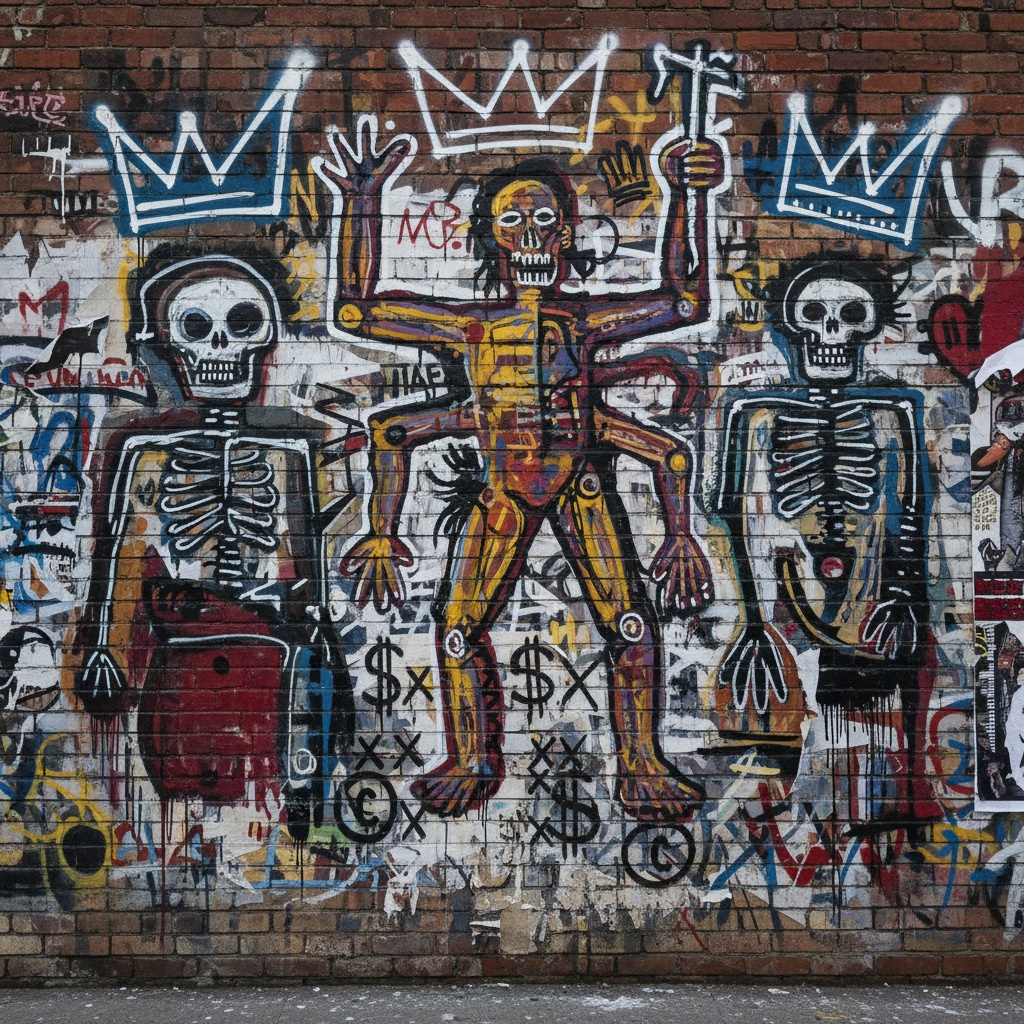
Basquiat’s paintings are rich with symbolism, creating a visual language that is both deeply personal and universally resonant. The crown motif, perhaps his most recognizable symbol, is particularly significant. It represents not simply royalty but also dignity, self-worth, and the reclaiming of Black identity. He often placed crowns atop the heads of African American figures, challenging conventional notions of power and elevating them to a position of authority.
Text plays an equally important role in his work. He incorporated words, phrases, and diagrams into his paintings, creating layers of meaning that invite interpretation. These aren’t simply labels; they are fragments of thought, poetic pronouncements, and historical references that add depth and complexity to the composition. The recurring use of anatomical drawings – skeletons, skulls, and internal organs – speaks to mortality, vulnerability, and the human condition. Snakeman, with its chaotic layers of red, text, and symbols, exemplifies this approach, capturing a raw energy that is both unsettling and captivating. The deliberate juxtaposition of these elements creates a visual narrative that challenges viewers to confront uncomfortable truths about society and themselves.
Power Dynamics & Social Commentary: Challenging Institutional Structures
 Logo, private
Explore Jean-Michel Basquiat’s chaotic 1984 collage – a vibrant red explosion of figures & text reflecting consumerism, race, and social commentary. Neo-expressionist masterpiece.
Logo, private, created in 1984, exemplifies Basquiat’s incisive social commentary. The vibrant red explosion of figures and text reflects a critical examination of consumerism, race, and the commodification of art itself. He wasn't simply creating beautiful objects; he was challenging the very structures that defined the art world – its hierarchies, biases, and power dynamics.
Basquiat’s work often critiques institutional racism and the historical erasure of Black voices. He incorporated references to slavery, colonialism, and segregation into his paintings, forcing viewers to confront uncomfortable truths about America's past. His use of language is particularly effective in this regard – he frequently crossed out words or phrases, creating a sense of tension between revealing and concealing meaning. This deliberate ambiguity reflects the complexities of identity and the challenges faced by marginalized communities. He questioned the authority of museums, galleries, and art critics, challenging them to acknowledge the contributions of Black artists and dismantle systemic barriers.
Basquiat's Enduring Legacy: Influence on Contemporary Art & Beyond
Despite a tragically short career – he died at the age of 27 in 1988 – Jean-Michel Basquiat left an indelible mark on contemporary art. His work continues to inspire artists, activists, and scholars alike, challenging conventional notions of beauty, representation, and power. He paved the way for a more diverse and inclusive art world, opening doors for future generations of Black artists.
Basquiat’s influence can be seen in the work of countless contemporary painters who embrace his raw aesthetic, symbolic language, and social commentary. His paintings command record-breaking prices at auction, but his legacy extends far beyond the market. He remains a powerful symbol of resistance, creativity, and the enduring struggle for racial justice. At ArtsDot.com, we are proud to offer high-quality reproductions of Basquiat’s iconic works, allowing you to experience his art firsthand and engage with his powerful message.