

Édouard Manet: Pioneering Modernism & Challenging Artistic Conventions
İçindekiler
Early Life & Artistic Formation: From Naval Aspirations to Couture’s Atelier
 Wikipedia: Édouard Manet
Édouard Manet (UK: , US: ; French: [edwaʁ manɛ]; 23 January 1832 – 30 April 1883) was a French modernist painter. He was one of the first 19th-century artists to paint modern life, as well as a pivotal figure in the transition from Realism to Impress...
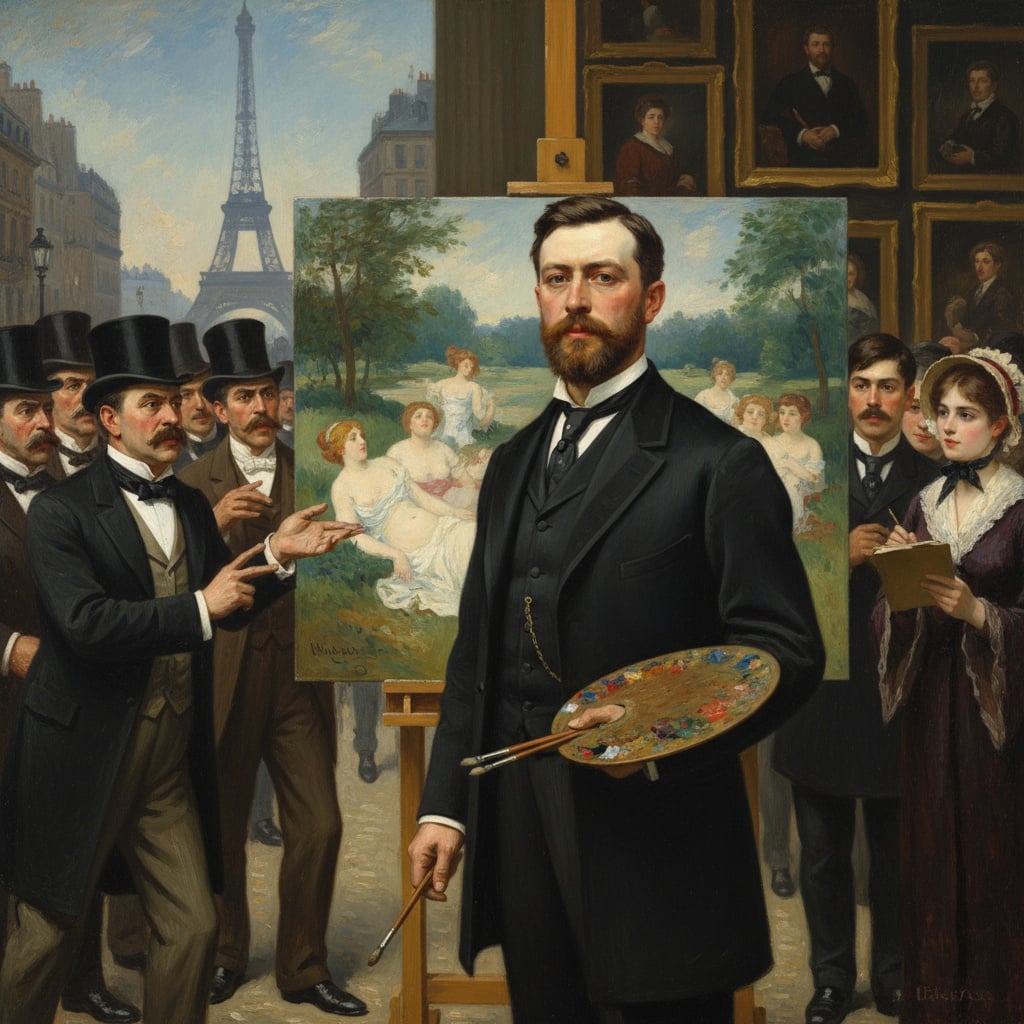
Édouard Manet, born into a respectable Parisian family in 1832, initially seemed destined for a life far removed from the world of art. His father, Auguste, envisioned a career at sea for his son, reflecting the societal expectations of the time. However, two unsuccessful attempts to enter naval school proved pivotal, revealing Édouard’s true calling – a passion that would ultimately redefine the landscape of 19th-century painting. His uncle, Edmond Fournier, recognizing and nurturing this nascent talent, introduced him to the artistic treasures housed within the Louvre, sparking an early fascination with the Old Masters. In 1850, Manet entered the studio of Thomas Couture, a prominent academic painter known for his historical and allegorical works. While he diligently absorbed the technical skills imparted by Couture – meticulous draftsmanship, careful composition, and a mastery of form – a fundamental tension arose. Manet’s spirit chafed against the rigid conventions of the Académie des Beaux-Arts, finding himself increasingly drawn to the immediacy and vibrancy of contemporary life rather than the idealized narratives favored by his teacher.
The Salon Scandals: 'Le Déjeuner sur l'herbe' and 'Olympia' – Shocking the Establishment
 Édouard Manet
Explore Édouard Manet (1832-1883), a pivotal figure bridging Realism & Impressionism. Discover iconic works like 'Le Déjeuner sur l'herbe' and 'Olympia,' and his lasting impact on modern art.
Manet’s early ambition was not to reject art, but to modernize it. This intention manifested most dramatically in his submissions to the Paris Salon, the official exhibition that dictated artistic success. In 1863, Le Déjeuner sur l'herbe (The Luncheon on the Grass) ignited a firestorm of controversy. The painting depicted a nude female figure casually picnicking with two fully clothed men in a park setting – a brazen departure from traditional depictions of nudes which were typically cloaked in mythological or allegorical justification. Its frank portrayal of contemporary figures, coupled with its unconventional composition and direct gaze of the woman towards the viewer, shattered academic norms. The Salon rejected it initially, but Manet defiantly exhibited it at the Salon des Refusés, an exhibition for works rejected by the official jury. Three years later, Olympia proved even more scandalous. Inspired by Titian’s *Venus of Urbino*, Manet replaced the idealized goddess with a contemporary Parisian courtesan, her gaze unapologetically direct and challenging. The painting was met with outrage, derision, and accusations of indecency. These works weren't merely paintings; they were statements – bold challenges to the established order that forced viewers to confront uncomfortable truths about society and representation.
Manet’s Revolutionary Technique: Visible Brushstrokes, Flattened Perspective, and Modern Subject Matter
Impressionism was a 19th-century art movement characterized by visible brush strokes, open composition, emphasis on accurate depiction of light in its changing qualities (often accentuating the effects of the passage of time), ordinary subject matter...
Beyond subject matter, Manet’s technique was profoundly innovative. He deliberately abandoned the smooth, blended brushwork prized by academic painters in favor of a looser, more visible application of paint. This wasn't carelessness; it was a conscious effort to capture the fleeting effects of light and atmosphere, anticipating the concerns of the Impressionists. He flattened perspective, reducing depth and emphasizing the two-dimensionality of the canvas – a rejection of the illusionistic space that had dominated painting for centuries. His color palette, while not as vibrant as those of Monet or Renoir, was nonetheless striking in its simplicity and directness. He often employed stark contrasts between light and shadow, creating a sense of immediacy and realism. Crucially, Manet’s focus remained firmly rooted in the modern world. He painted scenes of Parisian cafes, boulevards, theaters, and portraits of his contemporaries – subjects previously considered unworthy of serious artistic attention. This commitment to depicting contemporary life, with all its complexities and contradictions, was a defining characteristic of his work.
Bridging Realism & Impressionism: Manet’s Unique Position in Art History
While often categorized as an Impressionist, Manet occupies a more complex position within the history of art. He predated the formal emergence of the Impressionist movement and, importantly, never fully embraced their plein-air approach to painting. He continued to work primarily in his studio, carefully composing scenes that were less about capturing fleeting moments and more about exploring the psychological dynamics between figures and challenging conventional representations. Manet’s influence on the Impressionists was undeniable; artists like Monet, Renoir, and Degas admired his boldness and willingness to break with tradition. He provided a crucial link between the Realist concerns of Gustave Courbet – portraying contemporary life with honesty and accuracy – and the Impressionists' focus on light and color. He paved the way for their experimentation by demonstrating that it was possible to paint modern subjects with artistic integrity and intellectual rigor, even in defiance of academic expectations.
Portraying Parisian Life: Themes of Leisure, Society, and Psychological Depth
 Boating, Metropolitan Museum of Art, New York
Experience Édouard Manet’s "Boating" – a serene Impressionist masterpiece capturing leisure on the Seine. Explore its vibrant colors, symbolism & historical context at ArtsDot.
Boating, a serene depiction of leisure on the Seine, exemplifies Manet’s ability to capture the essence of modern Parisian life. The vibrant colors and loose brushwork hint at Impressionist influences, yet the carefully composed scene and psychological interplay between the figures reveal his unique sensibility. His portraits, such as Madame Auguste Manet, are equally compelling, offering intimate glimpses into the lives of his contemporaries. He wasn’t merely interested in depicting appearances; he sought to capture the inner lives of his subjects, their emotions, and their social context. His paintings often explored themes of class, gender, and morality, subtly challenging societal norms and prompting viewers to question their own assumptions. Even seemingly simple scenes, like Bouquet of Violets, reveal a sophisticated understanding of composition, color, and symbolism.
Legacy and Influence: Paving the Way for Future Generations of Artists
Édouard Manet’s impact on modern art is immeasurable. He didn't simply paint pictures; he challenged the very foundations of artistic convention, paving the way for future generations of artists to explore new forms of expression. His willingness to court controversy and his insistence on artistic integrity over public approval established a new model for the modern artist – one that prioritized personal vision over academic expectations. His influence can be seen in the works of countless painters who followed him, from the Impressionists and Post-Impressionists to the Fauves and Cubists. Today, Manet is celebrated as a pivotal figure in the transition from Realism to Impressionism, a revolutionary artist whose bold experimentation continues to inspire and challenge viewers. At ArtsDot.com, we are proud to offer high-quality reproductions of Manet’s masterpieces, allowing you to experience the beauty and innovation of his work firsthand.
İlgili Makaleler

Winston Churchill: Beyond Statesman – The Unexpected Life of a Passionate Painter
Discover the surprising artistic life of Winston Churchill! Explore his captivating paintings, influences, and unique style. Learn about collecting Churchill's art & its historical significance.


Echoes of Modernity: Exploring Themes & Innovations in 20th Century Art
Explore the pivotal themes & innovations of 20th Century Art. Discover key movements like Cubism & Expressionism with ArtsDot – handmade oil paintings and expert art insights for collectors.
ArtsDot.com SSS: Sanat Tarihinin İkonik Eserlerini Keşfetmek İçin Show Case Sayfası Rehberi
ArtsDot.com'da sanat tarihinin en ikonik eserlerini keşfedin. El yapımı yağlı boya reproduksiyonları, özel siparişler ve uzman danışmanlık hizmetiyle koleksiyonunuzu zenginleştirin. Ücretsiz kargo ve %100 memnuniyet garantisi!

