1


Ekim 2026 tarihinde güncellendi · popülerlik puanımıza göre sıralanmıştır (her bir eser için aramalar, ziyaretler ve siparişler) · 9 eser Adachi Ginko kataloğumuzda
Özetle
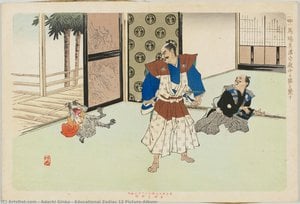
Adachi Ginko tarafından yapılmış en ünlü eser Educational Zodiac 12 Picture(Album) (1906)'dir. Bu eseri Tokyo şehrindeki Keio University Library içinde bulabilirsiniz. Listede sıradaki isimler Temporary Diet Assembly Hall, True Sight (1889) ve Educational Zodiac 12 Picture(Album). Kataloğumuzda Adachi Ginko tarafından yapılmış 9 eser bulunmaktadır; bu rehber, her bir eserin yılı, bulunduğu müze ve hikayesiyle birlikte en çok bilinen 9 parçayı seçip sunmaktadır.


In the delicate interplay of light and shadow found within Adachi Ginkō’s Educational Zodiac 12 Picture Album, we encounter a profound moment of communal connection captured through the masterful lens of late Meiji-era Ukiyo-e. This exquisite work, dating from 1908, transcends mere illustration to become a living tableau of social interaction and pastoral charm. At its heart, the painting presents a captivating scene: a central figure, perhaps a storyteller or…
Bu sayfadaki tabloların en büyük kısmına ev sahipliği yapan müze.
| Müze | Şehir | Adachi Ginko Eserleri | Bu listedeki tablolar |
|---|---|---|---|
 Keio University Library |
Tokyo | 9 | Educational Zodiac 12 Picture(Album), Temporary Diet Assembly Hall, True Sight, Educational Zodiac 12 Picture(Album) |
Adachi Ginko'in buradaki en eski ve en yeni tarihli eserleri arasında 20 yıl fark var; 1889 ve 1908. Bu kariyeri yıl yıl keşfedin.
Eserleri görmek için bir yıl seçin.
Listenin başında Keio University Library, Tokyo, Educational Zodiac 12 Picture(Album) (1906) yer alıyor. Hemen ardından ise Temporary Diet Assembly Hall, True Sight (1889) ve Educational Zodiac 12 Picture(Album) geliyor.
53 yaşında. Adachi Ginko, 1853 yılında doğmuştur ve Educational Zodiac 12 Picture(Album), 1906 yılına aittir.
Kataloğumuzda 1889 ile 1908 tarihleri arasında değişen, Adachi Ginko tarafından yapılmış 9 eser bulunmaktadır.
Çoğunu Keio University Library (Tokyo) içerisinde bulabilirsiniz. Yukarıdaki müze listesi tüm detayları içermektedir.
1908 döneminde, diğer tüm zamanlardan daha fazla: Bu sayfadaki 9 eserin 6 tanesi o döneme aittir, bunların içinde Educational Zodiac 12 Picture(Album) adet bulunmaktadır.
Buradaki en eski eser Temporary Diet Assembly Hall, True Sight (1889); en yeni eser ise Educational Zodiac 12 Picture(Album) (1908).
bu sayfadaki eserlerde görebileceğiniz gibi Ukiyo-e,
Keio University Library, Tokyo bünyesinde yer alan Educational Zodiac 12 Picture(Album), Temporary Diet Assembly Hall, True Sight ve Educational Zodiac 12 Picture(Album) dahil olmak üzere, bu sayfada 9 adet eser görebilirsiniz.
In the vibrant, transformative era of the late Meiji period, few artists captured the shifting soul of Japan as vividly as Adachi Ginkō. Born in 1853, a time when the traditional structures of the Edo period were beginning to yield to the rapid modernization of the West, Ginkō emerged as a master of the Ukiyo-e tradition. His life and work represent a profound bridge between the ancient aesthetics of woodblock printing and the burgeoning intellectual curiosity of a nation redefining itself. As a prominent member of the illustrious Utagawa school, Ginkō did not merely replicate the styles of his predecessors; he breathed new life into them, infusing the classical medium with a sense of realism and contemporary urgency that resonated deeply with the people of his time.
Ginkō’s artistic journey was marked by an extraordinary ability to synthesize diverse influences. While his roots were firmly planted in the lineage of masters like Hokusai, his early training likely involved exposure to Western-style watercolor techniques. This unique duality allowed him to develop a signature style characterized by bold, decisive outlines and a breathtakingly vibrant color palette. He was a master of light, often employing gold leaf to imbende his prints with a celestial luminosity, turning a simple piece of paper into a window of grandeur. His work moved beyond the stylized, flat depictions common in earlier eras, instead embracing a dynamic realism that captured the textures of fabric, the depth of landscapes, and the raw emotion of human subjects.
What truly set Adachi Ginkō apart was his prowess as a visual storyteller. He possessed an uncanny ability to weave complex narratives into single compositions, making him a pioneer of pictorial narrative. His repertoire was vast, ranging from the delicate bijin-ga (portraits of beautiful women) and dramatic actor prints to sweeping landscapes and intricate book illustrations. However, it was in his large-scale triptychs that his storytelling reached its zenith. These multi-panel masterpieces allowed him to depict contemporary events and historical epics with a cinematic scale, inviting the viewer to step into the unfolding drama.
Perhaps his most significant achievement was the Pictorial Outline of Japanese History series produced in the late 1880s. In this ambitious project, Ginkō utilized the power of the woodblock print to educate and inspire, chronicling the legends and turning points of the Japanese past. Yet, his commitment to truth—or at least his personal interpretation of it—was not without consequence. His fearless approach occasionally led him into political turbulence; in 1889, he famously faced imprisonment and fines for a satirical work that caricatured the Meiji Emperor. This moment of defiance underscores the spirit of an artist who viewed his craft not just as decoration, but as a potent medium for social commentary and reflection.
The significance of Adachi Ginkō extends far beyond the borders of the Meiji era. He remains a symbol of artistic resilience, demonstrating how traditional crafts can evolve to meet the challenges of a changing world without losing their essential identity. His work serves as a vital historical record, capturing the social hierarchies, pastoral charms, and cultural shifts of a Japan in transition. Through his meticulous craftsmanship and emotive power, Ginkō ensured that the Ukiyo-e tradition would not fade into obscurity but would instead leave an indelible mark on the global art canon.
To study the works of Adachi Ginkō is to encounter the heartbeat of a nation. His legacy lives on through: