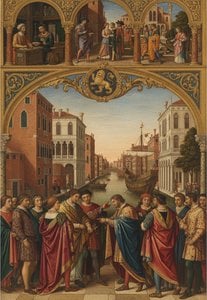
Early Life and Training
Vittore Carpaccio, a prominent italian painter, was born in venice around 1465. He studied under the tutelage of gentile bellini, a renowned artist of the venetian school. This apprenticeship laid the foundation for carpaccio's future success. His family were fishermen and boat builders, shaping his early worldview and fostering an appreciation for craftsmanship—skills that would later translate into his artistic endeavors. Carpaccio’s artistic journey began with intensive observation of bellini’s techniques and stylistic choices, absorbing the Venetian tradition’s emphasis on luminous color palettes and balanced compositions.Artistic Style and Influences
Vittore Carpaccio's style was characterized by its conservative nature, showing minimal influence from the humanist trends that transformed italian renaissance painting during his lifetime. He largely rejected the radical experimentation championed by artists like Leonardo da Vinci, prioritizing instead a meticulous approach rooted in established conventions. His work was profoundly impacted by antonello da messina’s style—particularly his masterful use of chiaroscuro—and early netherlandish art, notably Pieter Bruegel the Elder's landscapes and Jan van Eyck’s detailed realism. This unique blend resulted in a distinctive Venetian aesthetic that blended Byzantine iconography with Northern European precision.Notable Works
Vittore Carpaccio achieved considerable fame during his lifetime through his monumental cycle depicting Saint Ursula’s Life—a series of nine paintings housed in the gallerie dell'accademia. These canvases exemplify carpaccio’s narrative prowess, skillfully conveying biblical stories with dramatic lighting and expressive figures. Glory of St. Ursula Altarpiece (1491) showcases carpaccio’s ability to capture ethereal beauty and spiritual contemplation, mirroring bellini’s luminous style. Miracle of the Relic of the Cross at the Ponte di Rialto (1494) demonstrates carpaccio's meticulous attention to detail and compositional balance—a hallmark of Venetian painting during his era. His other significant works include depictions of Mary Magdalene and Saint Jerome, reflecting a deep understanding of religious symbolism and humanist ideals.Career Highlights and Legacy
Carpaccio’s principal artistic output spanned from 1490 to 1519, securing his place among the early masters of the venetian renaissance. He was recognized as one of Venice's most respected artists, attracting commissions from wealthy patrons and elevating Venetian art to new heights. Unlike many of his contemporaries who embraced innovation, carpaccio steadfastly adhered to traditional methods—a decision that arguably preserved the Venetian artistic heritage for future generations. Despite being somewhat overshadowed by luminaries like Bellini and Giorgione, Carpaccio’s enduring legacy resides in his contribution to Venetian painting's stylistic canon and his masterful storytelling abilities. His work continues to inspire admiration for its beauty and psychological depth.References and Further Reading
Vittore Carpaccio’s artworks on ArtsDot Vittore Carpaccio on wikipedia The italian renaissance art movement on ArtsDot The Italian Renaissance Art Movement Discover more about vittore carpaccio and the venetian school on ArtsDot Vittore CarpaccioFrågor & svar
Var kan jag se Vittore Carpaccios konstverk i kronologisk ordning?
Vittore Carpaccios konstverk kan ses i kronologisk ordning på artistens Tidslinje för konstverk-sida.
Var och när föddes Vittore Carpaccio?
Vittore Carpaccio föddes i Venedig år 1465.
Kan jag bläddra i Vittore Carpaccios verk efter stämning?
Känslomässigt rum för Vittore Carpaccio är en sida som sorterar konstnärens verk efter stämning.
Hur hittar jag verk av Vittore Carpaccio i en specifik färgpalett?
För att hitta verk av Vittore Carpaccio i en specifik färgpalett, använd artistens Efter färgpalett-sida.
I vilka stilarter verkade Vittore Carpaccio?
Sidan Alla epoker grupperar Vittore Carpaccios konstverk efter konstinriktning.
Var kommer Vittore Carpaccio ifrån?
Vittore Carpaccio föddes i Italien.
I vilken stad och vilket land föddes Vittore Carpaccio?
Vittore Carpaccio föddes i Venedig i Italien.