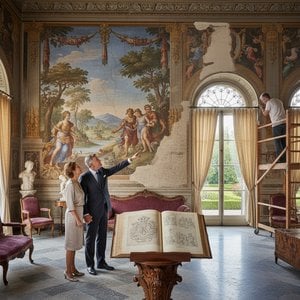
Bernardino di Betto, Known as Pinturicchio
Bernardino di Betto, known to the world as Pinturicchio – a nickname affectionately bestowed upon him for his diminutive stature – emerged from the artistic heartland of Perugia in 1454. His life unfolded during a period of immense cultural ferment, the High Renaissance blossoming across Italy, yet Pinturicchio carved out a unique path, one that blended the lingering elegance of Gothic traditions with the burgeoning innovations of the era. While giants like Leonardo da Vinci and Michelangelo strove for anatomical perfection and dramatic realism, Pinturicchio cultivated a style characterized by refined grace, intricate detail, and a vibrant, decorative sensibility. His journey wasn’t one of revolutionary upheaval, but rather of exquisite refinement – a testament to his skill in transforming established forms into something uniquely captivating.Early Years and Training
Pinturicchio’s early training remains somewhat shrouded in mystery, though it is believed he honed his skills under the guidance of lesser-known Perugian masters like Bonfigli and Fiorenzo di Lorenzo. He absorbed influences from the Umbrian School of Painting, which prioritized serene landscapes and luminous colors—a stylistic preference that would permeate much of his later work. Giorgio Vasari recounts Pinturicchio’s formative years as an assistant to Pietro Perugino, a pivotal connection that undoubtedly shaped his artistic development. This collaboration instilled in him a deep understanding of Perugian technique and fostered a commitment to meticulous observation—qualities that would serve him well throughout his career.The Sistine Chapel Commission
A defining moment arrived when Pinturicchio secured a commission for the Sistine Chapel in Rome during the early 16th century. Working alongside some of the most celebrated artists of the time – Botticelli, Ghirlandaio, and Signorelli among them – Pinturicchio contributed to this monumental project—though tragically his frescoes were later destroyed to make way for Michelangelo’s *Last Judgement*. Despite this devastating loss, the experience exposed him to new artistic currents and solidified his reputation as a master craftsman. He meticulously recreated scenes from Genesis and Exodus, employing a technique known as *trompe-l’œil*, creating illusions of depth and perspective that captivated viewers.The Borgia Apartments: A Triumph of Decorative Art
The years between 1484 and 1492 witnessed Pinturicchio’s most ambitious undertaking—the decoration of the Borgia Apartments within the Vatican Palace. Commissioned by Pope Alexander VI – Rodrigo Borgia – he embarked on a project that would become synonymous with Renaissance splendor. Collaborating with Raphael and Giulio Romano, Pinturicchio transformed five rooms into breathtaking spaces adorned with mythological frescoes depicting scenes from Homer’s *Odyssey* and Virgil’s *Aeneas*. The use of gold leaf, vibrant colors, and innovative illusionistic techniques—particularly the *quadratura*, a technique pioneered by Michelangelo—created an atmosphere of opulent grandeur that reflected the papal court's ambition.Legacy and Influence
Pinturicchio’s artistic legacy is one of understated elegance and unparalleled craftsmanship. While he may not have achieved the fame of Leonardo or Michelangelo, his influence on subsequent generations of artists is undeniable. His distinctive style—characterized by delicate figures, luminous colors, and intricate decorative motifs—resonated with those who appreciated subtlety and beauty. He demonstrated an exceptional ability to elevate decorative art to new heights, establishing himself as a cornerstone of Umbrian Renaissance painting. Notably, Pinturicchio’s frescoes in the Piccolomini Library in Siena foreshadowed the High Renaissance style, cementing his place as one of Italy's most enduring artistic figures. His work continues to inspire admiration and study today—a testament to the lasting power of a “little painter” who transformed tradition into timeless art.Frågor & svar
Var hittar jag Pinturicchios konstverk grupperade efter teknik?
För att hitta alla verk av Pinturicchio inom ett visst medium, besök artistens Alla medier-sida.
Vilka andra namn eller alias använder sig Pinturicchio av?
Pinturicchio förekommer även under namnen Bernardino di Betto, Benetto di Biagio, Sordicchio.
Var kan jag hitta statistik om Pinturicchios verk?
En Statistik-sida finns för Pinturicchio, som presenterar statistik om konstnärens verk på denna webbplats.