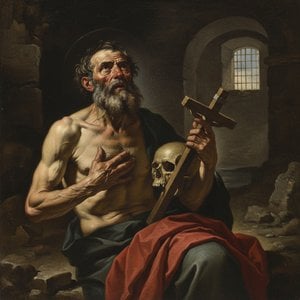
The Shadow and Soul of Baroque Spain
Jusepe Martínez Lurbe, born in the vibrant Spanish city of Zaragoza around 1602, stands as a pivotal figure within the dramatic landscape of the Spanish Baroque. His prolific career, which spanned nearly eight decades, produced an astonishing array of religious paintings that cemented his reputation as one of the era’s foremost masters. Unlike many of his contemporaries who sought to capture the opulent grandeur and decorative splendor of the age, Martínez turned his gaze inward. He focused on capturing profound spiritual emotion through a masterful use of light and shadow—a technique known as tenebrism—establishing himself as a champion of psychological realism. His work does not merely depict sacred scenes; it invites the viewer into a space of solemn contemplation, where the divine meets the human through the visceral language of contrast.
The foundations of Martínez’s artistic excellence were laid in his early years, shaped by a familial environment steeped in craftsmanship. His father, Daniel Martínez Sánchez, was a respected sculptor and architect, providing Juse and his siblings with an upbringing where the principles of form and structure were ever-present. This early exposure to the plastic arts allowed Jusepe to develop a deep understanding of volume and composition. However, it was his formal training under the legendary Francisco Ribera that would truly ignite his creative spirit. Ribera, a master of the dramatic chiaroscuro, instilled in Martínez a philosophical conviction regarding art’s capacity to convey spiritual truths through intensity rather than superficial beauty. Under this tutelage, Martínez learned to manipulate light not just as a tool for visibility, but as a narrative force capable of sculpting emotion out of the darkness.
A Mastery of Light and Devotion
The hallmark of Martínez’s style is the revolutionary embrace of tenebrism, a technique that defines much of his most celebrated output. By utilizing deep, enveloping blacks that surround figures illuminated by sudden, radiant pools of light, he created an atmosphere of intense psychological drama. This interplay between light and shadow serves to highlight the raw, human elements of his religious subjects—the furrowed brow of a saint, the trembling hand of a martyr, or the quiet exhaustion of a disciple. In works such as Apostle St Thomas, one can witness this mastery in action, where the starkness of the lighting strips away distractions, forcing the observer to confront the spiritual weight of the moment.
Beyond his technical prowess as a painter, Martínez was also a man of letters and a versatile creator. He was known to be an accomplished engraver and writer, even composing a treatise titled Discursos, which reflects his intellectual engagement with the theory and practice of art. This multifaceted nature allowed him to contribute to the broader cultural discourse of the 17'th century, bridging the gap between the manual skill of the workshop and the scholarly pursuits of the academy. His ability to navigate both the physical creation of art and its theoretical justification made him a significant figure in the intellectual life of Spain.
Legacy and Historical Significance
The historical significance of Jusepe Martínez lies in his role as a bridge between the intense, gritty realism of the early Baroque and the more refined religious aesthetics that followed. His influence can be traced through subsequent generations of Spanish painters who sought to balance emotional depth with formal elegance. While much of his work remains housed in prestigious institutions like the Museo Provincial de Bellas Artes in Zaragoza or the Museo Nacional del Prado, his impact resonates far beyond the walls of these galleries.
To reflect on the breadth of his contribution, one might consider the following elements of his enduring legacy:
- The Evolution of Tenebrism: His refinement of Ribera's techniques helped define the visual language of Spanish religious devotion.
- Psychological Realism: He moved away from idealized figures toward a more humanized, emotionally accessible portrayal of sacred subjects.
- Artistic Versatility: His work as an engraver and theorist enriched the technical and intellectual foundations of the Spanish Baroque movement.
Ultimately, Jusepe Martínez remains a master of the unseen. Through his brush, the shadows are never merely empty space; they are the fertile ground from which spiritual revelation emerges. He taught the viewer that in the darkest corners of the human experience, it is the sudden, piercing light of faith that truly defines our existence.