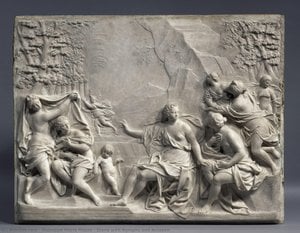
A Bolognese Master of Baroque Sensibility
Giuseppe Maria Mazza, born in Bologna in 1653 and passing in the same city in 1741, stands as a pivotal figure in Italian sculpture. Though initially steeped in the traditions of painting, it was through his masterful handling of terracotta and stucco that he secured lasting renown. He wasn’t merely a sculptor; he was a storyteller in three dimensions, weaving narratives of religious fervor, mythological drama, and secular grace into forms that captivated both private collectors and ecclesiastical patrons. His story is one of artistic evolution, familial influence, and the blossoming of a unique style that bridged the High Baroque with the emerging sensibilities of the 18th century.Formative Years and Artistic Lineage
Mazza’s artistic journey began within a family already deeply rooted in the world of art. His father, Camillo Mazza, was a respected sculptor who had honed his skills under the tutelage of Alessandro Algardi in Rome – a lineage that would profoundly shape Giuseppe Maria's aesthetic foundations. However, young Giuseppe didn’t immediately embrace sculpture. He initially pursued painting, studying with prominent Bolognese masters like Domenico Maria Canuti and participating in life classes led by Carlo Cignani, further refining his technique under Lorenzo Pasinelli. This early immersion in painting instilled within him a pictorial sensibility that would later distinguish his sculptural work, imbuing it with a remarkable sense of depth, color, and narrative clarity. It was only after this period of exploration that he returned to the family craft, furthering his training with Giovanni Gioseffo dal Sole and at a private school established within the Palazzo Fava in Bologna. This dual foundation – painterly observation combined with sculptural expertise – proved to be the cornerstone of his artistic success.Patronage, Commissions, and Artistic Flourishing
Mazza quickly established himself as a highly sought-after sculptor, particularly celebrated for his terracotta statuettes intended for the refined interiors of wealthy homes. His talent soon attracted the attention of Prince Johann Adam Andreas of Liechtenstein, an enlightened patron who recognized Mazza’s exceptional skill. Between 1691 and 1702, the Prince commissioned a series of works – six marble busts, twelve terracotta groups, two marble statues, and three terracotta models for vases – that showcased Mazza's versatility and imaginative power. The Prince was so impressed that he had many of the terracotta pieces replicated in stone for his gardens at Rossau, demonstrating the enduring appeal and artistic merit of Mazza’s creations. Beyond princely patronage, Mazza secured numerous commissions from churches throughout Bologna and beyond. He contributed significantly to the Capella Maggiore of Bologna Cathedral, painting figures of adoring angels within a larger composition. His work graced the Church of Corpus Domini in Bologna with a Virgin and Child, accompanied by two majestic angels and intricate bas-reliefs for the high altar. Further afield, he produced large bronze reliefs for the churches of San Clemente and Santi Giovanni e Paolo in Venice, the latter featuring five monumental depictions of the miracles of Saint Dominic. Between 1686 and 1695, Mazza collaborated with architect Giacomo Monti and painter Marcantonio Franceschini on a significant renovation project at the Corpus Domini church, contributing both reliefs and plaster statues to the revitalized space.Style and Legacy
Mazza’s sculptures are immediately recognizable for their distinctive pictorial quality – a direct result of his early training as a painter. His compositions exhibit a remarkable balance and self-containment, drawing the viewer into a carefully constructed world of form and emotion. While deeply influenced by Alessandro Algardi, Mazza infused his work with a vivacity that set him apart from the prevailing High Baroque style dominant in Rome at the time. He embraced a more nuanced approach, anticipating the aesthetic shifts of the 18th century. His versatility extended beyond terracotta and stucco; he demonstrated mastery across various materials and techniques, adapting his skills to suit the demands of each commission. Mazza’s influence extended through his pupils, including Angelo Piò and Lorenzo Sarti, who carried on his artistic legacy. Today, a road in Bologna bears his name – a lasting testament to his significance within the city's rich cultural heritage. Giuseppe Maria Mazza left behind a substantial body of work that continues to inspire admiration for its artistry, technical brilliance, and historical importance, solidifying his place as a leading sculptor of the Bolognese Baroque.Frågor och svar
Kan jag utforska Giuseppe Maria Mazzas verk efter färg?
Färgindex för Giuseppe Maria Mazza är en sida där konstnärens verk är organiserade efter färg.
Finns det en virtuell 3D-visning av Giuseppe Maria Mazzas verk?
Giuseppe Maria Mazzas konstverk kan upplevas i ett 3D-galleri på artistens sida Virtuellt 3D-galleri.
Hur många konstverk av Giuseppe Maria Mazza finns tillgängliga att bläddra bland?
Du kan bläddra bland 8 konstverk verk av Giuseppe Maria Mazza på sidan Samtliga konstverk.