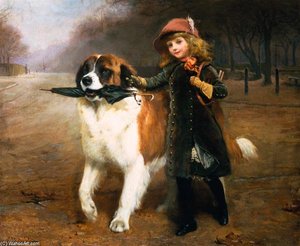
Charles Burton Barber (1845 – 1894): Beloved Victorian Painter of Heartwarming Scenes Featuring Children & Their Animal Companions
Charles Burton Barber, a name synonymous with Victorian sentimentality and heartwarming depictions of domestic life, flourished during a period captivated by the bonds between humans and animals. Born in Great Yarmouth in 1845, Barber’s artistic journey unfolded against the backdrop of a rapidly changing Britain, yet his work consistently offered a comforting glimpse into an idealized world of innocence and affection. While details surrounding his formal training remain somewhat elusive, it is clear that Barber possessed an innate talent nurtured through dedicated practice and keen observation—a talent that would ultimately define his enduring legacy within British art history.Early Life and Artistic Beginnings
Barber’s formative years were spent in Great Yarmouth, where he was born into a family of printers and booksellers. His father instilled in him a love for craftsmanship and visual storytelling from an early age—a passion that would soon translate into his own artistic pursuits. Recognizing his burgeoning talent, Barber enrolled at the Royal Academy in London in 1864, embarking on a formal education that honed his skills in draughtsmanship and composition. The Academy’s rigorous curriculum fostered a disciplined approach to artmaking, equipping him with the technical prowess necessary for capturing the subtleties of human emotion and the beauty of the natural world—a foundation upon which he would build his distinctive artistic style. A pivotal moment arrived in 1866 when Barber debuted at the Royal Academy, marking his official entry into London’s vibrant art scene and establishing a career trajectory marked by consistent exhibitions and critical acclaim.A Style Defined by Sentimentality and Realism
Barber’s artistic versatility was notable; he moved with ease between highly detailed, almost photographic realism and more spontaneous, sketch-like compositions—a duality that reflected the broader aesthetic currents of Victorian England. However, it is for his sentimental portrayals of children interacting with their animal companions – particularly dogs – that he remains best known today. His paintings aren’t merely representations of scenes but rather carefully constructed narratives brimming with warmth, tenderness, and a palpable sense of emotional connection. He possessed an exceptional skill in capturing the subtle nuances of expression, both human and canine, imbuing his subjects with personality and charm. Consider Suspense (1894), for instance—a captivating depiction of anticipation where Barber skillfully conveys the fleeting emotions of his figures. Similarly, Off to School (1883) captures a moment of childhood innocence alongside the unwavering loyalty of a dog companion. These works exemplify Barber’s ability to blend meticulous observation with heartfelt emotion—a hallmark of his artistic vision.Royal Patronage and Artistic Recognition
Barber’s reputation soared during his lifetime, largely thanks to commissions from Queen Victoria herself – a testament to his growing stature within the British monarchy and its artistic circles. Unlike many artists of his era who sought fame through grand public exhibitions, Barber prioritized fulfilling these royal obligations—a decision that underscored his unwavering dedication to craftsmanship and artistic excellence. One particularly memorable commission involved portraying Queen Victoria alongside her grandchildren in her pony carriage – a task undertaken with meticulous care and reflecting the Victorian fascination for familial bonds and idealized domestic life. The resulting painting stands as a poignant symbol of Barber’s artistic achievement and serves as an enduring reminder of the Queen's affection for animals—a connection that profoundly influenced his oeuvre. Furthermore, Barber was elected a member of the Royal Institute of Oil Painters in 1883 – cementing his position among Britain’s leading artists and securing his place within the intellectual landscape of Victorian London.Influence and Legacy
Barber's artistic style resonated deeply with contemporaries like Arthur Elsley—who would later become renowned for his own depictions of children and pets—demonstrating a shared commitment to capturing emotional narratives and portraying animals with remarkable sensitivity. His technique involved layering glazes to achieve rich colors and textures, enhancing the visual impact of his paintings and inviting viewers into the intimate world he created. Despite occasional criticisms regarding his perceived sentimentality, Barber’s enduring popularity stems from his masterful execution—a testament to his unwavering dedication to artistic craftmanship. The widespread reproduction of his artworks through photogravure prints ensured that his charming scenes reached a vast audience across Britain and beyond – securing his place as one of the most beloved Victorian artists. Today, a significant portion of Barber’s oeuvre resides at the Lady Lever Art Gallery in Port Sunlight—a lasting tribute to his artistic legacy and guaranteeing that his evocative depictions of childhood innocence and animal companionship continue to inspire admiration for generations to come. His paintings remain a poignant reminder of Victorian values and the enduring power of human-animal connection—a testament to Barber’s profound contribution to British art history.Frågor & svar
Kan jag sortera Charles Burton Barbers konstverk efter färg?
Sidan Färgindex organiserar Charles Burton Barbers konstverk efter färg.
Var kan jag hitta statistik om Charles Burton Barbers verk?
Sidan Statistik för Charles Burton Barber presenterar statistik beräknad utifrån konstnärens verk som finns listade på denna webbplats.
Var kan jag se Charles Burton Barbers konstverk i ett 3D-galleri?
3D-museum för Charles Burton Barber är en sida som visar konstnärens verk i ett virtuellt tredimensionellt galleri.
I vilken stad och vilket land föddes Charles Burton Barber?
Charles Burton Barber föddes i Yarmouth i Storbritannien.
Var och när föddes Charles Burton Barber?
Charles Burton Barber föddes i Yarmouth år 1845.
Var kommer Charles Burton Barber ifrån?
Charles Burton Barber föddes i Storbritannien.
Finns det en översikt över alla de motiv som Charles Burton Barber målade?
Charles Burton Barbers verk kan utforskas efter motiv på artistens Ämnesatlas-sida.