

Franz Ehrlich: Bridging Expressionism, Bauhaus & the Shadows of History
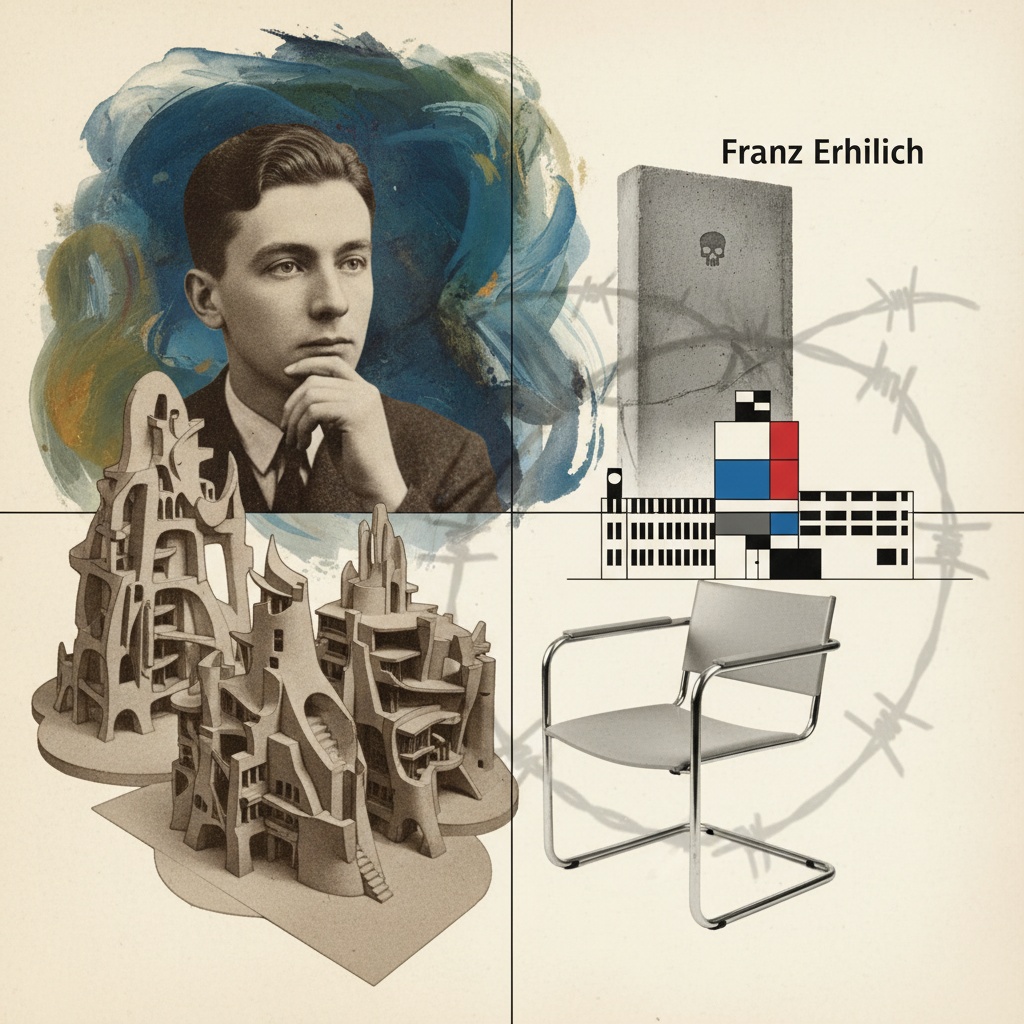
Innehållsförteckning
Early Life & Artistic Foundations: From Metalwork to Bauhaus Aspirations
Franz Ehrlich’s trajectory was not one of immediate artistic privilege, but rather a compelling ascent forged through the socio-political currents of early 20th-century Germany. Born in Reudnitz near Leipzig in 1907, his initial path led him not towards academies and studios, but into the practical world of metalworking. This apprenticeship, however, proved to be far more than a vocational training; it was an immersion into the heart of the German labor movement. Involvement with the German Metal Workers’ Union (Metallarbeitergewerkschaft – DMV) and the Socialist Workers' Youth (Sozialistischen Arbeiter-Jugend – SAJ) instilled in him a profound sense of social consciousness that would permeate his artistic endeavors throughout his life. This early engagement wasn’t merely political; it was formative, shaping a worldview where art held responsibility—a potential to reflect, critique, and even challenge the established order.
The pivotal moment arrived in 1923 with Ehrlich's visit to the Bauhaus exhibition showcasing New Objectivity architecture. This encounter wasn’t simply an aesthetic awakening; it was a revelation. The clarity of form, the emphasis on functionality, and the integration of art with industrial production resonated deeply with his existing convictions. It offered a tangible path for realizing his ideals – a way to create meaningful work that served society rather than solely adorning the elite. This spark ignited a determined pursuit of formal education, leading him to complete further schooling before securing admission to the prestigious Bauhaus in Dessau in 1927.
The Bauhaus Years: A Crucible of Modern Design (1927-1930)
The Staatliches Bauhaus (German: [ˈʃtaːtlɪçəs ˈbaʊˌhaʊs] ), commonly known as the Bauhaus (German for 'building house'), was a German art school operational from 1919 to 1933 that combined crafts and the fine arts. The school became famous for its ap...
The Bauhaus was more than just a school; it was an intellectual and artistic ecosystem. For Ehrlich, arriving at Dessau meant entering a world defined by rigorous experimentation and the pursuit of a *Gesamtkunstwerk* – a total work of art encompassing all disciplines. He initially found himself in László Moholy-Nagy’s preliminary course, a foundational experience designed to strip away preconceived notions and cultivate a new visual language. This was followed by studies with luminaries like Paul Klee and Wassily Kandinsky, figures who profoundly influenced his understanding of color theory, composition, and abstract form.
However, Ehrlich's engagement wasn’t confined to the traditional art disciplines. He actively collaborated with Walter Gropius on the ambitious Total Theatre project conceived by Erwin Piscator, a venture that explored the possibilities of integrating stage design, technology, and political commentary. This period also saw him delve into sculpture and typography, demonstrating a remarkable versatility and willingness to explore diverse mediums. Crucially, in 1930 he passed his journeyman’s examination as a carpenter at the Chamber of Crafts Dessau, solidifying his practical skills alongside his theoretical knowledge – a combination that would prove invaluable in the years to come.
Resistance, Imprisonment & the Buchenwald Commission: Art Under Duress
Franz Ehrlich (28 December 1907 in Reudnitz near Leipzig – 28 November 1984 in Bernburg) was a German architect, calligrapher and graphic designer. He was a student at the Bauhaus in Dessau from 1927 to 1930. Ehrlich was a Communist and was arrested...
The ascent of National Socialism in 1933 irrevocably altered Ehrlich’s path. His commitment to Communist ideals led him into the anti-fascist resistance, actively participating in the production of illegal magazines and leaflets for the Young Communist League (Kommunistische Jugendverband Deutschlands – KJVD). This clandestine activity inevitably drew the attention of the authorities, resulting in his arrest in Leipzig in 1934. What followed was a harrowing ordeal of imprisonment, first at Waldheim penitentiary and then, more brutally, at Zwickau.
The circumstances surrounding Ehrlich’s survival during this dark period are particularly poignant – and deeply troubling. Released from prison in 1937, he found himself subjected to “protective custody” and transferred to the infamous Buchenwald concentration camp. His architectural training, ironically, became his means of survival. The Nazi regime exploited his skills, tasking him with designing the entrance gates for the camp – a chilling commission that included the infamous motto *Jedem das Seine* (“To each his own”). He was subsequently appointed as the main designer for the camp’s construction office, responsible for furnishings in the commandant's house and other structures. The moral complexities of this situation are immense; while forced to collaborate with evil, there are accounts suggesting he subtly aided the resistance by passing on construction details – a dangerous act of defiance within an environment of unimaginable brutality.
Post-War Reconstruction and GDR Architect: Navigating Ideology and Innovation
The liberation at the end of World War II brought a semblance of freedom, but also the weight of rebuilding a shattered nation. Ehrlich turned his attention to reconstruction efforts in Dresden, applying his architectural expertise to heal the wounds of war. In the 1950s, he assumed the role of technical director for the Design Office for Industrial Construction of the GDR in Berlin, contributing significantly to the post-war industrial landscape.
During the 1960s, Ehrlich rose to prominence as chief architect for the Leipzig Trade Fair, a key showcase for East Germany’s economic achievements. His ambitious design for a “Messeturm” (Trade Fair Tower) unfortunately remained unrealized, but his work nonetheless reflected the prevailing modernist aesthetic of the GDR. He also served as the architect for the Ministry for Foreign Trade, designing interiors for numerous embassies and trade missions – projects that demanded both functional efficiency and a carefully curated representation of socialist ideals.
A Complex Legacy: The Bauhaus Collection and Ehrlich’s Stasi Involvement
Ehrlich's legacy is far from straightforward. He bequeathed the Bauhaus Dessau Foundation an extraordinary collection of approximately 7000 items – life drawings, artworks, furniture designs, plans, studies, photographs, and publications – providing invaluable insight into the work of former Bauhaus students during the turbulent years between 1933 and 1945, as well as their subsequent experiences in the GDR. This collection stands as a testament to his dedication to preserving the spirit of the Bauhaus.
However, this commitment is shadowed by a troubling revelation: from 1954 to 1975, Ehrlich served as an informer for the Stasi, East Germany’s notorious secret police. This involvement raises difficult questions about his motivations and compromises made within a repressive regime. It underscores the complexities of navigating life under totalitarian rule – the pressures, the surveillance, and the moral ambiguities that shaped the lives of countless individuals.
Ehrlich's Enduring Influence: A Synthesis of Styles and a Troubled History
Franz Ehrlich’s story is not simply a biographical narrative; it is a microcosm of the 20th century itself – a testament to the power of artistic vision, the fragility of freedom, and the enduring struggle between ideology and integrity. His work embodies a synthesis of Expressionist sensibilities, Bauhaus principles, and the pragmatic demands of post-war reconstruction. While his Stasi involvement casts a long shadow, it cannot diminish the significance of his architectural contributions or the importance of preserving the Bauhaus collection he so diligently assembled.
Today, Ehrlich’s designs continue to inspire – a reminder that even in the darkest of times, the pursuit of beauty and functionality can endure. At ArtsDot, we offer high-quality reproductions of his work, allowing you to experience firsthand the innovative spirit and enduring legacy of this complex and fascinating artist. Explore our collection and discover the power of art to transcend boundaries and provoke reflection.
- Explore Ehrlich’s ‘Tubular Steel Chair’ (1976) – a modernist graphite drawing showcasing innovative design & Bauhaus influence.
- Discover rare architectural sketches like ‘Untitled (Designs of various room furnishings. Large room, small room, for the villa of an SS officer in Buchenwald)’ (1943).
Relaterade artiklar

Tysk Expressionism: 10 Mästerverk som Definierade en Epok – Konst & Inredning
Utforska 10 ikoniska mästerverk inom tysk expressionism! Lär känna konstnärer som Nolde, Kirchner & Heckel. Upptäck historien bakom dessa färgstarka målningar och finn inspiration till din inredning med ArtsDot.com – museumkvalitet för ditt hem.


Lyonel Feininger: Bridging Expressionism & Cubism – A Study of Spiritual Geometry
Explore the captivating world of Lyonel Feininger, a pivotal figure bridging Expressionism & Cubism. Discover his architectural visions, Bauhaus influence, and enduring legacy in modern art history. Learn more at ArtsDot.

