

Beyond Reality's Grasp: Exploring the Philosophical Foundations of Surrealism
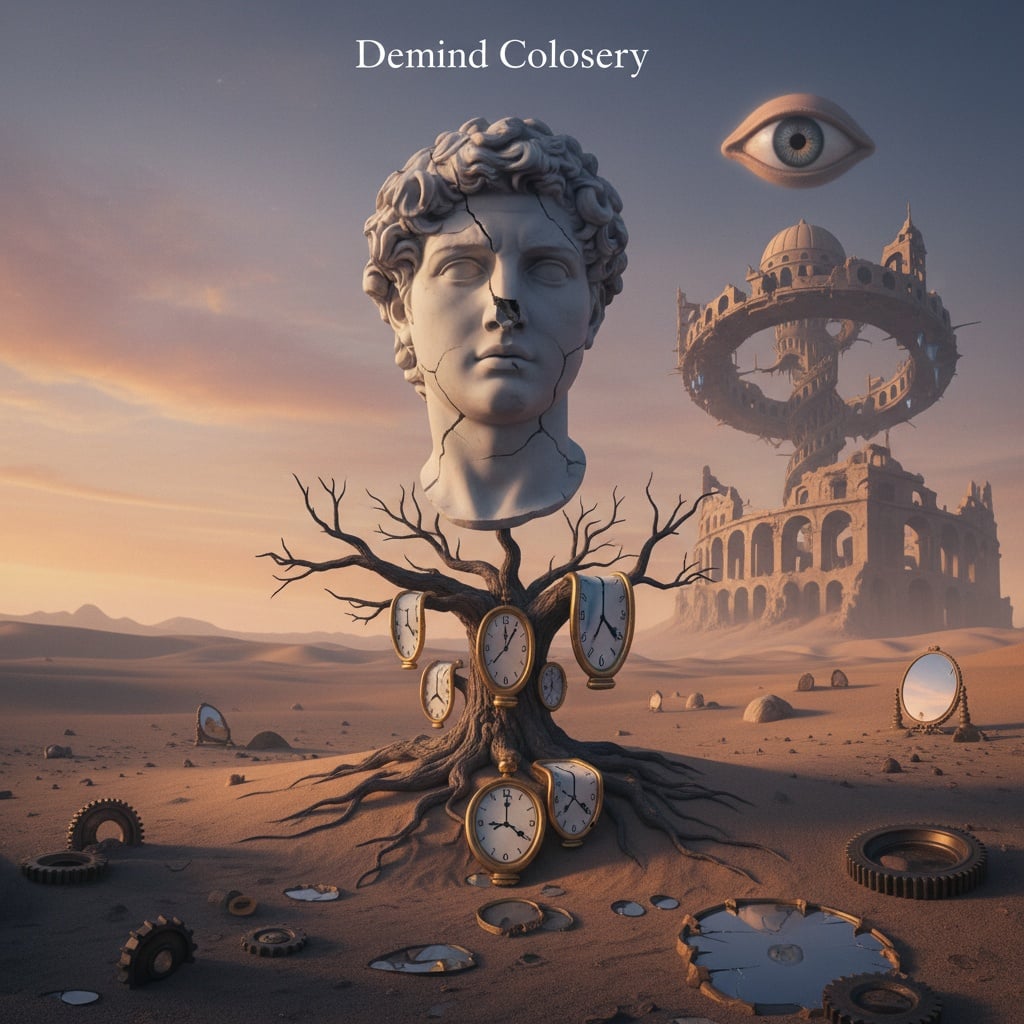
Innehållsförteckning
The Historical Genesis of Surrealism: From Dada's Ruins to Breton's Manifesto
Surrealism is an art and cultural movement that developed in Europe in the aftermath of World War I in which artists aimed to allow the unconscious mind to express itself, often resulting in the depiction of illogical or dreamlike scenes and ideas. I...
The birth of Surrealism wasn’t a sudden revelation, but rather an evolution—a phoenix rising from the ashes of World War I and its attendant disillusionment. The horrors of the conflict shattered pre-existing notions of reason, progress, and societal norms, leaving a generation grappling with profound existential questions. From this fertile ground of despair emerged Dada, a deliberately anti-art movement that rejected logic in favor of chaos and absurdity. While Dada was powerfully nihilistic, it lacked a constructive alternative. André Breton, a French writer and physician deeply affected by his experiences treating shell-shocked soldiers during the war, recognized this void. He sought to channel the destructive energy of Dada into something more focused—a systematic exploration of the unconscious mind as a pathway to liberation. Breton’s 1924 *Manifesto of Surrealism* formally defined the movement, drawing heavily from the psychoanalytic theories of Sigmund Freud and proposing that art should not be constrained by reason or morality, but rather embrace the irrationality of dreams, free association, and automatism.
The early Surrealists weren’t simply rebelling against artistic conventions; they were attempting a fundamental shift in human consciousness. They believed that the rational mind suppressed powerful creative forces residing within the subconscious, and that by unlocking these hidden depths, humanity could achieve a higher state of being—a “surreality” transcending the limitations of everyday experience. This ambition fueled their experimentation with various techniques designed to bypass conscious control, setting the stage for a revolution in artistic expression.
Freud's Influence: Unlocking the Subconscious in Art
To understand Surrealism is to understand Sigmund Freud. Breton’s fascination with Freud’s work—particularly his theories on dreams, repression, and the interpretation of symbols—was paramount. Freud posited that dreams were not random occurrences but rather expressions of unconscious desires, fears, and anxieties, disguised through symbolic language. The Surrealists seized upon this idea, viewing dreams as a direct conduit to the subconscious and a rich source of artistic inspiration. They weren’t interested in merely *depicting* dreams; they aimed to recreate the very logic—or lack thereof—of the dream state on canvas.
The concept of free association, another cornerstone of Freudian psychoanalysis, also profoundly influenced Surrealist practice. Artists would attempt to bypass conscious thought by writing or drawing spontaneously, allowing images and ideas to emerge unfiltered from their subconscious. This process, known as automatism (discussed further below), was seen as a way to access the “true” self, unburdened by societal conditioning and rational constraints. The resulting works often featured bizarre juxtapositions of seemingly unrelated objects, illogical scenes, and unsettling imagery—precisely because they weren’t governed by conventional logic but rather by the unpredictable currents of the unconscious.
Automatism & Dreamscapes: Key Techniques and Artistic Expression
Automatism may refer to: Automatic behavior, spontaneous verbal or motor behavior Automatism (law), a defense used in criminal law Automatism (toxicology), when an individual repeatedly takes a medication because the individual forgets previous dose...
The pursuit of accessing the subconscious led Surrealists to develop a range of innovative techniques. Automatism, perhaps the most defining, involved relinquishing conscious control over the creative process. Artists like André Masson pioneered “automatic drawing,” allowing their hands to move freely across the canvas without pre-planning or intention. The resulting lines and shapes were then interpreted as expressions of the unconscious mind. Similarly, in literature, automatic writing—writing without conscious thought—became a popular method for exploring hidden thoughts and emotions.
Exquisite Corpse, another signature technique, involved collaborative creation. Several artists would contribute to a drawing or poem sequentially, each unaware of the previous contributions, resulting in bizarre and often humorous compositions that defied logical coherence. Beyond these techniques, Surrealists employed methods like frottage (rubbing textures onto paper) and decalcomania (pressing paint between surfaces) to generate unexpected patterns and forms.
The visual language of Surrealism is characterized by dreamlike landscapes, distorted figures, and unsettling juxtapositions. Artists often combined realistic rendering with illogical arrangements, creating a sense of unease and disorientation. Objects were frequently stripped of their familiar context and imbued with new symbolic meanings, challenging viewers to question their perceptions of reality.
Iconic Surrealist Painters: Dalí, Ernst, and Delvaux – A Comparative Study
 Paul Delvaux
Explore the dreamlike world of Paul Delvaux (1897-1994), a Belgian Surrealist painter known for his enigmatic scenes, classical nudes & haunting landscapes. Discover his unique artistic vision.
While united by their shared philosophical principles, individual Surrealist painters developed distinct styles and approaches. Salvador Dalí, arguably the most recognizable figure of the movement, embraced a meticulous realism to depict fantastical scenes populated with melting clocks, elongated shadows, and bizarre creatures. His work often explored themes of sexuality, death, and decay, rendered with an almost obsessive attention to detail. Dalí’s paintings are characterized by their theatricality and provocative imagery, inviting viewers into a world of irrational desires and hidden anxieties.
Max Ernst, in contrast, employed a more abstract and experimental approach. He pioneered techniques like frottage and collage, creating dreamlike landscapes populated with hybrid creatures and enigmatic symbols. Ernst’s work often draws upon mythology, folklore, and personal experiences, resulting in compositions that are both visually striking and intellectually stimulating. His 1923 painting *Enter, Exit* exemplifies his layered geometric panels and symbolic imagery.
Paul Delvaux, a Belgian painter, developed a unique style characterized by his hauntingly beautiful depictions of classical nudes in vast, empty spaces. His paintings often feature trains, locomotives, and architectural elements, creating a sense of isolation and melancholy. Delvaux’s work explores themes of desire, memory, and the subconscious, rendered with a precise realism that belies their dreamlike quality.
The Enduring Legacy of Surrealism: Impact on Modern and Contemporary Art
Surrealism's influence extends far beyond the confines of painting. It profoundly impacted literature, film (think Luis Buñuel and David Lynch), photography, sculpture, and even fashion. The movement’s emphasis on the unconscious mind paved the way for new forms of artistic expression and challenged traditional notions of beauty and representation.
Even today, Surrealism continues to resonate with artists and audiences alike. Its exploration of dreams, symbolism, and the irrational remains relevant in a world increasingly dominated by logic and technology. The techniques developed by the Surrealists—automatism, collage, frottage—continue to be employed by contemporary artists seeking to unlock their creative potential and explore the hidden depths of the human psyche.
At ArtsDot.com, we celebrate the enduring power of Surrealist art through high-quality reproductions that capture the essence of these iconic masterpieces. Whether you’re drawn to Dalí’s provocative imagery, Ernst’s experimental techniques, or Delvaux’s haunting landscapes, our collection offers a gateway into a world beyond reality—a world where dreams and imagination reign supreme.
Relaterade artiklar

Beyond Reality's Grasp: Exploring the Evolution of Surrealist Painting
Explore the captivating world of Surrealism with ArtsDot. Discover its origins, key artists like Dalí & Ernst, and enduring influence on art history. High-quality reproductions available.


Surrealismens 10 Mästerverk: Konst som Utmanar Verkligheten – ArtsDot
Utforska surrealismens 10 mest ikoniska mästerverk – Dalí, Magritte & mer. Lär känna historien bakom drömlika landskap och symbolik i konsten. Hitta konsttryck av högsta kvalitet för ditt hem på ArtsDot.com.

