Portrait of Камиј Писаро

Your Guide to the 100 Most Famous Камиј Писаро Paintings

Updated октобар 2026 · ranked by our popularity score (searches, visits and orders for each work) · 1.559 works by Камиј Писаро in our catalogue

In short

Камиј Писаро's best-known piece is Булвар Монмартр ноћу (1897). You'll find it at the National Gallery in London. Next on the list are Јесен, Бање (1893) and Крње Роофс, Конер Оф А Виљеџ (1877). We have 1,559 works by Камиј Писаро in our catalogue; this guide picks out the 100 best known, with the year, the museum and the story of each piece.

1830 – 1903, Шарлота Амалија Impressionist landscape Most works: Musée d'Orsay

The 10 Камиј Писаро paintings to know first

1
Булвар Монмартр ноћу (1897) by Камиј Писаро

Булвар Монмартр ноћу

1897 · Ulje na platnu · National Gallery, London

Kamila Pisara, figura od neprospornog značaja u svetu impresionizma, zauvek je vezan za oslikavanje menjajućih pejzaža. Njegovo delo "Bulvar Montmartr noću", nastalo 1897. godine, nije samo slika; to je poetski zapis pulsirajućeg života Pariza pod svetlom gasnih lampi i veštačkih izvora. Ova kompozicija nas poziva u dinamičan gradski pejzaž gde se igra svetla i senke stvara jedinstvenu atmosferu, čineći je bezvremenskim dodatkom svakoj kolekciji ili enterijeru.

2
Јесен, Бање (1893) by Камиј Писаро

Јесен, Бање

1893 · Ulje na platnu · Denver Art Museum, Denver

Delo „Jesen, Poplaci” umetnika Kamila Pizara beleži samu suštinu jeseni u mirnom pejzažu koji obiluje živopisnim lišćem i uzvišenim stablima topola. Ovo remek-delo poziva posmatrače u spokojnu šumsku scenu, gde tople nijanse jeseni stvaraju osećaj harmonije i prirodne lepote.

3
Крње Роофс, Конер Оф А Виљеџ (1877) by Камиј Писаро

Крње Роофс, Конер Оф А Виљеџ

1877 · Ulje na platnu · Musée d'Orsay, Pariz

Očaravajući seoski zaklon Kamil Pizarovo delo „Crveni krovovi, ugao sela, zima” poziva posmatrače u spokojni ruralni pejzaž okupan toplim jesenjim nijansama. Ova očaravajuća scena beleži tiho lepotu sela smeštenog među golo drvećem, izazivajući osećaj spokoja i nostalgije. Ovo sliko je svedočanstvo Pizarove sposobnosti da stopi prirodne elemente sa ljudskim staništem, stvarajući harmoničnu kompoziciju koja deluje istovremeno utemeljeno i sanjivo. Postimpresionističko majstorstvo Pizar, pionir impresionističkog pokreta i ključna figura postimpresionizma, koristi…

4
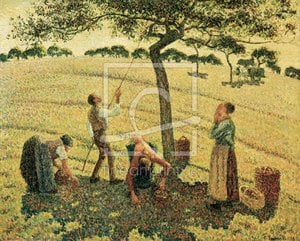
Прибирање јабљиња код Ерагњи-сур-Епте (1888) by Камиј Писаро

Прибирање јабљиња код Ерагњи-сур-Епте

1888 · Ulje na platnu · Dallas Museum of Art, Dallas

Camille Pissarro’s “Apple Picking at Eragny-sur-Epte,” completed in 1888, stands as a quintessential embodiment of Impressionism's quest for capturing fleeting moments of beauty amidst the rhythms of rural life. More than just a depiction of agricultural activity—the careful harvesting of apples beneath the dappled shade of an ancient tree—it’s a profound meditation on harmony between humanity and nature, rendered with unparalleled sensitivity to color and texture.

5
Кућа господина Музија, Рута де Марли, Лувесијен (1872) by Камиј Писаро

Кућа господина Музија, Рута де Марли, Лувесијен

1872 · Ulje na platnu

"Kuća gospoda Musija, Ruta de Marli, Luvećijen" Kamila Pisaroa nije samo slika; to je trenutak zaleđen u vremenu, poziv da se uroni u mirnu atmosferu ruralne Francuske 19. veka. Ova dela, nastala 1872. godine, predstavlja vrhunac impresionističkog stila i pokazuje Pisarovljev talenat za hvatanje prolaznih efekata svetlosti i atmosfere. Kompozicija nas vodi zemljanim putem koji se prostire u daljinu, okrenut kućom sa krovom od crvenih tepiha na desnoj strani i…

7
Corner of the Garden in Eragny (1897) by Камиј Писаро

Corner of the Garden in Eragny

1897 · Oil On Canvas · Ordrupgaard, Gentofte

Camille Pissarro’s “Corner of the Garden in Eragny,” painted in 1897, is a captivating example of Impressionism that transports viewers to a tranquil garden scene. This oil on canvas masterpiece, currently residing within the esteemed Ordrupgaard Collection in Denmark, exemplifies Pissarro's skill in capturing fleeting moments and the beauty of everyday life through light and color.

8
Boulevard Montmartre, morning, cloudy weather (1897) by Камиј Писаро

Boulevard Montmartre, morning, cloudy weather

1897 · Acrylic On Canvas · Nacionalna galerija Viktorije, Melburn

A Snapshot of Parisian Life: Camille Pissarro’s Boulevard Montmartre Camille Pissarro's "Boulevard Montmartre, morning, cloudy weather" isn’t merely a depiction of a street; it’s a distillation of Impressionism itself. Painted in 1897 during a prolific period for the artist—a time when he meticulously documented the evolving cityscape of Paris—this canvas captures a fleeting moment imbued with profound observation and artistic sensitivity. The painting resides within the National Gallery of Victoria's…

9
Sen i Louvre, Pariz (1903) by Камиј Писаро

Sen i Louvre, Pariz

1903 · Ulje na platnu · Musée d'Orsay, Pariz

„Sen i Louvre“, koje je naslikao Kamilo Pisarov 1903. godine, nije samo prikaz Pariza; to je oličenje srži impresionizma – hvatanje prolaznih trenutaka lepote i emocije kroz svetlost i boju. Više od pukog posmatranja gradske panorame, Pisarov je želeo da prenese duh svog vremena, odražavajući rastući optimizam i dinamiku Francuske početkom dvadesetog veka.

10
Setting Sun, Autumn in Eragny (1900) by Камиј Писаро

Setting Sun, Autumn in Eragny

1900 · Oil On Canvas

Setting Sun, Autumn in Eragny is an oil on canvas painting created in 1900. The scene depicts a sunny day in the countryside featuring trees and grass. Several individuals are visible in the landscape, with some positioned in the foreground and others further away, appearing to walk and enjoy the outdoors. A dog is also present in the composition, located near the center of the scene.

Numbers 11 to 100: more Камиј Писаро paintings

11Voćnjak u cvetu, Лувесиен (1872) by Камиј ПисароVoćnjak u cvetu, Лувесиен1872 · National Gallery of Art 12Портрет Родо Писсарро читајућег (1900) by Камиј ПисароПортрет Родо Писсарро читајућег1900 13Gleaners (1887) by Камиј ПисароGleaners1887 · Kunstmuseum Basel 14The Quarry, Pontoise (1875) by Камиј ПисароThe Quarry, Pontoise1875 · Kunstmuseum Basel 15Outer harbour of Le Havre (1903) by Камиј ПисароOuter harbour of Le Havre1903 16The Chou Quarries, Pontoise (1882) by Камиј ПисароThe Chou Quarries, Pontoise1882 17Landscape with Factory (1867) by Камиј ПисароLandscape with Factory1867 18Убирање пешта (1880) by Камиј ПисароУбирање пешта1880 19Урожај картофеља (1885) by Камиј ПисароУрожај картофеља1885 20Self-Portrait, Musée d'Orsay, Paris. (1873) by Камиј ПисароSelf-Portrait, Musée d'Orsay, Paris.1873 21A Path Across the Fields (1879) by Камиј ПисароA Path Across the Fields1879 · Musée d'Orsay 22Women Tending the Laundry (study) (1887) by Камиј ПисароWomen Tending the Laundry (study)1887 23The Chemin des Mathurins Climbing through Fields, Pontoise (1879) by Камиј ПисароThe Chemin des Mathurins Climbing through Fields, Pontoise1879 · Musée d'Orsay 24Drveća na brdu, Jesen (1872) by Камиј ПисароDrveća na brdu, Jesen1872 25Boulevard Montmartre Foggy Morning (1897) by Камиј ПисароBoulevard Montmartre Foggy Morning1897 26Jutro, efekat sunčeve svetlosti, Zima (1895) by Камиј ПисароJutro, efekat sunčeve svetlosti, Zima1895 · Muzej finih umetnosti u Bostonu 27The Laundry Woman (also known as Laundry) (1879) by Камиј ПисароThe Laundry Woman (also known as Laundry)1879 28Bouquet of Flowers (Bouquet de Fleurs) (1898) by Камиј ПисароBouquet of Flowers (Bouquet de Fleurs)1898 · Fine Arts Museums of San Francisco 29Фестивал при Ермитажу (1876) by Камиј ПисароФестивал при Ермитажу1876 · Courtauld Gallery 30Вид преко Чешик Хоуса и Стамфорд Брук Коммон (1897) by Камиј ПисароВид преко Чешик Хоуса и Стамфорд Брук Коммон1897 31The Outer Boulevards, Snow Effect (1879) by Камиј ПисароThe Outer Boulevards, Snow Effect1879 · Musée Marmottan Monet 32self portrait. (1873) by Камиј Писароself portrait.1873 33Пролетна китња, Плава Време, Ерагњи (1895) by Камиј ПисароПролетна китња, Плава Време, Ерагњи1895 34The Tuileries Gardens: Winter Afternoon (1899) by Камиј ПисароThe Tuileries Gardens: Winter Afternoon1899 · Metropoliten музеј у Њујорку 35Bather in the Woods (1895) by Камиј ПисароBather in the Woods1895 36Село Углик (1863) by Камиј ПисароСело Углик1863 37The banks of the Viosne at Osny in grey weather, winter (1883) by Камиј ПисароThe banks of the Viosne at Osny in grey weather, winter1883 · Nacionalna galerija Viktorije 38The Oise at Pontoise in Bad Weather (1876) by Камиј ПисароThe Oise at Pontoise in Bad Weather1876 · Museum Boijmans Van Beuningen 39Диеп, басен Данкен, ниски прилив, сунце, јутро (1902) by Камиј ПисароДиеп, басен Данкен, ниски прилив, сунце, јутро1902 · Musée d'Orsay 40Côte des Grouettes, near Pontoise (1878) by Камиј ПисароCôte des Grouettes, near Pontoise1878 · Metropoliten музеј у Њујорку 41Борде Оазе при Понтоаизу (1870) by Камиј ПисароБорде Оазе при Понтоаизу1870 42The Seine and Louvre (1903) by Камиј ПисароThe Seine and Louvre1903 · Musée d'Orsay 43The Garden of the Tuileries on a Winter Afternoon (1899) by Камиј ПисароThe Garden of the Tuileries on a Winter Afternoon1899 · Metropoliten музеј у Њујорку 44Walnut and Apple Trees in Bloom, Eragny by Камиј ПисароWalnut and Apple Trees in Bloom, Eragny 45Resting in the woods Pontoise (1878) by Камиј ПисароResting in the woods Pontoise1878 · Hamburger Kunsthalle 46Setting Sun and Fog, Eragny (1891) by Камиј ПисароSetting Sun and Fog, Eragny1891 47Landscape at Valhermeil (1878) by Камиј ПисароLandscape at Valhermeil1878 48The Rising Path, Pontoise (1875) by Камиј ПисароThe Rising Path, Pontoise1875 · Brooklyn Museum 49The Pont-Neuf: Snow (1902) by Камиј ПисароThe Pont-Neuf: Snow1902 · Nacionalna galerija u Velsu 50Улазак у Лес Марли (Снежна Ефекта) (1869) by Камиј ПисароУлазак у Лес Марли (Снежна Ефекта)1869 51Hyde Park, London (1890) by Камиј ПисароHyde Park, London1890 52The Crossroads, Pontoise (also known as Place du Vieus Cimitiere) (1872) by Камиј ПисароThe Crossroads, Pontoise (also known as Place du Vieus Cimitiere)1872 · Carnegie Museum of Art 53Понтоис Ландшафт, Через Поля (1879) by Камиј ПисароПонтоис Ландшафт, Через Поля1879 54Вртови и дрвјећа у цвету, прољеће, Понтоизе (1877) by Камиј ПисароВртови и дрвјећа у цвету, прољеће, Понтоизе1877 · Musée d'Orsay 55Le Boulevard Montmartre, temps de pluie, apres-midi by Камиј ПисароLe Boulevard Montmartre, temps de pluie, apres-midi 56Mardi Gras na bulevardima (1897) by Камиј ПисароMardi Gras na bulevardima1897 · Fogg Art Museum 57Julie Pissarro in the Garden (1874) by Камиј ПисароJulie Pissarro in the Garden1874 · Petit Palais 58Le Boulevard Montmartre, apres-midi, soleil, (1897) by Камиј ПисароLe Boulevard Montmartre, apres-midi, soleil,1897 59Порт Хавр, послеобеденное солнце (1903) by Камиј ПисароПорт Хавр, послеобеденное солнце1903 60Сцена у Рюине: Морено Ефекта Пон Корнеил (1896) by Камиј ПисароСцена у Рюине: Морено Ефекта Пон Корнеил1896 61Roze peonije (1873) by Камиј ПисароRoze peonije1873 · Ashmolean Museum 62Путник у земљиштама (1877) by Камиј ПисароПутник у земљиштама1877 63Брига Мисирја у Ерањи (1884) by Камиј ПисароБрига Мисирја у Ерањи1884 64Gardens At Kew, Sunset (1892) by Камиј ПисароGardens At Kew, Sunset1892 65The Cote des Boeurs at l'Hermitage, near Pontoise (1877) by Камиј ПисароThe Cote des Boeurs at l'Hermitage, near Pontoise1877 · National Gallery 66Мост Ньоф и статуя Генри IV (1901) by Камиј ПисароМост Ньоф и статуя Генри IV1901 67Луча и Докове Роан: Послеподневње (1898) by Камиј ПисароЛуча и Докове Роан: Послеподневње1898 · Kunstmuseum Bern 68Путеви Версайским и Снежним (1869) by Камиј ПисароПутеви Версайским и Снежним1869 · Walters Art Museum 69L_Hermitage at Pontoise. (1867) by Камиј ПисароL_Hermitage at Pontoise.1867 70Kew Gardens: Put između jezera i Palme (1892) by Камиј ПисароKew Gardens: Put između jezera i Palme1892 71Cowherds, Bazincourt (1890) by Камиј ПисароCowherds, Bazincourt1890 72Кућа у шуми (1872) by Камиј ПисароКућа у шуми1872 73Павильон Флор и Мост Роял (1902) by Камиј ПисароПавильон Флор и Мост Роял1902 74Landscape near Pontoise, the Auvers Road (1881) by Камиј ПисароLandscape near Pontoise, the Auvers Road1881 · Izraelski muzej 75Убирање паљачица 1 by Камиј ПисароУбирање паљачица 1 76Avenue de l'Opera Morning Sunshine (1898) by Камиј ПисароAvenue de l'Opera Morning Sunshine1898 · Philadelphia Museum of Art 77Goose Girl (1890) by Камиј ПисароGoose Girl1890 78Коур Ла Риен, Нотр Дам Роуен (1898) by Камиј ПисароКоур Ла Риен, Нотр Дам Роуен1898 79Les chataigniers a Osny (1873) by Камиј ПисароLes chataigniers a Osny1873 80The Roofs of Old Rouen (The Cathedral) by Камиј ПисароThe Roofs of Old Rouen (The Cathedral) 81Тржниште пилета код Понтоа (1882) by Камиј ПисароТржниште пилета код Понтоа1882 · Norton Simon Museum 82Mirbeau's Garden, the Terrace (1892) by Камиј ПисароMirbeau's Garden, the Terrace1892 83The House of Monsieur Musy, Louveciennes (1870) by Камиј ПисароThe House of Monsieur Musy, Louveciennes1870 84Self_Portrait with Palette (1896) by Камиј ПисароSelf_Portrait with Palette1896 · Dallas Museum of Art 85Река Оиз код Понтоа (1873) by Камиј ПисароРека Оиз код Понтоа1873 86Фармиште код Мезон Рож, Понтоа (1877) by Камиј ПисароФармиште код Мезон Рож, Понтоа1877 87The Bassin des Tuileries. Afternoon, Sun by Камиј ПисароThe Bassin des Tuileries. Afternoon, Sun 88Улазишта код Ермитажа, Понтоа (1879) by Камиј ПисароУлазишта код Ермитажа, Понтоа1879 89The Bather (1895) by Камиј ПисароThe Bather1895 · National Gallery of Art 90Hoarfrost (1890) by Камиј ПисароHoarfrost1890 91Le Boulevard Montmartre, effet de nuit, - (53.5x) (1897) by Камиј ПисароLe Boulevard Montmartre, effet de nuit, - (53.5x)1897 92Унутарски Порт Хавре (1903) by Камиј ПисароУнутарски Порт Хавре1903 93Peasant Woman Carrying Two Bundles of Hay (1883) by Камиј ПисароPeasant Woman Carrying Two Bundles of Hay1883 · Dallas Museum of Art 94После дождя, осенью, Эраньи (1901) by Камиј ПисароПосле дождя, осенью, Эраньи1901 95Spring Morning, Cloudy, Eragny (1900) by Камиј ПисароSpring Morning, Cloudy, Eragny1900 · Tokyo Fuji Art Museum 96The Louvre, March Mist (1903) by Камиј ПисароThe Louvre, March Mist1903 · Ny Carlsberg Glyptotek 97Послеподневње Паришке плоче (1903) by Камиј ПисароПослеподневње Паришке плоче1903 98Пијесјарово тржиште у Понтоизу (1882) by Камиј ПисароПијесјарово тржиште у Понтоизу1882 99Chrysanthemums In a Chinese Vase (1873) by Камиј ПисароChrysanthemums In a Chinese Vase1873 · National Gallery of Ireland 100Мост Боильдиев у Руане (1896) by Камиј ПисароМост Боильдиев у Руане1896

Камиј Писаро's paintings, period by period

What Камиј Писаро painted most

The four subjects that come up most often in these pieces, each with its best-known example.

Where you can see Камиј Писаро's paintings

The 8 museums that hold the most of the paintings on this page.

Museum City Works by Камиј Писаро Paintings from this list
Musée d'Orsay, ParizMusée d'Orsay Pariz 58 Крње Роофс, Конер Оф А Виљеџ, Sen i Louvre, Pariz, A Path Across the Fields
Metropoliten музеј у Њујорку, ЊујоркMetropoliten музеј у Њујорку Њујорк 29 The Tuileries Gardens: Winter Afternoon, Côte des Grouettes, near Pontoise, The Garden of the Tuileries on a Winter Afternoon
Dallas Museum of Art, DallasDallas Museum of Art Dallas 9 Прибирање јабљиња код Ерагњи-сур-Епте, Self_Portrait with Palette, Peasant Woman Carrying Two Bundles of Hay
National Gallery of Art, WashingtonNational Gallery of Art Washington 21 Voćnjak u cvetu, Лувесиен, The Bather
National Gallery, LondonNational Gallery London 13 Булвар Монмартр ноћу, The Cote des Boeurs at l'Hermitage, near Pontoise
Kunstmuseum Basel, BaselKunstmuseum Basel Basel 9 Gleaners, The Quarry, Pontoise
Nacionalna galerija Viktorije, MelburnNacionalna galerija Viktorije Melburn 2 Boulevard Montmartre, morning, cloudy weather, The banks of the Viosne at Osny in grey weather, winter
Ashmolean Museum, OksfordAshmolean Museum Oksford 15 Roze peonije

Decade by decade: the best-known Камиј Писаро piece of each

Works per decade

Pick a decade to see its standout piece.

Камиј Писаро: quick answers about the paintings

What is Камиј Писаро's best-known painting?See the answer

Top of the list is Булвар Монмартр ноћу (1897), National Gallery, London. Right behind it: Јесен, Бање (1893) and Крње Роофс, Конер Оф А Виљеџ (1877).

What age was Камиј Писаро when creating Булвар Монмартр ноћу?See the answer

67 years old. Камиј Писаро was born in 1830, and Булвар Монмартр ноћу dates from 1897.

What are Камиј Писаро's top 10 paintings?See the answer

Булвар Монмартр ноћу, Јесен, Бање, Крње Роофс, Конер Оф А Виљеџ, Прибирање јабљиња код Ерагњи-сур-Епте, Кућа господина Музија, Рута де Марли, Лувесијен, Закатанје роуенског запада, Corner of the Garden in Eragny, Boulevard Montmartre, morning, cloudy weather, Sen i Louvre, Pariz and Setting Sun, Autumn in Eragny. You'll find the year and the museum of each in the list above.

How many works by Камиј Писаро are in your catalogue?See the answer

We have 1,559 works by Камиј Писаро in our catalogue, dated 1863 to 1903.

In which museums can you see Камиј Писаро's famous works?See the answer

You'll find most of them in Musée d'Orsay (Pariz), Metropoliten музеј у Њујорку (Њујорк) and Dallas Museum of Art (Dallas). The museum list above has the full breakdown.

When did Камиј Писаро make the most famous pieces?See the answer

In 1870s, more than any other time: 32 of the 100 pieces on this page date from then, Крње Роофс, Конер Оф А Виљеџ among them.

What are Камиј Писаро's first and last famous pieces?See the answer

The earliest piece here is Село Углик (1863); the most recent is Sen i Louvre, Pariz (1903).

Which subjects did Камиј Писаро paint most often?See the answer

Rural scene (13), Trees (12) and Cityscape (10), out of the 100 pieces on this page.

Which medium shows up most in Камиј Писаро's paintings?See the answer

Oil On Canvas, used in 44 of the 100 pieces on this page.

What style or movement is Камиј Писаро known for?See the answer

Impressionist landscape, as you can see in the pieces on this page.

Which famous Камиј Писаро paintings are at the Musée d'Orsay?See the answer

You can see 7 of the pieces on this page at the Musée d'Orsay, Pariz, including Крње Роофс, Конер Оф А Виљеџ, Sen i Louvre, Pariz and A Path Across the Fields.

Where can I order a Камиј Писаро reproduction?See the answer

Yes. Every painting on this page is available as a hand-painted oil reproduction or a print, in the size that suits you. Just open the painting's page to order.

Камиј Писаро's story

Early Life, Family and Training

Camille Pissarro enters the world on July 10, 1830, in Charlotte Amalie, Saint Thomas. His origins are a convergence of identities. His father, Frederick Abraham Gabriel Pissarro, is a man of Portuguese Jewish descent holding French nationality. His mother, Rachel Manzano-Pomié, brings a French-Jewish lineage with Provençal roots to the household. This diverse background shapes a childhood far from the French mainland, set against the backdrop of the Danish West Indies.

The pull toward Paris eventually dictates his path. After early training at the Savary Academy in Passy, near Paris, the focus shifts toward formal academic rigor. He moves through the halls of the École des Beaux-Arts and the Académie Suisse. The training is not merely theoretical; it is a direct encounter with the giants of the era. He studies under Gustave Courbet and Jean-Baptiste-Camille Corot, absorbing the foundations of realism and the burgeoning interest in the natural world. By 1861, he is a registered copyist in the Musée du Louvre, working among the shadows of the masters he seeks to emulate.

Artistic Development and Style

The transition from academic tradition to the open air marks a fundamental shift in his approach. He moves away from the stifling constraints of formal training to embrace plein air painting, working directly from nature to capture the immediate sensations of the landscape. This commitment to the outdoors necessitates a new technical language. He begins applying oil on canvas with visible, textured strokes, abandoning the smooth finish of the academies. His palette brightens, utilizing separate patches of unmixed pigments to build up color. By the first half of the 1870s, his compositions appear firmly controlled, maintaining a structural integrity even as his brushwork becomes more expressive.

The search for new ways to render light leads to radical experimentation. He moves beyond the traditional application of paint to explore the delicate possibilities of pastel, layering thin washes of pigment onto paper to achieve subtle gradations of tone. This curiosity extends into his later years when he engages with Neo-Impressionism. Influenced by the methods of Georges Seurat and Paul Signac, he adopts pointillist techniques, utilizing regulated, comma-like brushstrokes to build his surfaces. This period demonstrates a willingness to abandon his established methods in favor of scientific precision and new optical effects.

The Impressionist Circle and Mentorship

The Impressionist movement is often viewed as a collection of fractured, competing egos, but Pissarro provides the glue. Between 1874 and 1886, he exhibits at all eight Paris Impressionist exhibitions, maintaining a steady presence while others drifted or clashed. He is the stabilizing force in a circle defined by internal disagreements. While the group navigates the friction of radical new ideas, Pissarro remains a constant, providing a sense of camaraderie that keeps the movement from splintering entirely.

His influence extends into the studios of the next generation. He acts as a mentor to Paul Cézanne, Vincent van Gogh, and Paul Gauguin, offering the technical and philosophical guidance they require to find their own paths. The connection with Cézanne is particularly intense; the two artists often work side by side, sometimes painting the exact same subjects to test the limits of space and color. They experiment together, regulating their brushstrokes and restricting their palettes in a shared search for a new visual language.

Personal stability also anchors his life away from the Parisian ferment. In 1871, he marries Julie Vellay, a vine-grower's daughter from Burgundy, in London. This connection to the land and the working class informs the quiet, rhythmic pulse of his social outlook. He does not merely observe the landscape; he builds a community of artists around the act of seeing.

Key Works and Subjects

Pissarro moves between the quietude of the countryside and the shifting energy of the city. He captures the rhythm of everyday life, often focusing on the labor of peasants working in open fields. In 1867, he produced The Jallais Hills, Pontoise, a work that looks toward the landscapes of his frequent subjects. By 1872, his gaze turned to the architecture of the outskirts in The House of Monsieur Musy, Route de Marly, Louveciennes.

The artist also turns his attention to the intimate and the individual. In 1874, he painted a Portrait of Paul Cezanne. His experimentation with medium is evident in the 1876 Portrait of Eugenie Estruc, a pastel on paper measuring 31 x 21 cm. This work utilizes thin washes of pigment to achieve a soft, diffused light across the subject's features. Later, in 1882, he documented the social pulse of a local market in The Poultry Market at Pontoise.

Legacy and Influence

The revolution of modern art finds its structural core in Pissarro’s insistence on the plein air method. By moving the easel from the controlled studio to the unpredictable outdoors, he fundamentally altered how landscape art is perceived. This commitment to capturing the immediate, fleeting effects of light and atmosphere changed the trajectory of painting. He did not merely observe the landscape; he sought to record the very sensations of the natural world through a textured, rhythmic application of pigment.

His influence operates through a direct lineage of mentorship. He provided the philosophical and technical framework that allowed younger, more volatile talents to find their footing. Without his stabilizing presence and willingness to experiment—even venturing into the pointillist techniques of Neo-Impressionism—the development of Post-Impressionism might have taken a different shape. He bridged the gap between the structured realism of the past and the radical, subjective expressions of the future.

Today, his presence is felt in the permanent collections of major museums across the globe. His canvases remain essential for understanding the shift toward modernism. His works are held in:

Where to See the Works Today

The weight of Pissarro's influence is felt most heavily in Paris. The Musée d'Orsay holds the largest concentration of his output, with 23 works preserved within its walls. Here, the evolution of his brushwork remains visible, from the structured compositions of his early years to the more liberated, textured surfaces of his later period. Visitors can find his depictions of the French countryside and the shifting light of the Seine, including works like Red Roofs, Corner of a Village, Winter from about 1877.

Across the Atlantic, the Metropolitan Museum of Art in New York maintains a significant presence of his vision, housing 14 works. This collection allows for a direct comparison of his stylistic shifts, such as the transition from his more traditional landscapes to the experimental textures of his Neo-Impressionist phase. In the United States, the National Gallery of Art in Washington holds 6 works, while the Art Institute of Chicago preserves 5. These pieces often focus on the quiet dignity of rural labor and the atmospheric qualities of the French landscape.

The reach of his canvases extends into the United Kingdom and beyond. The Ashmolean Museum in Oxford contains 6 of his paintings, offering a window into the specific light and color he sought to capture through plein air observation. His presence in these global institutions ensures that his commitment to the ephemeral qualities of nature remains accessible to those studying the development of modern painting.

All 1559 works by Камиј Писаро →