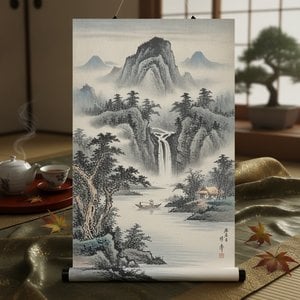
A Chronicler of Tokyo’s Soul: The Life and Art of Takanori Oguiiss
Takanori Oguiiss (1901-1986) stands as a poignant observer of 20th-century Japan, specifically the rapidly evolving cityscape of Tokyo. While not widely known outside specialized circles until recently, his paintings offer an intimate and invaluable glimpse into the daily life, atmosphere, and subtle beauty of a metropolis undergoing dramatic transformation. Born in a period of immense social and political change – the waning years of the Edo period and the dawn of the Meiji Restoration – Oguiiss’s artistic sensibility was deeply rooted in capturing the ephemeral moments often overlooked amidst grand historical narratives. He wasn't interested in imperial portraits or sweeping landscapes; his focus lay on the streets, the people, the rain-slicked pavements, and the glow of lanterns illuminating a bustling evening.
Early Life and Artistic Formation
Details regarding Oguiiss’s formal artistic training remain somewhat scarce, contributing to the mystique surrounding his work. It is believed he received instruction in traditional Japanese painting techniques – *nihonga* – which emphasized meticulous detail, subtle color palettes, and a reverence for nature. However, unlike many of his contemporaries who adhered strictly to these conventions, Oguiiss began to subtly incorporate elements influenced by Western Impressionism and Realism. This fusion wasn’t abrupt; rather, it was a gradual absorption of new perspectives that allowed him to more accurately convey the dynamism and energy he perceived in modern Tokyo. He eschewed the idealized depictions common in traditional art, opting instead for a raw, honest portrayal of urban life. His early works demonstrate a fascination with light and shadow, reminiscent of European masters but applied to distinctly Japanese subjects.
The Tokyo Street Scenes: A Unique Artistic Vision
Oguiiss’s most celebrated body of work centers on his depictions of Tokyo street scenes. These paintings are not merely representations of physical locations; they are atmospheric studies imbued with a profound sense of place and time. He frequently painted the Ginza district, known for its upscale shops and theaters, but also ventured into less glamorous neighborhoods, capturing the everyday lives of ordinary citizens. His technique is characterized by delicate brushwork, muted colors – often dominated by grays, blues, and browns – and a masterful use of perspective to create depth and realism.
What sets Oguiiss apart is his ability to capture the *feeling* of Tokyo. The rain-soaked streets reflecting neon lights, the blurred figures hurrying past in the twilight, the quiet intimacy of small shops—these are not simply visual observations but emotional experiences translated onto canvas. He often painted from memory or sketches made on location, allowing him to distill the essence of a scene rather than meticulously documenting every detail. His paintings evoke a sense of nostalgia and longing, even for those who never experienced Tokyo during his lifetime.
Influences and Historical Context
While Oguiiss’s style is uniquely his own, several influences can be discerned in his work. The *ukiyo-e* woodblock prints of the Edo period – particularly the works of artists like Utagawa Hiroshige and Katsushika Hokusai – undoubtedly informed his compositional sensibilities and his appreciation for everyday life as a worthy subject matter. However, Oguiiss moved beyond the stylized conventions of *ukiyo-e*, embracing a more naturalistic approach to representation.
The rise of modernism in Japan during the early 20th century also played a role in shaping his artistic vision. The influx of Western art and ideas challenged traditional norms and encouraged artists to experiment with new forms and techniques. Oguiiss’s subtle incorporation of Impressionist principles – such as broken color and an emphasis on capturing fleeting moments – reflects this broader cultural shift. His work can be seen as a bridge between tradition and modernity, blending the aesthetic values of *nihonga* with the innovative spirit of Japanese modernism.
Legacy and Significance
Despite not achieving widespread recognition during his lifetime, Takanori Oguiiss’s paintings have gained increasing attention in recent years. His work offers a rare and valuable glimpse into the social and cultural landscape of Tokyo during a period of rapid transformation. He documented a city on the cusp of change, capturing the beauty and complexity of urban life before it was irrevocably altered by modernization.
His paintings serve as historical documents, providing insights into the architecture, fashion, and daily routines of early 20th-century Tokyo.
They also offer a powerful commentary on the human condition, exploring themes of alienation, loneliness, and the search for meaning in a rapidly changing world.
Oguiiss’s unique artistic vision – blending traditional Japanese techniques with elements of Western modernism – continues to inspire artists today.
His legacy lies not in grand pronouncements or revolutionary styles but in his quiet, unwavering dedication to capturing the soul of a city and the lives of its people. He was, ultimately, a chronicler of Tokyo’s spirit—a painter who found beauty in the ordinary and transformed it into enduring art.
Uredništvo ArtsDot.com
Kviz o umetnosti
Svako pitanje ima samo jedan tačan odgovor.
Pitanje 1:
What was Takanori Ogisu’s birthplace?
Pitanje 2:
Where did Ogisu study painting initially?
Pitanje 3:
Who encouraged Ogisu and Yamaguchi to study in France?
Pitanje 4:
In what Parisian district did Ogisu establish himself as an artist?
Pitanje 5:
What was Ogisu’s primary subject matter in his paintings?
Explore the rich history of landscape art with ArtsDot. Discover renowned artists, movements like Impressionism & Romanticism, and expert guidance for collecting timeless pieces. Find your perfect serene escape today!
Uronite u svet Katsushike Hokusaija! Otkrijte 25 remek-dela japanskog umetnika, uključujući čuveni 'Veliki talas'. Ukiyo-e štampe, pejzaži i istorija iza svakog dela. Pronađite inspiraciju za dekor enterijera i kupite reprodukcije slika vrhunskog kvaliteta na ArtsDot.com.
Discover the serene beauty of Japanese landscape painting. From Hokusai's iconic woodblock prints to meditative sumi-e ink washes, explore a visual journey through the 'floating world' and learn how to bring this timeless Zen aesthetic into your modern home decor.