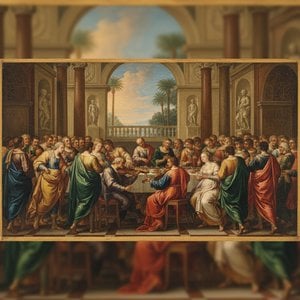
Paolo Ventura, born in Laveno-Mombello, Italy, is a contemporary artist whose work transcends simple categorization. He isn’t merely a photographer; he's a storyteller, a builder of worlds, and an evocative conjurer of memory. His practice centers around meticulously crafted dioramas – miniature scenes populated by figures that seem to step out of faded photographs or half-remembered dreams. These aren’t recreations of reality, but rather the *construction* of it, born from personal narratives, family history, and a deep fascination with the aesthetics of mid-20th century Italy. Ventura's art is deeply rooted in his upbringing near Lake Maggiore, an environment that instilled in him a love for theatricality, storytelling, and the beauty found within everyday objects. He initially trained as a painter at the Academy of Brera in Milan, but quickly gravitated towards photography as a means to explore his artistic vision more fully. This background in painting is crucial; it informs the rich detail, dramatic lighting, and carefully composed scenes that characterize his work.
Early Influences and Artistic Development
Ventura’s early work explored themes of isolation and alienation through stark black-and-white photography. However, a pivotal shift occurred when he began to build his own sets and props, realizing the limitations of finding pre-existing environments that truly matched the images in his mind. This marked the birth of his signature diorama style. He started small, creating intimate scenes often featuring solitary figures – soldiers, children, or anonymous individuals caught in moments of quiet contemplation. These early works were imbued with a sense of melancholy and nostalgia, hinting at untold stories and hidden emotions. The influence of Italian Neorealist cinema is palpable here; the grainy texture, naturalistic lighting, and focus on everyday life echo the aesthetic of filmmakers like Vittorio De Sica and Roberto Rossellini. But Ventura doesn’t simply replicate this style; he infuses it with a distinctly personal sensibility, creating worlds that are both familiar and unsettlingly strange. He draws heavily from his family's past, particularly the experiences of his father and grandfather during World War II, weaving their stories into the fabric of his art.
The Construction of Memory: Themes and Techniques
Ventura’s dioramas aren’t simply visually striking; they are deeply conceptual works that explore the subjective nature of memory and the power of narrative. He meticulously constructs each scene from scratch, using found objects, handmade props, and carefully positioned figures. The scale is deliberately small – often just a few inches high – which creates a sense of intimacy and invites viewers to peer into these miniature worlds as if looking through a keyhole. The deliberate imperfections in his constructions are crucial. He doesn’t strive for photorealistic accuracy; instead, he embraces the handmade quality of his work, leaving visible brushstrokes, uneven textures, and subtle distortions. This adds to the sense that these aren't representations of reality, but rather reconstructions – fragmented memories filtered through the lens of time and imagination. His frequent use of sepia tones and vintage-style printing techniques further enhances this nostalgic atmosphere. The themes he explores are often complex and ambiguous: loss, longing, identity, and the search for meaning in a chaotic world.
Major Achievements and Recognition
Ventura’s work has garnered international acclaim, exhibited in galleries and museums around the globe. He's been praised for his unique artistic vision, technical skill, and ability to evoke powerful emotions through seemingly simple scenes. His series “War Souvenir” – featuring miniature dioramas depicting scenes from World War II – is perhaps his most well-known work. These haunting images explore the psychological impact of war on individuals and families, challenging traditional notions of heroism and patriotism. The series isn’t about glorifying conflict; it's about exploring the human cost of violence and the enduring scars left behind. He has published several monographs showcasing his work, further solidifying his reputation as a leading contemporary artist. His ability to blend photography, sculpture, and storytelling has inspired a new generation of artists working in similar fields.
Historical Significance and Lasting Impact
Paolo Ventura’s contribution to contemporary art lies in his innovative approach to image-making and his exploration of the subjective nature of memory. He challenges viewers to question the authenticity of photographs and to recognize that all images are, ultimately, constructions – interpretations of reality shaped by personal experience and cultural context. His work stands as a powerful reminder of the importance of storytelling and the enduring power of the human imagination.
Ventura’s influence extends beyond the realm of photography, impacting artists working in sculpture, installation art, and even filmmaking.
His dioramas have been described as “photographic novels” – miniature worlds that tell complex stories without relying on traditional narrative structures.
He has helped to redefine the boundaries of contemporary art, blurring the lines between different disciplines and challenging conventional notions of artistic practice.
His legacy is one of poetic beauty, haunting nostalgia, and a profound exploration of the human condition.
Explore the captivating world of Giovanni Paolo Panini, master of Roman vedute painting. Discover his technique, iconic works, influence on art history & collecting advice from experts at ArtsDot.
Explore the vibrant world of Paolo Veronese, a Renaissance master renowned for his opulent compositions, masterful use of color, and dramatic Venetian scenes. Discover key artworks & legacy.
Postoji li hronološki pregled radova umetnika Paolo Sala?
Hronološki prikaz radova umetnika Paolo Sala dostupan je na njegovoj stranici Hronika, gde se dela predstavljaju redom stvaranja, poglavlje po poglavlje.
Mogu li da istražim dela umetnika Paolo Sala prema temi?
Radove umetnika Paolo Sala možete istražiti prema tematici na njegovoj stranici Atlas tema.
Mogu li da istražim dela umetnika Paolo Sala prema kolorističkom spektru?
Stranica Spektar boja organizuje dela umetnika Paolo Sala prema boji.
Mogu li da pregledam dela umetnika Paolo Sala prema medijumu?
Radove umetnika Paolo Sala možete pregledati prema tehnici na stranici Svi mediji.
Mogu li da pregledam dela umetnika Paolo Sala prema raspoloženju?
Na stranici Soba po raspoloženju umetnik Paolo Sala prikazuje svoja dela poređana prema njihovoj atmosferi.
Mogu li da pregledam dela umetnika Paolo Sala prema paleti boja?
Radove umetnika Paolo Sala možete pregledati prema paleti boja na Preko palete boja stranici umetnika.
Gde mogu da pogledam sva dela umetnika Paolo Sala?
Sva dela umetnika Paolo Sala na ovaj sajt možete pregledati na njegovoj/njenoj stranici sa Sva umetnička dela.
Postoji li hronološki prikaz dela umetnika Paolo Sala?
Stranica Hronologija dela umetnika prikazuje dela umetnika Paolo Sala poređana hronološki, godinu po godinu.
U kom istorijskom periodu je stvarao/la Paolo Sala?
Paolo Sala je radila u periodu 19th Century. Ovaj period smešta umetnikov rad u istorijski kontekst.