Meni
BESPLATNE KONSULTACIJE SA STRUČNJAKOM ZA UMETNOST

Osnovne informacije

  • Born: 1933
  • Works on APS: 8
  • Copyright status: Under copyright
  • Lifespan: 86 years
  • Top-ranked work: Duplex
  • Prikaži više…
  • Art period: Modern
  • Also known as: Joseph Boucher De Niverville
  • Died: 2019
  • Top 3 works:
    • Duplex
    • Nude and Orange Bird
    • Seated Woman with Orange Shoes (Or) The Girl He Left Behind

Kviz o umetnosti

Svako pitanje ima samo jedan tačan odgovor.

Pitanje 1:
What was Louis de Niverville’s primary artistic influence during his childhood?
Pitanje 2:
Where did Louis de Niverville begin his career as a graphic designer?
Pitanje 3:
What is Louis de Niverville known for in terms of his artistic style?
Pitanje 4:
Which prestigious order was Louis de Niverville awarded by the French monarchy?
Pitanje 5:
Louis de Niverville’s monumental mural “Le Roi S’Amuse” was commissioned for what iconic location?

Louis de Niverville (1933 – 2019): A Visionary Painter Bridging Neoclassicism and Surrealism

Louis de Niverville was born in Andover, England, in 1933 to Canadian parents, Éméla Noël and Albert de Niverville. Shortly after his birth, the family relocated to Montreal where he spent his formative years immersed in a vibrant multicultural environment. Recognizing early on the profound impact of illness on creativity—he endured spinal tuberculosis from age six until 1944—de Niverville attributed much of the fantastical quality characteristic of his later artistic endeavors to this period of isolation and introspection. He honed his skills through self-teaching, drawing inspiration from artists like Max Ernst, Salvador Dali, Matisse, Rousseau, Saul Steinberg, James Thurber, and Pierre Bonnard. These influences shaped his distinctive style—a blend of surrealism, symbolism, and primitivism—which sought to capture the essence of dreams, memories, and subconscious impulses.

Early Life and Artistic Beginnings

De Niverville’s fascination with visual art began at a young age when he encountered the witty illustrations in Saul Steinberg's book “All in Line” (1945). Encouraged by his mentor, Paul Arthur—who recognized his talent and urged him to pursue formal artistic training—he moved to Toronto in 1957. There, he secured employment as a graphic designer at CBC with Dennis Burton and Graham Coughtry, furthering his artistic development and establishing connections within the Canadian art scene. He joined the Royal Canadian Academy of Art (RCA) in 1963, marking a significant milestone in his career.

Career Highlights: Mural Commissions and Artistic Recognition

Throughout his prolific career spanning over six decades, Louis de Niverville achieved considerable acclaim as a muralist, illustrator, and printmaker. Notably, he undertook commissions for Toronto International Airport (1963) and the atrium of The Hospital for Sick Children (Toronto) (1993), demonstrating his commitment to public art projects and engaging with diverse audiences. His monumental mural “The Maple Tree,” installed in Halifax’s Maple condominium complex in 2008, stands as a testament to his artistic vision and enduring legacy. Furthermore, he received four senior Canada Council grants which supported his ongoing artistic exploration and broadened his intellectual horizons.

Style and Influences: Surrealism and Beyond

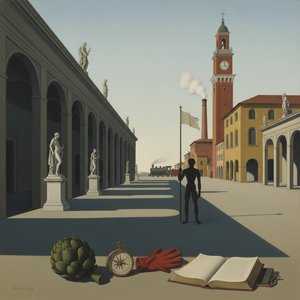
De Niverville’s artistic style was characterized by an imaginative blend of surrealist techniques—particularly “inside-outside” spaces—infused with elements of symbolism and primitivism. He explored themes ranging from personal recollections and subconscious desires to landscapes, architectural grandeur, and animal imagery. His meticulous attention to detail combined with a masterful command of color and texture resulted in artworks that captivated viewers with their evocative beauty and intellectual depth. Like many artists before him, he drew inspiration from masters such as Matisse, Rousseau, Ernst, Dali and Steinberg.

Legacy and Artistic Influence

Louis de Niverville’s enduring impact on Canadian art is undeniable. His multifaceted oeuvre—spanning paintings, collages, prints, and mural commissions—continues to inspire artists and scholars alike. Recognized for his distinctive style and unwavering dedication to artistic exploration, he solidified his place as a pivotal figure in the history of modernist painting. His work resides in numerous public collections across Canada and internationally, ensuring that his visionary aesthetic will resonate for generations to come.