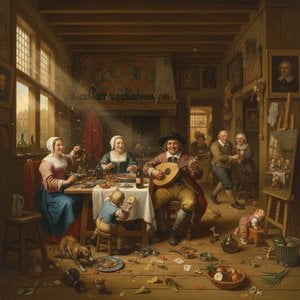
Johannes Verkolje: A Delft Master of Elegance and Light
Johannes Verkolje (1650-1693) stands as a captivating figure within the vibrant tapestry of 17th-century Dutch art. Born in Amsterdam, he ultimately established himself as a leading portraitist and genre painter centered in the elegant city of Delft, where his refined style and technical skill earned him considerable renown. While not boasting the dramatic flair of Rembrandt or the grand scale of Rubens, Verkolje’s contribution lies in his ability to capture subtle nuances of character, domestic tranquility, and the luminous quality of light – hallmarks of a distinctly Delft aesthetic. His legacy is preserved through a remarkable body of work, offering intimate glimpses into the lives and social circles of his era.
Verkolje's early life remains somewhat shrouded in mystery, though biographical accounts suggest a precocious talent. Legend has it that a childhood injury – a mishap involving darts – led to prolonged bed rest, during which he discovered a passion for copying prints. This nascent skill blossomed under the guidance of Jan Andrea Lievens, a prominent Amsterdam painter, marking the beginning of his artistic journey. A pivotal move in 1672 brought him to Delft, coinciding with the tumultuous “rampjaar” (disaster year) that reshaped the Dutch Republic. This relocation proved strategically advantageous; Delft’s wealthy merchant class and aristocratic patrons provided Verkolje with unparalleled opportunities for commissions, solidifying his position within the city's artistic landscape.
A Portraitist of Distinction
Verkolje quickly established himself as a sought-after portrait painter, catering to a diverse clientele ranging from prominent figures like Antonie van Leeuwenhoek – whose meticulously rendered likeness in oil and mezzotint remains one of his most celebrated works – to members of Delft’s legal elite, including Johan de la Faille and his wife. His portraits weren't merely representations of physical appearance; they were carefully constructed narratives, imbued with an air of sophistication and social standing. He skillfully employed lighting and composition to convey personality, capturing not just the outward form but also the inner character of his subjects. Notably, Verkolje’s portraiture often eschewed the overtly dramatic poses favored by some contemporaries, instead opting for a more naturalistic approach that emphasized grace and composure.
Beyond individual portraits, Verkolje excelled in depicting couples within intimate domestic settings – scenes of refined leisure and quiet companionship. These genre paintings, frequently set in richly furnished interiors, offer valuable insights into the social customs and material culture of Delft society. The use of light is particularly noteworthy here, bathing the figures in a warm, inviting glow that evokes a sense of comfort and serenity. His ability to render fabrics, textures, and reflections with remarkable detail further enhances the realism and visual appeal of these scenes.
The Mezzotint Master
While primarily recognized for his paintings, Verkolje’s contribution to printmaking was equally significant. He possessed a rare talent for mezzotint – a technique involving the creation of tonal values through the roughening of metal plates. This allowed him to achieve astonishingly rich and velvety blacks, particularly effective in depicting fabrics and shadows. He wasn't simply replicating existing engravings; Verkolje developed his own distinctive style within the medium, utilizing subtle gradations of tone and carefully controlled hatching to create a remarkable sense of depth and atmosphere. His mezzotints of Leeuwenhoek and other figures demonstrate both technical mastery and artistic sensitivity.
Legacy and Influence
Johannes Verkolje’s career was tragically cut short by illness in 1693, at the age of 43. Despite his relatively brief working life, he left behind a substantial body of work that continues to captivate viewers today. His influence can be seen in the works of subsequent Delft painters, particularly in their emphasis on elegant portraiture and the skillful use of light. Verkolje’s legacy is not one of revolutionary innovation but rather of consistent refinement – a testament to his dedication, technical skill, and keen eye for capturing the beauty and complexity of human experience within the context of 17th-century Dutch society. His paintings and prints remain treasured examples of Delft painting, offering enduring insights into a bygone era.