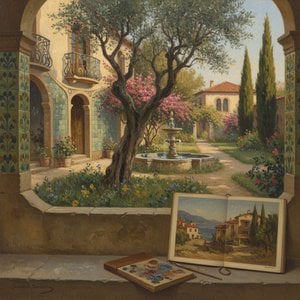
Joaquín Sorolla y Bastida – A Life Bathed in Light
Joaquín Sorolla y Bastida, a name synonymous with the radiant light and vibrant energy of Spain, was more than just a painter; he was a chronicler of his nation’s soul. Born in Valencia in 1863, Sorolla's early life was marked by tragedy. Orphaned at the tender age of two following a cholera epidemic that claimed both parents, young Joaquín and his sister were raised by their maternal aunt and uncle. This early experience with loss perhaps instilled within him a profound appreciation for the fleeting beauty of life – a sentiment that would permeate his art. Though hardship shadowed his beginnings, it did not dim the spark of artistic talent that quickly became apparent. He received initial instruction in Valencia, demonstrating an aptitude that led to studies under established artists like Cayetano Capuz and José Benlliure, eventually culminating in a four-year grant to study in Rome. It was there, amidst the classical grandeur of Italy, that Sorolla began to forge his unique artistic path, absorbing influences while simultaneously developing a style distinctly his own.Early Life and Influences
Joaquín Sorolla’s formative years instilled within him a deep sensitivity to loss – an experience profoundly shaping his artistic vision. Born on February 27, 1863, in Valencia, Spain, he was the eldest child of Joaquín Sorolla Bastida, a tradesman, and Concepción Bastida. Tragically, both parents succumbed to cholera just two years later, leaving him and his sister under the care of their maternal aunt and uncle. This early exposure to sorrow undoubtedly fueled his desire to capture moments of beauty before they vanished—a preoccupation that would become central to his oeuvre. Recognizing his exceptional talent at a young age, Sorolla pursued formal artistic training in Valencia, studying under prominent figures like Cayetano Capuz and José Benlliure. His dedication to mastering technique was further solidified by a scholarship enabling him to embark on a four-year journey of artistic exploration in Rome, Italy—a pivotal moment that exposed him to the stylistic innovations of Impressionism and Luminism. The influence of artists such as Francisco Pradilla Ortiz and Jules Bastien-Lepage proved particularly formative, shaping Sorolla’s approach to composition and color palettes.Rome and Artistic Development
Sorolla's time in Rome marked a decisive turning point in his artistic evolution. He enrolled at the Spanish Academy, immersing himself in the study of classical sculpture and painting—a deliberate effort to absorb the stylistic heritage of antiquity while simultaneously experimenting with new techniques. The atmosphere of the Italian capital fostered an openness to experimentation that would characterize his subsequent work. Sorolla’s fascination with Impressionism was palpable; he meticulously observed the effects of sunlight on surfaces, striving to reproduce its shimmering brilliance and transient nuances. This pursuit of luminosity—a hallmark of Luminism—became a defining element of his artistic style. He diligently copied works by masters like Velázquez and Rembrandt, honing his observational skills and refining his understanding of tonal gradation. Furthermore, Sorolla’s engagement with Parisian art circles exposed him to the avant-garde currents circulating at the time, broadening his artistic horizons and enriching his stylistic repertoire.The Valencian Coast: A Celebration of Light
Sorolla's artistic sensibilities found their most compelling expression in his depictions of the Valencian coast—a landscape he regarded as a source of endless inspiration. Unlike many artists of his era who favored studio settings, Sorolla championed *plein air* painting—working outdoors directly confronted with the challenges and rewards of capturing fleeting light conditions. This commitment to observation resulted in canvases brimming with vitality and immediacy—images infused with the warmth of Mediterranean sunshine and the dynamism of coastal life. His iconic beach scenes—such as Children on the Seashore and Sewing the Sail—are not merely picturesque representations; they are profound meditations on beauty, joy, and the ephemeral nature of existence. Sorolla’s technique—characterized by loose, energetic brushstrokes—was revolutionary for its time. He employed a bold palette dominated by yellows, oranges, and blues—colors he skillfully manipulated to convey the illusion of shimmering light and atmospheric haze. The resulting canvases possess an unparalleled sense of spontaneity and emotional depth—a testament to Sorolla’s mastery of Luminism and his unwavering devotion to capturing the essence of his beloved homeland.Legacy and Recognition
Joaquín Sorolla y Bastida achieved international renown during his lifetime, becoming one of Spain's most celebrated artists. His prolific output encompassed portraits, landscapes, historical narratives, and monumental murals—each infused with a distinctive stylistic signature. He exhibited extensively throughout Europe and the United States, garnering critical acclaim and securing commissions from prominent patrons. Sorolla’s magnum opus, Vision of Spain—a series of fourteen canvases commissioned by Archer Milton Huntington—stands as an enduring monument to his artistic vision and technical prowess. Completed posthumously, these murals captured the spirit of Spain's diverse regional cultures—celebrating its traditions, costumes, and landscapes with breathtaking grandeur. Sorolla’s influence extended far beyond his own era, inspiring generations of artists who embraced Luminism and sought to emulate his masterful technique. Today, Sorolla’s paintings reside in major museums worldwide—including the Museo Sorolla in Madrid—where they continue to captivate audiences with their luminous beauty and emotional resonance—affirming his place as one of Spain's greatest artistic treasures.Pitanja i odgovori
Gde je i kada je rođen/a Joaquin Sorolla?
Joaquin Sorolla je rođen/a u gradu Валенсия godine 1863.
Gde se dela umetnika Joaquin Sorolla mogu pronaći organizovana po boji?
Stranica Spektralni indeks organizuje dela umetnika Joaquin Sorolla prema boji.
U kom gradu i državi je rođen/a Joaquin Sorolla?
Joaquin Sorolla je rođen/a u gradu Валенсия, u državi Испанија.
Postoji li hronološki prikaz za Joaquin Sorolla?
Hronološki prikaz radova umetnika Joaquin Sorolla dostupan je na njegovoj stranici Hronologija, gde se dela predstavljaju redom stvaranja, poglavlje po poglavlje.
Otkud je Joaquin Sorolla?
Joaquin Sorolla je rođen/a u Испанија.
Mogu li da pregledam dela umetnika Joaquin Sorolla prema paleti boja?
Radove umetnika Joaquin Sorolla možete pregledati prema paleti boja na Preko palete boja stranici umetnika.
Postoji li pregled svih motiva koje je Joaquin Sorolla naslikao/la?
Atlas tema za Joaquin Sorolla je stranica koja mapira umetnikova dela prema njihovim motivima.