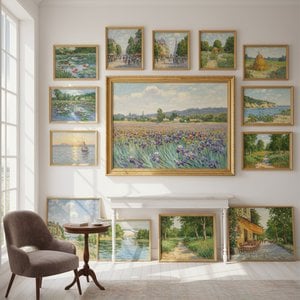
The Enigmatic Visions of Jacobus Schoemaker Doyer
Jacobus Schoemaker Doyer remains a somewhat elusive figure in the pantheon of 19th-century Dutch landscape painting, yet his work possesses a quiet power and distinctive atmosphere that continues to captivate. Born in The Hague, Netherlands, in 1843, Doyer emerged during a period of significant artistic transition, bridging the Romantic ideals of earlier generations with the burgeoning Realism and Impressionistic tendencies that would define the latter half of the century. While biographical details surrounding his life are scarce – a testament to his reserved nature and perhaps a lack of self-promotion – the paintings themselves speak volumes about his deep connection to the Dutch countryside and his masterful ability to evoke mood and light. He died in 1909, leaving behind a legacy of evocative landscapes that offer a poignant glimpse into a vanishing world.
Early Influences and Artistic Development
Doyer’s artistic journey began with formal training at the Royal Academy of Fine Arts in The Hague, where he honed his skills in traditional landscape techniques. However, it was through direct observation of nature that his unique style truly blossomed. He became deeply influenced by the Barbizon school painters – Théodore Rousseau and Charles-François Daubigny among them – whose emphasis on plein air painting and realistic depictions of rural life resonated with Doyer’s own sensibilities. Unlike many of his contemporaries who sought to capture grand, dramatic vistas, Doyer focused on the more intimate aspects of the Dutch landscape: quiet meadows bathed in soft light, winding waterways reflecting the changing sky, and humble farmsteads nestled amongst the trees. His early works demonstrate a meticulous attention to detail, reminiscent of the Hague School’s focus on capturing the nuances of atmospheric conditions. He skillfully rendered the subtle gradations of color and texture that characterize the Dutch lowlands, creating paintings that are both realistic and deeply poetic.
A Master of Atmospheric Perspective
Doyer's mature style is characterized by a remarkable sensitivity to light and atmosphere. He wasn’t interested in simply reproducing what he *saw*, but rather in conveying how the landscape *felt*. His paintings often feature muted color palettes – predominantly greens, browns, and grays – which contribute to their melancholic yet serene mood.
He was particularly adept at capturing the effects of mist and fog, using subtle tonal variations to create a sense of depth and distance. This mastery of atmospheric perspective is evident in works such as “Marsh Landscape with Cattle,” where the receding planes are blurred by a delicate haze, drawing the viewer into the scene and evoking a feeling of quiet contemplation.
His ability to render these ephemeral effects was highly praised by his contemporaries, who recognized him as one of the leading exponents of atmospheric landscape painting in the Netherlands.
Themes and Symbolism in Doyer’s Work
While seemingly straightforward depictions of rural life, Doyer's paintings often contain subtle layers of symbolism. The presence of cattle, for example, is not merely a matter of depicting farm animals; it represents a connection to the land, a sense of pastoral harmony, and perhaps even a nostalgic longing for a simpler way of life.
- The waterways that frequently appear in his paintings can be interpreted as metaphors for the passage of time and the ever-changing nature of existence.
- His depictions of farmsteads often evoke a sense of solitude and resilience, suggesting the enduring spirit of the Dutch people in the face of adversity.
- The soft, diffused light that permeates his work can be seen as representing hope and renewal, even amidst the melancholy atmosphere.
Doyer’s paintings are not overtly didactic or moralizing; rather, they invite viewers to reflect on their own relationship with nature and the deeper meaning of life.
Historical Significance and Legacy
Although he never achieved widespread fame during his lifetime, Jacobus Schoemaker Doyer's work has experienced a resurgence in popularity in recent years. His paintings are now recognized as important examples of Dutch landscape painting from the 19th century, offering a unique perspective on the country’s rural heritage.
He stands apart from many of his contemporaries due to his understated style and his focus on capturing the subtle nuances of atmosphere and mood. Doyer's legacy lies in his ability to create paintings that are both visually beautiful and emotionally resonant, inviting viewers to connect with the Dutch countryside on a deeply personal level. His work continues to inspire artists and art lovers alike, serving as a reminder of the enduring power of nature and the importance of preserving our cultural heritage.