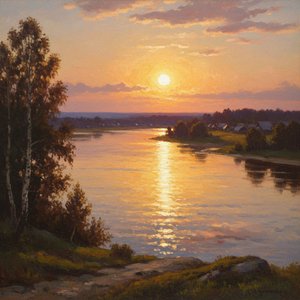
The Quiet Observer of the Berezina
Born in Astroŭki, Belarus, in 1828, Ippolit Goravsky occupied a specific, often overlooked niche within the landscape traditions of the Russian Empire. His life was shaped by the rigorous training of the Academy, where he studied under Sokrat Vorobyov. This formal education provided the technical foundation for a career spent documenting the subtle shifts of the natural world. Unlike many of his contemporaries who sought the grandiosity of historical scenes, Goravsky turned his gaze toward the riverbanks and rural stretches of his homeland.
His work from the mid-nineteenth century reflects a commitment to the specificities of place. In 1857, he produced On the banks of the Berezina River, a work that captures a particular sense of geography and light. His approach was characterized by a steady, observational hand, focusing on the quietude of the Belarusian landscape rather than the dramatic spectacles favored by the academic mainstream.
Technical Foundations and Subject Matter
The development of his style was rooted in the disciplined instruction of his mentors. He did not seek to disrupt the established order of the Academy but rather to expand its reach into the rural territories of Belarus and Ukraine. His paintings functioned as visual records of a way of life that was often ignored by the urban-centric art circles of the era.
- Early training under Sokrat Vorobyov
- Focus on the Berezina River region
- Documentation of rural landscapes
His output remained focused on the intersection of light and terrain. He sought to translate the atmosphere of the countryside into a permanent visual form, ensuring that the specific character of the Belarusian landscape was preserved through his brushwork.
A Life of Quiet Documentation
Goravsky’s significance lies in his role as a chronicler of the periphery. While the major art movements of the nineteenth century moved toward various forms of realism and impressionism, his work remained anchored in the physical reality of the land. He was a painter of the specific, finding substance in the riverbanks and the quiet stretches of the empire's borderlands.
He lived through a period of significant transition, yet his artistic identity remained tied to the soil and the water. His legacy is found in the quiet permanence of his landscapes, which offer a window into the mid-century atmosphere of the regions he called home.