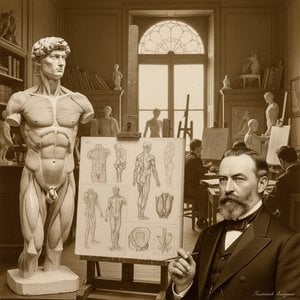
The Curious World of Gerard Thomas: A Physician’s Artistic Vision
Gerard Thomas, a name perhaps unfamiliar to many outside the circles of medical history and art connoisseurship, represents a fascinating intersection of scientific observation and artistic expression. While biographical details remain somewhat elusive – he is a living artist represented by ArtsDot – his body of work speaks volumes about Victorian sensibilities, the evolving understanding of medicine, and a unique dedication to documenting the profession through paint. Thomas’s paintings aren't simply depictions of doctors or hospitals; they are windows into a world where clinical practice was interwoven with social status, artistic patronage, and a burgeoning fascination with the human body. He stands as a testament to the idea that art can be both aesthetically pleasing and profoundly informative, serving as a historical record alongside its inherent beauty.
A Legacy Rooted in Observation: Themes and Techniques
Thomas’s oeuvre is dominated by scenes of medical life, particularly those centered around St Thomas' Hospital in London. He masterfully captures the atmosphere of 19th-century hospitals – not as sterile environments but as bustling centers of activity filled with dedicated physicians, anxious patients, and a complex social hierarchy. His paintings often feature portraits of prominent doctors, rendered with meticulous detail that conveys both their professional authority and individual character. Beyond portraiture, Thomas delves into the specifics of medical procedures and diagnostic tools. Perhaps most strikingly, he is known for his depictions of urine flasks – seemingly mundane objects elevated to symbolic importance through his artistic treatment. These aren’t merely clinical specimens; they represent a crucial element in Victorian diagnosis, reflecting the era's reliance on visual observation and humoral theory. His technique leans towards realism, with a focus on accurate representation of anatomy, clothing, and hospital interiors. The lighting in his works often creates dramatic effects, highlighting key figures or objects and drawing the viewer’s eye to the core narrative. He employs a rich palette, favoring earth tones and muted colors that evoke a sense of historical authenticity.
Influences and Context: Victorian Medicine & Artistic Patronage
To understand Thomas's work fully, one must consider the context of Victorian medicine. The 19th century witnessed significant advancements in medical knowledge, driven by discoveries in anatomy, physiology, and bacteriology. However, it was also a period marked by social inequalities and limited access to healthcare for many. St Thomas’ Hospital, where much of Thomas's work is set, played a pivotal role in this era, serving as both a teaching institution and a public hospital. The hospital benefited from the patronage of wealthy benefactors, including members of the aristocracy, who often commissioned portraits of themselves or prominent doctors. This system of patronage likely influenced Thomas’s career, providing him with opportunities to document the lives of those associated with the hospital. Artistically, Thomas's work reflects the influence of Realism and academic painting traditions prevalent in Victorian England. He shares similarities with artists like William Powell Frith and John Everett Millais in his attention to detail and narrative focus, though Thomas’s subject matter remains uniquely centered on the world of medicine. The Baron Gerard Museum, while not directly linked as a patron, represents the aristocratic context within which such art flourished.
Major Achievements & Historical Significance
While pinpointing specific “major achievements” is difficult given the limited biographical information available, Thomas’s lasting contribution lies in his comprehensive documentation of Victorian medical life. His paintings offer invaluable insights into the practices, social dynamics, and visual culture of 19th-century hospitals. The focus on seemingly overlooked objects like urine flasks elevates them to symbolic status, prompting viewers to consider the importance of diagnostic tools and the role of observation in medical practice.
His work serves as a bridge between art history and medical history, providing scholars with visual evidence of past clinical environments and patient care. Furthermore, his portraits offer glimpses into the lives of prominent physicians, capturing their personalities and professional standing within society. The enduring appeal of Thomas’s paintings lies in their ability to evoke a sense of empathy for both doctors and patients, reminding us that medicine has always been a human endeavor.
His legacy is one of meticulous observation, artistic skill, and a unique dedication to documenting the evolving world of healthcare.
Continuing Relevance: Thomas’s Art in the 21st Century
In an age dominated by digital imaging and advanced medical technology, Gerard Thomas's paintings offer a poignant reminder of the origins of modern medicine. His work encourages us to reflect on the historical context of clinical practice and the challenges faced by physicians in past eras.
- The detailed depictions of hospital interiors provide valuable insights into the evolution of healthcare environments.
- His portraits offer a humanizing perspective on the lives of doctors, challenging stereotypical representations of medical professionals.
- The symbolic importance he assigns to everyday objects like urine flasks prompts viewers to consider the role of observation and diagnostic tools in medical practice.
Through platforms like ArtsDot, Thomas’s paintings are now accessible to a wider audience, ensuring that his unique artistic vision continues to inspire and inform generations to come. His work is not merely a historical artifact; it is a testament to the enduring power of art to illuminate the human condition and document the complexities of our shared past.