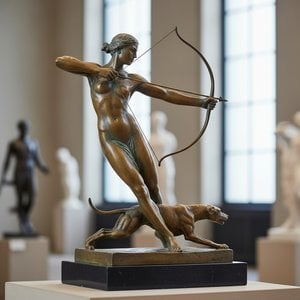
The Sculptor of Memory and Diaspora
Enoch Hendrik Glicenstein, a name that echoes through the corridors of European and American art history, was an artist whose life was as much a journey of displacement as it was one of profound creative discovery. Born in 1870 in Turek, Poland, into a family where craftsmanship was woven into the very fabric of daily existence, Glicenstein’s early years were shaped by the tactile reality of his father’s trade as a monumental mason. This intimate connection to stone and form provided the foundational language for a career that would eventually transcend borders. Though initially destined for the spiritual path of the rabbinate, the pull of the aesthetic was irresistible. His early endeavors in Łódź—painting signs and carving wood—served as a prelude to a formal education at the Royal Bavarian Academy of Art in Munich, where he began to master the delicate balance between raw material and emotive expression.
The trajectory of Glicenstein’s life took a transformative turn when he moved to Rome, adopting the Italianate name Enrico. This period of his life was marked by a deep immersion in the classical and avant-garde currents of Italy, a time during which he became an Italian citizen and established a family. His marriage to Helena Hirsztenberg in 1896 anchored him within a vibrant intellectual milieu, allowing him to absorb the light and history of the Eternal City. It was here that his sculptural voice began to mature, blending the rigorous training of Munich with the soulful, classical echoes of Rome. His achievements during this era were notable, including winning the prestigious Prix de Rome twice, an honor that solidified his standing among the elite sculptors of his generation.
A Life in Motion: From Warsaw to New York
The twentieth century brought with it a series of seismic shifts that would force Glicenstein to navigate the complexities of a world in upheaval. In 1910, he assumed the Chair of Sculpture at the University of Warsaw, demonstrating a profound commitment to the academic and pedagogical advancement of his craft. However, the shadows of World War I eventually disrupted this stability, leading him through Switzerland and eventually to London in 1920. This period of wandering was not merely a flight from conflict but an expansion of his artistic horizons. In London, he engaged with new collectors and critics, ensuring that his work continued to resonate within the international art dialogue.
The final chapter of his migratory journey led him to the United States in 1926, where he settled in New York City. This transition from the old world of Europe to the burgeoning energy of America allowed his work to encounter new perspectives and materials. Throughout his travels, Glicenstein remained a sculptor of deep psychological resonance, capable of imbuing bronze and stone with a sense of human vulnerability and historical weight. His legacy is not merely found in the physical objects he left behind, but in the way his art bridged the gap between the traditions of the past and the modern anxieties of a century defined by movement and loss.
The enduring significance of Enrico Glicenstein can be summarized through several key facets of his career:
- Mastery of Form: His ability to translate the heavy permanence of stone into fluid, emotive human figures.
- Cultural Synthesis: The unique blending of Polish roots, German training, Italian sensibility, and American experience.
- Academic Leadership: His influential role in shaping the next generation of sculptors at the University of Warsaw.
- Historical Resilience: An artistic output that persisted through the profound disruptions of two World Wars and global migration.