

The Stillness Within: Contemplation in Art History & its Enduring Aesthetic Force

Sadržaj
Introduction: The Quiet Revolution – Defining Contemplation as an Artistic Subject
For centuries, art has mirrored the external world—grand narratives of power, depictions of bustling life, and celebrations of earthly beauty. Yet, a subtle but profound shift began to occur during the Renaissance, one that turned the gaze inward. This was not merely a change in subject matter, but a revolution in perspective: the elevation of contemplation as a worthy artistic pursuit. Before this period, inner states were often implied through religious iconography or allegorical figures. Now, artists sought to directly represent the experience of thought, reflection, and spiritual seeking. It’s a move that resonates deeply with our own modern desire for authenticity and self-understanding, making these works not just historical artifacts but enduring windows into the human condition.
Renaissance Roots: Botticelli, Medici Portraits & the Rise of Interiority
The Florentine Renaissance provided fertile ground for this burgeoning interest in interiority. Artists like Sandro Botticelli, commissioned by the powerful Medici family, began to subtly infuse their portraits with a psychological depth previously unseen. Consider his depiction of Giuliano de’ Medici. While outwardly a celebration of aristocratic lineage and physical beauty, there's an almost melancholic stillness in Giuliano’s expression, a sense of awareness that transcends mere likeness. This isn’t simply a portrait *of* a man; it feels like a glimpse *into* him. The carefully rendered fabrics, the subdued color palette, even the positioning of his hands—all contribute to this atmosphere of quiet reflection. The Medici patronage itself played a role; their humanist ideals encouraged an exploration of individual character and intellectual pursuits, fostering an environment where such nuanced representations could flourish.
St. Augustine in His Cell: A Visual Theology of Inner Space and Devotion
Perhaps no work embodies the spirit of contemplative art more powerfully than Botticelli’s series depicting St. Augustine in His Cell. These paintings, created for a private chapel within San Marco monastery, are remarkable not for dramatic action or elaborate settings, but for their profound simplicity. Augustine is shown alone, immersed in thought, often with books open before him—symbols of learning and spiritual inquiry. The limited space, the stark architecture, and the carefully controlled light all serve to focus attention on the saint’s inner world. It's a masterful depiction of solitude not as isolation, but as a necessary condition for communion with the divine. Botticelli doesn’t show us Augustine *doing* anything; he shows us Augustine *being*, lost in the depths of his own consciousness. The repetition of this theme across multiple panels suggests a deliberate attempt to create an environment conducive to personal reflection and devotion.
Beyond Religious Iconography: Secularizing Contemplation in Portraiture and Genre Scenes
The exploration of contemplation wasn’t confined to religious subjects, however. As the Renaissance progressed, artists began to apply this psychological depth to secular portraiture and even genre scenes. While grand historical narratives continued to be popular, there was a growing demand for works that captured the subtleties of everyday life—moments of quiet observation, intimate conversations, and private reverie. Artists started focusing on capturing fleeting emotions, subtle gestures, and the play of light and shadow to convey inner states. This shift reflects a broader cultural interest in human psychology and the complexities of individual experience. The focus moved from depicting *what* people were doing to exploring *how* they felt while doing it.
The Humanist Gaze: Self-Portraiture as an Act of Introspection and Artistic Inquiry
Self-portraiture, emerging as a distinct genre during this period, became the ultimate act of contemplative art. Artists turned their gaze inward, using their own likenesses as vehicles for self-exploration and artistic inquiry. This wasn’t simply about recording physical features; it was about grappling with questions of identity, mortality, and the very nature of representation. The act of painting oneself required a level of introspection rarely demanded before. Artists were forced to confront their own vulnerabilities, strengths, and weaknesses, translating these inner states onto canvas. The resulting works are often deeply personal and psychologically complex, offering viewers a rare glimpse into the artist’s soul. This practice also served as a means of asserting artistic individuality and challenging traditional notions of authorship.
Contemplation's Legacy: From the High Renaissance to Modern Expressions of Stillness
The legacy of this “quiet revolution” extends far beyond the Renaissance. The emphasis on inner space, psychological depth, and individual experience continues to shape art today. From Rembrandt’s haunting self-portraits to the introspective works of modern masters like Edward Hopper and Francis Bacon, artists have consistently returned to the themes of contemplation and self-reflection. The desire to capture the elusive qualities of consciousness—to represent not just what we see but how we feel—remains a central driving force in artistic creation. At ArtsDot, we are dedicated to making these masterpieces accessible, allowing you to bring the power of contemplation into your own home and experience the enduring beauty of art that speaks to the depths of the human spirit. Explore our collection of Renaissance paintings and discover the timeless allure of inner space.
Povezani članci
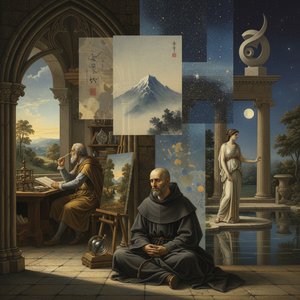
The Stillness Within: Exploring Contemplation in Art Across Eras
Explore the profound beauty of contemplative art across history. Discover how artists have captured solitude, introspection & emotion through iconic paintings. Find handmade oil reproductions at ArtsDot.


Edward Hopper: 25 Remek-dela Američkog Realizma za Vaš Dom | ArtsDot
Istražite 25 ремек-дела Edward Hopper-a! Otkrijte приче иза његових најпознатијих слика, симболизма америчког реализма и уметничке технике. Купите висококвалитетне репродукције на ArtsDot.com.

Amedeo Modigliani: 25 Remek-dela Italijanskog Majstora | ArtsDot
Istražite 25 remek-dela Amedea Modiglianija! Otkrijte priče iza njegovih prepoznatljivih portreta, ekspresionističkog stila i emotivnih boja. Reprodukcije slika vrhunskog kvaliteta dostupne na ArtsDot.com.

