

Early Life & Artistic Foundations: From Realism to Symbolist Beginnings
 Wikipedia: Ferdinand Hodler
Ferdinand Hodler (March 14, 1853 – May 19, 1918) was a Swiss painter. He is one of the best-known Swiss painters of the nineteenth century. His early works were portraits, landscapes, and genre paintings in a realistic style. Later, he adopted a pers...
Ferdinand Hodler’s journey toward becoming one of Switzerland's most celebrated artists was not paved with ease, but rather forged in the crucible of personal tragedy and unwavering determination. Born in Bern in 1853, his early years were shadowed by loss – the premature deaths of his father and two younger siblings to tuberculosis cast a long pall over his childhood. This experience instilled within him a profound sensitivity to mortality, a theme that would resonate throughout his oeuvre. Initially apprenticed to decorative painters and later studying under Ferdinand Sommer, Hodler’s earliest works reflected the prevailing realist style of the time – detailed landscapes and portraits demonstrating technical proficiency but lacking a distinct voice. However, a move to Geneva in 1872 marked a turning point. There, under the tutelage of Barthélemy Menn, he began to shed the constraints of conventional representation, embarking on a path that would ultimately lead him to develop his signature style.
Geneva proved fertile ground for artistic exploration, exposing Hodler to new ideas and influences. While initially grappling with financial hardship, he persevered, exhibiting works that garnered both praise and criticism for their unflinching realism. These early paintings, often depicting scenes of Swiss life or portraits of ordinary people, reveal a nascent talent struggling to find its unique expression. It was during this period that Hodler began to question the limitations of purely objective representation, seeking instead to capture something deeper – the underlying emotional truth beneath the surface of appearances. This quest for essence would soon propel him into the realm of Symbolism.
The Birth of 'Parallelism': Hodler's Unique Aesthetic Philosophy
 Ferdinand Hodler
Explore the captivating world of Ferdinand Hodler, Swiss Symbolist painter renowned for his evocative landscapes & pioneering 'parallelism'. Discover hand-painted reproductions of his masterpieces at ArtsDot.
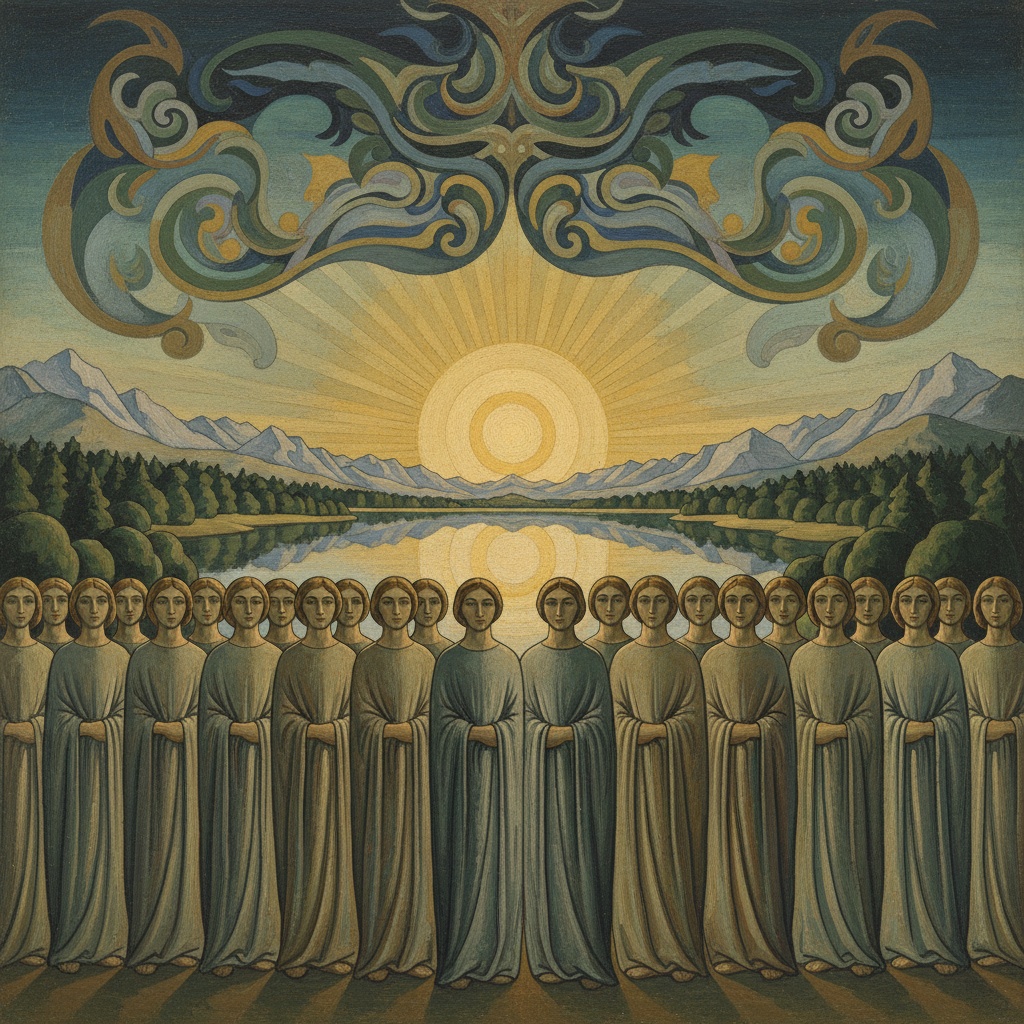
By the mid-1880s, Ferdinand Hodler had begun to articulate a profoundly original artistic vision – one he termed “parallelism.” This wasn’t merely a stylistic innovation; it was a philosophical approach rooted in his belief that nature possessed an inherent order and unity. He sought to reveal this underlying structure through simplified forms, rhythmic repetition, and symmetrical compositions. Unlike the often-dreamlike or fantastical imagery of other Symbolist painters, Hodler grounded his work in meticulous observation of the natural world. However, he wasn’t interested in replicating reality; rather, he aimed to distill it down to its essential elements.
Parallelism, as Hodler defined it, involved isolating and repeating motifs – trees, figures, mountains – creating a sense of harmonious resonance across the canvas. This technique wasn't arbitrary; it was intended to evoke a feeling of universal interconnectedness, suggesting that all things are part of a larger cosmic order. His 1885 painting, *The Brothers’ Wood*, serves as an early example of this approach, with its carefully arranged fir trees creating a rhythmic pattern that symbolizes unity and shared existence. This emphasis on symmetry and repetition wasn't simply aesthetic; it was a deliberate attempt to convey his philosophical beliefs about the fundamental laws governing nature and human life.
Landscapes as Metaphor: Exploring Nature and the Human Condition
 St. Georges Street, near Geneva, in 1890
Experience the tranquility of St. Georges Street near Geneva (1890) by Ferdinand Hodler. This Symbolist masterpiece captures atmospheric perspective & Swiss history. Own a hand-painted reproduction today! #Hodler #Geneva #Symbolism
Hodler’s landscapes are far more than picturesque depictions of the Swiss countryside. They function as powerful metaphors for the human condition, imbued with a sense of both grandeur and melancholy. The mountains, in particular, became recurring motifs in his work, representing strength, resilience, and the enduring power of nature. He often depicted them shrouded in mist or bathed in dramatic light, creating an atmosphere of mystery and awe. Works like *Lake Thun with Symmetrical Reflections* exemplify his mastery of parallelism, transforming a familiar scene into a hauntingly beautiful meditation on time, space, and existence.
The Jungfrau in the Fog, painted in 1908, is particularly striking for its innovative composition. By eliminating the traditional foreground, Hodler created a sense of ethereal suspension, as if the mountain were floating amidst a sea of clouds. This unconventional approach challenged conventional notions of perspective and depth, drawing attention to the inherent beauty of form and color. His landscapes weren’t simply representations of places; they were explorations of inner states – reflections on life, death, and the search for meaning.
Hodler’s Influence on Art Nouveau and Modernism
While often categorized as a Symbolist painter, Ferdinand Hodler's influence extended far beyond this movement. His emphasis on simplified forms, rhythmic patterns, and decorative elements resonated with artists associated with Art Nouveau, particularly in its Swiss manifestation. The flowing lines and stylized motifs found in his work foreshadowed many of the aesthetic principles that would define this influential style. Furthermore, his pioneering use of parallelism paved the way for later Modernist movements, such as Cubism and Abstract Expressionism.
Hodler’s rejection of traditional perspective and his exploration of non-representational forms anticipated the radical innovations of artists like Picasso and Mondrian. His emphasis on emotional expression and subjective experience also aligned with the broader trends of early 20th-century art, challenging conventional notions of beauty and representation. Although he remained largely independent from specific artistic groups, Hodler’s work exerted a significant influence on a generation of painters who sought to break free from the constraints of academic tradition.
Key Works & Lasting Legacy: A Celebration of Swiss Symbolism
Ferdinand Hodler's legacy as Switzerland’s greatest painter is secure. His iconic works, such as *The Brothers’ Wood*, *Lake Thun with Symmetrical Reflections*, and numerous self-portraits, continue to captivate audiences with their emotional depth and formal innovation. The Musée d'Orsay exhibition in 2007 brought renewed attention to his oeuvre, highlighting the breadth and complexity of his artistic vision. His influence can be seen in the work of countless artists who followed, cementing his place as a pivotal figure in the transition between 19th-century Symbolism and early 20th-century Modernism.
Hodler’s enduring appeal lies in his ability to connect with viewers on a deeply emotional level. His paintings are not merely aesthetically pleasing; they are profound meditations on life, death, and the search for meaning. Through his unique style of parallelism, he revealed an underlying order and unity in nature, suggesting that all things are interconnected. Today, ArtsDot.com offers exquisite hand-painted reproductions of Hodler’s masterpieces, allowing art enthusiasts to experience the beauty and emotional power of his work firsthand. Explore our collection and discover the timeless allure of Swiss Symbolism.