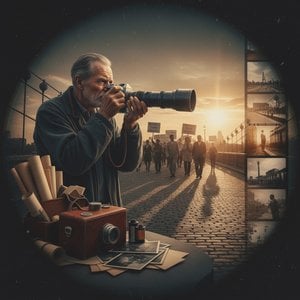
The Lens of Resilience: The Life and Legacy of Voúla Papaioannou
Emerging from the cultural heart of Lamia, Greece, Voúla Papaioannou (1898–1990) was far more than a mere chronicler of her era; she was a visual poet who captured the very soul of a nation in transition. Born into a family where artistic tradition flourished, Papaioannou’s journey began with an academic foundation at Athens Polytechnic University. This early training instilled in her a technical precision and an eye for structural elegance that would later define her signature style. Her initial explorations were deeply rooted in the physical essence of Greece, focusing on the quiet majesty of landscapes and the enduring strength of architectural monuments. Through these early works, she established a mastery of light and shadow, using the monochrome palette to emphasize the weathered textures and geometric grace of the Greek terrain.
However, the trajectory of her art was irrevocably altered by the shadows of World War II. As the German occupation descended upon Greece, Papaioannou’s camera transitioned from capturing beauty to documenting survival. This period marked her evolution into a practitioner of profound social realism. She moved away from the static elegance of monuments to find the raw, pulsing heartbeat of humanity amidst catastrophe. Her photographs from this era, such as the haunting Soup-kitchen during the German Occupation (1941), serve as visceral testaments to the resilience of the Greek spirit. In these frames, the struggle for sustenance and the quiet dignity maintained under extreme hardship are rendered with a sensitivity that transcends simple journalism, turning historical documentation into enduring art.
A Humanist Vision: Portraits and Postwar Reflections
In the wake of the war, Papaioannou’s work underwent a further refinement, shifting her focus toward the intimate and the individual. She became a master of the humanistic portrait, possessing a rare ability to capture the fleeting nuances of emotion. Her lens often sought out the most vulnerable members of society, particularly children, whose faces reflected both the innocence of youth and the heavy imprint of recent history. Works like Portrait of a young girl (1949) demonstrate her unparalleled skill in using subtle visual cues—a downward glance, a reflective posture—to evoke deep empathy in the viewer. This period of her career solidified her reputation as an artist who could find profound meaning in the quietest moments of human existence.
Beyond the intimate portrait, Papaioannou continued to celebrate the timeless identity of Greece through her architectural studies. Her 1950 photograph, Island of Santorini, remains a cornerstone of her oeuvre, immortalizing the Cycladic landscape with a masterful use of black and white tones. In this piece, the interplay of light on whitewashed walls and the stark geometry of the architecture create a sense of eternal beauty that feels both grounded in reality and elevated by art. Her ability to oscillate between the monumental and the microscopic—between the vastness of an island and the expression in a child's eye—is what defines her unique artistic contribution.
Historical Significance and Lasting Impact
The historical weight of Papaioannou’s archive cannot be overstated. Her body of work functions as a vital social record, preserving the memory of a transformative and often traumatic era for the Greek people. By documenting both the architectural heritage and the human struggle, she provided a dual perspective on national identity: one rooted in the permanence of stone and the other in the fragility of life. Today, her legacy is preserved through institutions such as the Benaki Museum, where her collection continues to offer scholars and art lovers alike a poignant glimpse into the Greek experience.
The enduring power of her photography lies in its ability to transcend time. While her subjects were often bound by the specific hardships of the mid-20th century, the themes she explored—resilience, vulnerability, and the search for beauty amidst chaos—are universal. Through her meticulous observation and profound empathy, Voúla Papaioannou ensured that the faces and landscapes of a pivotal moment in history would never be forgotten, leaving behind a visual legacy that remains as striking and essential today as it was during her lifetime.
Vprašanja in odgovori
Koliko umetnin umetnika Voúla Papaïoánnou je na voljo za ogled?
Na strani Vsi umetniški slogi si lahko ogledate 17 umetnin del umetnika Voúla Papaïoánnou.
Kje in leta je se rodil/a Voúla Papaïoánnou?
Voúla Papaïoánnou se je rodil/a v Lamia leta 1898.
Ali lahko dela umetnika Voúla Papaïoánnou brskam glede na vzdušje?
Delo umetnika Voúla Papaïoánnou si lahko ogledate po razpoloženju na njegovi strani Soba razpoloženj, kjer so umetniška dela razvrščena glede na njihovo vzdušje.