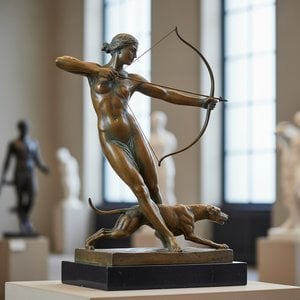
A Sculptor of the American West: The Life and Art of Solon Hannibal Borglum
Solon Hannibal de la Mothe Borglum, born December 22, 1868, in Ogden, Utah, was a sculptor whose work became inextricably linked with the spirit and landscape of the American West. Though often overshadowed by his more famous brother, Gutzon Borglum – creator of Mount Rushmore – Solon carved out a distinct artistic identity, one deeply rooted in realism and imbued with a sensitive portrayal of frontier life. His story is one of familial complexity, artistic dedication, and a profound connection to the evolving narrative of a nation forging its identity. The early years of his life were marked by an unconventional family dynamic; his father, James Borglum, a Danish immigrant and Mormon polygamist, was married to two sisters, Ida and Christina Mikkelsen. This arrangement led to a fractured childhood for Solon, particularly after his mother, Christina, left the family when he was young – a subject discouraged from discussion within the household. He spent formative years on the Nebraska prairie where his father practiced medicine, developing an intimate understanding of the land and its inhabitants. Initially drawn to the life of a cowboy-rancher, it was his brother Gutzon who recognized and nurtured Solon’s artistic inclinations, encouraging him to pursue formal training.From Paris to the Prairie: Artistic Development and Style
Solon's artistic journey led him first to the Cincinnati Art Academy from 1895 to 1897, where he began to hone his skills. However, it was his subsequent studies in Paris at the Académie Julian under Emmanuel Fremiet that truly shaped his aesthetic vision. There, he gained recognition as “le sculpteur de la prairie” – the sculptor of the prairie – a testament to the unique perspective he brought to European artistic circles. His time in Paris exposed him to classical traditions and refined sculpting techniques, yet he remained steadfastly committed to depicting the scenes and subjects that resonated with his American experience. Borglum’s style is characterized by meticulous realism, an acute understanding of anatomy and movement, and a narrative depth that breathes life into his creations. He didn't merely represent figures; he captured moments, emotions, and the essence of a disappearing way of life. His work focused primarily on depicting life in the American West, particularly scenes involving cowboys, Native Americans, and the vast, untamed landscapes that defined the era. Notable sculptures include “Saint John the Baptist baptizing on the banks of the river” (1900), now housed in Recife, Brazil, a piece demonstrating his mastery of Baroque realism and dramatic composition, and drawings like "Cow" at the Smithsonian American Art Museum, showcasing his ability to capture the raw power and beauty of animal life.War, Teaching, and a Lasting Legacy
The outbreak of World War I saw Solon shift his focus from artistic creation to service. He worked with the YMCA, contributing to Les Foyers du Soldat service clubs in France, providing respite and support for soldiers on the front lines. His dedication was recognized with the Croix de Guerre, a testament to his selfless contributions during wartime. Following the war, Borglum returned to the United States and founded the School of American Sculpture in New York City. Driven by a desire to pass on his knowledge and expertise, he mentored aspiring artists, developing a textbook titled *Sound Construction* as a guide for his students. This pedagogical endeavor reflects his commitment to fostering a new generation of sculptors grounded in both technical skill and artistic vision. Tragically, Solon Borglum’s life was cut short on January 31, 1922, following an appendectomy. However, his legacy endured through the dedication of his wife, Emma Vignal, and later through his daughter Monica and her husband, who diligently preserved and exhibited his work, ensuring that his artistic contributions would not be forgotten.A Bridge Between Eras: Historical Significance
Solon Borglum’s impact on American sculpture lies in his ability to bridge the gap between realism and iconic representations of frontier life. He didn't romanticize the West; he depicted it with honesty, sensitivity, and a deep understanding of its complexities. His sympathetic portrayal of Native Americans was particularly noteworthy, challenging prevailing stereotypes and offering a more nuanced perspective on their culture and experiences. Borglum’s teachings and artistic style influenced numerous artists, including Paul Manship, who studied under him and went on to become a prominent sculptor in his own right. Today, the New Britain Museum of American Art houses a significant collection of Borglum's sculptures and related materials, safeguarding his art for future generations. His work provides invaluable insights into the cultural landscape of the late 19th and early 20th centuries, reflecting both the romantic allure and the harsh realities of life in the American West. Through his remarkable sculptures and drawings, Solon Hannibal Borglum continues to inspire artists and art enthusiasts alike, reminding us of a pivotal era in American history and the enduring power of artistic expression. His legacy is not merely one of sculpted forms but of stories told in bronze and stone, capturing the heart and soul of a nation.Vprašanja in odgovori
Kje lahko najdem dela umetnika Solon Hannibal Borglum, organizirana po barvah?
Delo umetnika Solon Hannibal Borglum lahko raziskujete po barvah na njegovi strani Spektralni pregled.
Od kod prihaja Solon Hannibal Borglum?
Solon Hannibal Borglum se je rodil/a v državi United States of America.
Katera dela umetnika Solon Hannibal Borglum imajo največ ogledov?
Stran Statistika umetnika Solon Hannibal Borglum prikazuje statistiko, izračunano na podlagi umetnin tega umetnika, ki so navedene na ta spletna stran.