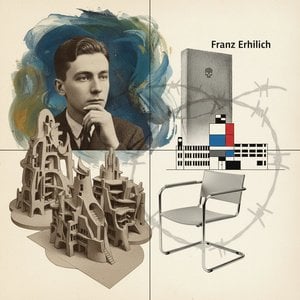
A Life Shaped by Light and Shadow
In the quiet corners of Stolp, within the province of Pomerania, a boy was born into a world that would eventually witness both his greatest creative triumphs and his most profound tragedies. Otto Freundlich did not begin his path with a brush in hand; instead, he pursued the precise sciences of dentistry and the deep inquiries of philosophy and art history. This academic foundation provided a structural rigor that would later manifest in his approach to form and space. When he moved to Paris in 1908, he entered a whirlwind of intellectual energy, finding himself a resident of the Bateau-Lavoir alongside figures like Pablo Picasso and Georges Braque. It was here, amidst the bohemian pulse of Montmartre, that his true vocation took hold.
The transition from the clinical world of dentistry to the experimental studios of France was not merely a change in profession, but a total reconfiguration of his soul. He found himself drawn to the fragmented geometries of Cubism and the expressive potential of color. His time in Paris allowed him to forge connections with the very architects of modernism, yet he remained a singular voice, seeking a way to translate the unseen forces of the universe into tangible shapes. Even as he returned to Germany during the Great War, serving as a medical orderly, the seeds of abstraction had already taken root in his mind.
The Search for a New Language
As the years progressed, Freundlich’s work moved steadily away from the representational toward a language of pure, abstract form. He became deeply involved with various artistic circles, including the November Group and Abstraction-Creation, where he sought to push the boundaries of what a canvas could communicate. His interests were not limited to the flat surface; he explored the spiritual weight of sculpture and the intricate patterns of stained glass, perhaps influenced by his time at Chartres cathedral. This fascination with light and fragmentation led to works that felt both ancient and entirely new.
His creative output was marked by a profound interest in the metaphysical. In the 1920s, he turned toward mystical themes, finding inspiration in Theosophy to explore the spiritual dimensions of existence. This period saw him producing works like The Birth of Man, where mosaic and form merged to suggest something beyond the physical realm. He was a man of intense conviction, often using his art to advocate for social reform and utopian ideals. His sculpture, Der Neue Mensch, embodied this vision of a reconstructed humanity, even as the political landscape of Europe began to darken around him.
A Legacy Interrupted
The rise of the Nazi regime brought a cruel end to the freedom Freundlich had fought so hard to express. Because of his Jewish heritage and his commitment to avant-garde experimentation, his art was targeted for destruction. The authorities labeled his work as degenerate, seizing pieces for the infamous exhibition in Munich. It was a bitter irony that his sculpture Der Neue Mensch was used as the cover for the very catalogue meant to mock him. Many of his creations were lost or destroyed during this period of persecution.
The final chapter of his life was written in the darkness of the Holocaust. After fleeing to the Pyrenees and being interned in Vichy France, he was eventually arrested and deported. He met his end at the Majdanek concentration camp in 1943. Though much of his physical work was silenced by the era's violence, the fragments that survived—his woodcuts, his gouaches, and the rediscovered pieces of his monumental sculptures—continue to speak of a man who sought to find harmony in a fractured world.