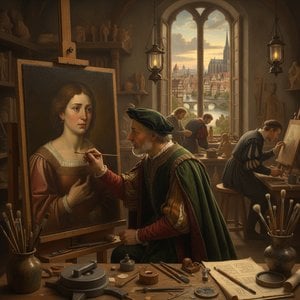
A Renaissance Master of Saxony: The Life and Art of Lucas Cranach the Elder
Lucas Cranach the Elder, born in Kronach, Germany around 1472, stands as a pivotal figure of the German Renaissance. His life unfolded during a period of immense religious and political upheaval, and his art became inextricably linked to both the burgeoning Protestant Reformation and the opulent courts he served. Initially trained by his father, Hans Maler, Cranach’s early artistic development remains somewhat shrouded in mystery, though influences from South German masters are evident in his evolving style. He quickly distinguished himself not merely as a skilled craftsman but as an artist capable of capturing psychological depth alongside technical precision – qualities that would soon draw the attention of powerful patrons. In 1504, he entered the service of Frederick III, Elector of Saxony, a relationship that would define much of his career and provide him with both stability and access to influential circles. This appointment as court painter in Wittenberg wasn’t simply about producing decorative works; it placed Cranach at the very heart of one of the most transformative movements in European history.Early Life and Artistic Training
Information regarding Lucas Cranach's formative years is scarce, reflecting a common characteristic of Renaissance artists whose personal histories were often deliberately obscured to enhance their artistic reputations. However, scholarly research suggests that he received his initial artistic education from his father, Hans Maler—a respected painter known for his frescoes in churches throughout Bavaria and Saxony. Like many artists of his time, Cranach’s training encompassed not only painting techniques but also humanist scholarship, fostering a broader intellectual understanding crucial to navigating the complexities of Renaissance culture. While precise details about his early stylistic influences remain elusive, evidence indicates connections with South German masters—particularly Matthias Grünewald—whose expressive use of color and dramatic compositions foreshadowed many innovations that would characterize Cranach’s mature oeuvre.Service to Frederick III and Wittenberg
Cranach's ascension to prominence began in 1504 when he was appointed court painter to Frederick III, Elector of Saxony—a patronage that proved remarkably fruitful both artistically and politically. Wittenberg, Frederick’s seat of power and the epicenter of Luther’s Reformation movement, became Cranach’s artistic laboratory—a space where he honed his skills, experimented with new ideas, and engaged directly in shaping the visual culture of a nation undergoing radical transformation. This appointment wasn't merely about fulfilling a contractual obligation; it demanded an artist capable of conveying Luther’s theological convictions through compelling imagery—a task Cranach undertook with unwavering dedication and artistic brilliance. He produced no fewer than eleven portraits of Luther, each meticulously crafted to embody the reformer’s moral authority and intellectual conviction. These weren’t simply likenesses; they were carefully constructed images designed to project strength, piety, and erudition – essential qualities for a leader challenging papal dogma.The Reformation Art: Symbolism and Narrative
Lucas Cranach's contribution to the Reformation extended far beyond portraiture. He spearheaded the production of woodcuts and engravings that disseminated Protestant doctrines widely—a feat unparalleled in its scope and impact. These prints weren’t merely didactic illustrations; they were artistic statements imbued with symbolic meaning—reflecting a profound shift away from Catholic iconography toward a more personal engagement with scripture. Cranach's depictions of biblical scenes moved decisively away from traditional representations, emphasizing direct confrontation with God’s word and fostering a deeper spiritual connection between the viewer and faith. The Annunciation to Joachim exemplifies this innovative approach—radiating joy and optimism as it portrays Mary receiving the divine messenger—a visual testament to Luther's belief in predestination and divine grace. Cranach skillfully employed color, composition, and symbolism to convey complex theological concepts—demonstrating that art could serve as a powerful vehicle for religious persuasion.Style and Technique: A Legacy of Elegance and Precision
Lucas Cranach the Elder’s artistic style is instantly recognizable—characterized by elongated figures with graceful proportions, vibrant hues, and meticulous attention to detail. His technique involved a masterful blend of oil painting, woodcut, and engraving—allowing him to reach a vast audience through both original artworks and affordable prints. The workshop established by Cranach became renowned for its distinctive aesthetic—reflecting the humanist ideals prevalent in Renaissance Germany. Cranach’s mastery of perspective and chiaroscuro—the interplay of light and shadow—created dramatic visual effects that heightened the emotional impact of his paintings. Stag Hunt of Elector Friedrich III the Wise stands as a paragon of Northern Renaissance style—capturing the dynamism of the hunt while simultaneously conveying the noble status of its patron—a testament to Cranach’s ability to synthesize artistic innovation with humanist conviction. His portraits are equally compelling, distinguished by their psychological insight and refined execution—demonstrating that an artist could convey profound emotion through subtle gestures and nuanced expressions.Concluding Reflections: An Enduring Influence
Lucas Cranach the Elder died in 1553, leaving behind a monumental artistic legacy that continues to inspire admiration and scholarly inquiry today. He was arguably the most influential painter of his era—a master of portraiture, a visionary interpreter of religious themes, and a shrewd businessman who understood the transformative potential of visual communication. His work transcends mere stylistic imitation; it embodies the spirit of the Renaissance—characterized by intellectual curiosity, humanist conviction, and artistic daring. Cranach’s enduring influence can be discerned in the works of countless subsequent artists—who adopted his techniques and embraced his aesthetic sensibilities—solidifying his place as one of the foremost figures of European art history. From the iconic portraits of Martin Luther to the captivating mythological scenes—Cranach's oeuvre remains a beacon of artistic excellence—a testament to the power of imagination, skill, and unwavering dedication to conveying profound human experience.Vprašanja in odgovori
V katerem mestu in državi se je rodil/a Lucas Cranach Starejši?
Lucas Cranach Starejši se je rodil/a v Kronach v državi Nemčija.
Kje in leta je se rodil/a Lucas Cranach Starejši?
Lucas Cranach Starejši se je rodil/a v Kronach leta 1472.
Od kod prihaja Lucas Cranach Starejši?
Lucas Cranach Starejši se je rodil/a v državi Nemčija.
Ali lahko dela umetnika Lucas Cranach Starejši raziskujem po ključnih besedah?
Delo umetnika Lucas Cranach Starejši lahko raziščete po ključnih besedah na njegovi strani Po ključnih besedah. Vsaka ključna beseda združuje sorodna dela.
Ali lahko dela umetnika Lucas Cranach Starejši brskam glede na vzdušje?
Delo umetnika Lucas Cranach Starejši si lahko ogledate po razpoloženju na njegovi strani Soba razpoloženj, kjer so umetniška dela razvrščena glede na njihovo vzdušje.
Koliko umetnin umetnika Lucas Cranach Starejši je na voljo za ogled?
Na strani Vsi umetniški slogi si lahko ogledate 893 umetnin del umetnika Lucas Cranach Starejši.
Kako najdem vse dela umetnika Lucas Cranach Starejši v določeni tehniki?
Vse dela umetnika Lucas Cranach Starejši v določeni tehniki najdete na njegovi strani Vse tehnike.