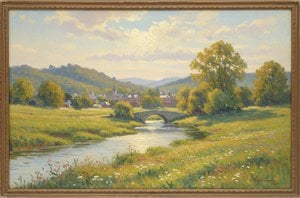
A Life Bridging Worlds: The Artistic Journey of Henry Salem Hubbell
Henry Salem Hubbell, born in 1870, occupies a fascinating, and often overlooked, space within the narrative of American Impressionism. While many artists of his generation sought to capture fleeting moments of light and atmosphere *en plein air*, Hubbell’s journey was uniquely shaped by extensive study and practice abroad, particularly in France, before he brought his refined skills back to America. He wasn't merely an importer of style; he synthesized European techniques with a distinctly American sensibility, focusing on figural work – portraits and genre scenes – that set him apart from the landscape-dominated trends of many of his contemporaries. His life story is one of dedication to craft, a pursuit of artistic excellence across continents, and ultimately, a contribution to bridging the gap between academic tradition and the burgeoning modern art movements.From Academic Roots to Parisian Light
Hubbell’s early training laid a solid foundation in traditional techniques. He initially studied at the Art Students League of New York, absorbing the principles of drawing and composition that would remain central to his work throughout his career. However, it was his move to Paris around the turn of the century that proved transformative. He enrolled at the Académie Julian and later worked under Jean-Léon Gérôme, a highly respected academic painter known for his meticulous realism and historical subjects. This rigorous training instilled in Hubbell a mastery of anatomy, perspective, and rendering detail – skills he would later adapt to the looser brushwork and vibrant palettes associated with Impressionism. Paris at this time was a crucible of artistic innovation, and while Hubbell initially embraced the academic style, he gradually absorbed the influence of artists like Monet, Renoir, and Degas. He exhibited regularly at the prestigious Paris Salon, gaining recognition for his portraits and scenes of Parisian life. This period wasn’t about abandoning tradition but rather *evolving* it; Hubbell sought to infuse the precision of academic painting with the luminosity and spontaneity of Impressionism.A Transatlantic Career: Portraits and American Life
Upon returning to America, Hubbell established a successful studio practice, primarily focusing on portraiture. He became highly sought after by prominent families in New York and beyond, capturing their likenesses with a sensitivity and psychological depth that went beyond mere representation. His portraits weren’t simply records of appearance; they were insightful studies of character, revealing the inner lives of his sitters through subtle gestures, expressions, and carefully chosen settings. He also continued to paint genre scenes depicting everyday life in America, often featuring women and children engaged in domestic activities. These works are characterized by a warm, intimate atmosphere and a delicate handling of light and color. Hubbell’s ability to seamlessly blend European techniques with American subject matter made his work particularly appealing during this period, as it offered a sophisticated alternative to the more overtly modern styles emerging from Europe.Influences and Artistic Development
While firmly rooted in Impressionism, Hubbell's artistic development wasn’t confined to a single style. The influence of John Singer Sargent is readily apparent in his confident brushwork and elegant compositions. He also admired the work of James McNeill Whistler, particularly his emphasis on tonal harmony and atmospheric effects. However, Hubbell never fully embraced the radical experimentation of artists like the Abstract Expressionists; he remained committed to representational painting throughout his career. His landscapes, though less numerous than his portraits, demonstrate a keen eye for color and light, often featuring scenes from Long Island where he spent summers.- Key Influences: Jean-Léon Gérôme, John Singer Sargent, James McNeill Whistler
- Dominant Styles: American Impressionism, Academic Painting, Portraiture
- Recurring Themes: Portraits of prominent families, scenes of domestic life, landscapes of Long Island.
Legacy and Historical Significance
Henry Salem Hubbell’s work represents a crucial link between the academic tradition and the rise of modern art in America. He demonstrated that it was possible to embrace the innovations of Impressionism without abandoning the fundamental principles of drawing, composition, and anatomical accuracy. His portraits offer a valuable glimpse into the lives of affluent Americans during the early 20th century, capturing their social status, personal character, and aesthetic sensibilities. While he may not be as widely recognized as some of his more avant-garde contemporaries, Hubbell’s contribution to American art is significant. He helped to refine and popularize Impressionistic techniques in America, paving the way for future generations of artists who sought to capture the beauty and complexity of modern life. His paintings continue to resonate with viewers today, offering a compelling blend of technical skill, artistic sensitivity, and historical insight. He stands as a testament to the enduring power of dedication, refinement, and the ability to synthesize diverse influences into a uniquely personal artistic vision.Vprašanja in odgovori
Kje so dela umetnika Henry Salem Hubbell razvrščena po barvni paleti?
Delo umetnika Henry Salem Hubbell si lahko ogledate po barvni paleti na njegovi strani Po barvnih paletah.
Ali obstaja pregled vseh motivov, ki jih je Henry Salem Hubbell naslikal?
Atlas motivov umetnika Henry Salem Hubbell je stran, ki razvršča umetnikova dela glede na njihove teme.
Ali lahko obiščem virtualni muzej del Henry Salem Hubbell?
3D muzej umetnika Henry Salem Hubbell je stran, ki v virtualni trodimenzionalni galeriji prikazuje umetnikova dela.