


Mirrors of the Soul: The Intimacy of Self-Perception
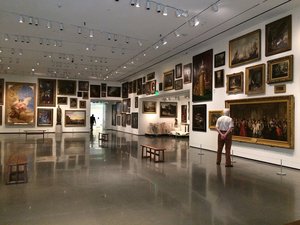 Rhode Island School of Design Museum of Art
Explore the RISD Museum in Providence, RI – a unique blend of art & design education and public exhibition. Discover ancient to contemporary works, including Chinese sculpture, Impressionist paintings, and innovative decorative arts.
There is a specific kind of silence found only in the presence of a mirror. It is a quietude that does not feel empty, but rather heavy with the weight of a single, private thought. In the 1670 oil on canvas by Frans van Mieris the Elder, we witness this exact pause. A woman stands in profile, her gaze fixed upon her own reflection, framed by a heavy, dark blue curtain that lends the scene a sense of theatrical depth. A small dog rests at her feet, a quiet witness to a ritual that feels entirely unobserved. This is not a moment of public display, but a hushed, domestic intimacy where the subject is caught between the person she is and the image she sees.
This preoccupation with the reflected self finds a different, more atmospheric resonance in J. Alden Weir’s 1896 work, Face Reflected in a Mirror. Held in the Rhode Island School of Design Museum of Art, this Impressionist piece moves away from the theatricality of the Dutch Golden Age and into a softly lit, private bedroom. The composition is vertical, drawing the eye toward the central figure and her reflection to create a visual echo. Here, the light is diffused, casting gentle shadows that suggest a moment suspended in time. Much like the woman in the Dutch interior, Weir’s subject exists in a state of quiet solitude, inviting us to consider how we perceive ourselves when the world is no longer watching.
The act of looking inward, whether through a glass or a canvas, remains a fundamental human impulse. We find ourselves drawn to these quiet corners of art history to seek a reflection of our own internal landscapes.
The Softness of Light: Capturing a Moment Suspended
 Young woman with a glass of wine, holding a letter in her hand
, Gerard ter Borch
Light has a way of slowing the passage of time. When it filters through a window or catches the edge of a fabric, it creates a sense of stillness that defies the frantic pace of modern life. In the works of Gerard ter Borch, light is a tactile presence. We see it spill into a room, catching the shimmering surface of a white satin gown and the delicate translucency of a glass. A young woman sits in profile, her gaze lost in a letter, her expression caught in a private thought. The air feels heavy with the weight of the news contained within those folded pages, creating a profound interiority that pulls the viewer into her solitary world.
This mastery of light finds a historical parallel in the High Renaissance, specifically in the details of Raphael’s Stanze Vaticane - La Disputa. While the larger work is a grand theological assembly, the specific details of figures seated by windows evoke a sense of respite. The soft, diffused light creates an atmosphere of serenity, where the garden visible through the window symbolizes nature's restorative power. It is a visual sanctuary, offering a moment of peace through a harmonious palette of gentle blues, greens, and yellows.
Whether it is the heavy shadows of a Dutch interior or the luminous clarity of a Renaissance window, light serves as the primary tool for grounding the viewer in a moment of quietude.
Nature’s Gentle Echo: Finding Peace in the Landscape
Nature offers a specific kind of grounding, a way to find stability when the world feels turbulent. In Boise, Idaho, the painting Quiet Reflection by Steve Klamm provides exactly this. Commissioned for emotional grounding within the City of Boise Public Art Collection, the work depicts light filtering through trees and reflecting off the waters of a forest brook. It is an invitation to contemplation, a visual balm designed to offer a sense of calming tranquility in times of transition.
This connection between the natural world and the human psyche is a theme that echoes through the centuries. In the seventeenth century, painters like Pieter de Hooch used orderly, clean interiors with glimpses of sunny streets and gardens to create a sense of domestic peace. These spaces served as a refuge from the busy bustle of daily life, providing a dwelling place for thought. Just as Klamm uses the movement of water and light to soothe the viewer, the masters of the Dutch Golden Age used the order of the home and the beauty of the garden to offer a sense of sanctuary.
When we look at a landscape that captures the play of light on water, we are not just looking at nature; we are looking at a way to find our own center.
The Weight of Stillness: Art as an Emotional Companion
Art is rarely just a decoration; it is a presence. It is a companion that remains on the wall long after a conversation has ended or a guest has departed. There is a significant difference between a mass-produced print that shouts for attention and a hand-painted oil reproduction that whispers something true. A real painting, with its visible brushstrokes and the tactile depth of impasto, carries a weight that a digital print cannot replicate. It holds a memory, an emotion, and a sense of the artist's hand.
This sense of presence is what allows art to endure. In a studio, silence is not empty; it is full of the sound of the brush against canvas and the scrape of a palette knife. This attentiveness is what transforms a piece of art from a mere object into a vessel for thought. When we choose art that is made to be lived with—art that is quiet and reflective—we are choosing a piece that can hold our own reflections and our own silences.
To live with art is to live with a window into another's perception, a way to invite a sense of presence into the sterile corners of a modern home.
The Architecture of Calm: Designing Spaces for Contemplation
The way we arrange our surroundings dictates the rhythm of our lives. A room filled with transient decor can feel unsettled, but a space curated with intention can become a sanctuary. This is why the choice of art is so vital for the modern interior. Whether it is a large-format mural that recreates a historical ceiling or a series of multi-panel paintings that flow seamlessly across a wide wall, the scale and style of the work define the energy of the room.
For those looking to infuse their homes with historical resonance, the ability to "remix" art history offers a unique opportunity. One might request a personal photograph to be painted in the light-drenched style of Monet or the dramatic chiaroscuro of Rembrandt. This allows for a personalized connection to the past, turning a modern space into one that feels grounded and meaningful. By selecting works that prioritize depth and tonal range over mere color, we create environments that encourage us to pause.
Ultimately, the goal of a thoughtful collection is to create a space where thinking can take place—a place where the walls do not just decorate, but listen.


