

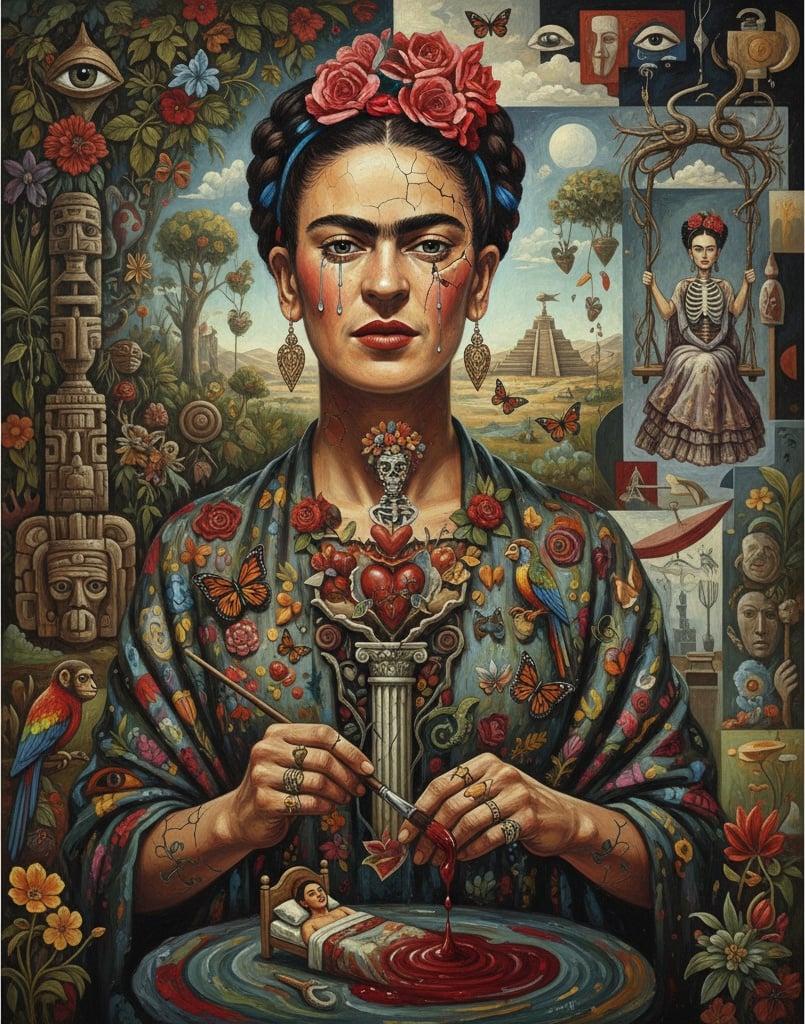


The Early Life & Trauma Shaping an Artistic Vision
FRIDA KAHLO, or MAGDALENA CARMEN FRIDA KAHLO CALDERÓN, was born on July 6, 1907 in the Mexico City home owned by her parents since 1904, known today as the ...
Magdalena Carmen Frida Kahlo y Calderón, born July 6th, 1907, in Coyoacán, Mexico City, entered a world steeped in both cultural richness and personal hardship. Her childhood home, La Casa Azul – now the celebrated Frida Kahlo Museum – would become not only a sanctuary but also a potent symbol of her intensely internal life. While often categorized as a surrealist painter, to define Kahlo solely through that lens diminishes the profound impact of her lived experience on her artistic output. The polio she contracted at age six left her with a permanent physical disability, a stark contrast to the vibrant energy of pre-revolutionary Mexico. This early encounter with vulnerability and limitation profoundly shaped her self-perception and would later become a recurring motif in her work. Her father, Guillermo Kahlo, a German photographer, encouraged Frida’s independence and athleticism as a means of recovery, yet it was within the walls of La Casa Azul that her artistic journey truly began – initially not as a pursuit of passion, but as a form of solace during prolonged convalescence.
Beyond Folk Art: Kahlo’s Complex Relationship with Surrealism
Surrealism is an art and cultural movement that developed in Europe in the aftermath of World War I in which artists aimed to allow the unconscious mind to express itself, often resulting in the depiction of illogical or dreamlike scenes and ideas. I...
The association of Frida Kahlo with surrealism is perhaps the most debated aspect of her career. André Breton, the movement's founder, championed her work after encountering it in Mexico in 1938, declaring her a natural surrealist. However, Kahlo herself resisted this categorization. While her paintings undeniably feature dreamlike imagery, unexpected juxtapositions, and a fascination with the subconscious, she maintained that these elements stemmed not from an exploration of abstract psychological concepts but directly from her own reality – a reality marked by physical pain, emotional turmoil, and deeply personal experiences. She famously stated, “I never painted dreams. I painted my own reality.” Her style, while incorporating fantastical elements, was rooted in Mexican folk art traditions—the vibrant colors, symbolic imagery, and direct narrative approach of *retablos* (votive paintings) heavily influenced her aesthetic. To understand Kahlo is to recognize a deliberate fusion: the raw honesty of autobiography channeled through a uniquely Mexican visual language, rather than a strict adherence to European surrealist principles.
Identity, Mestizaje, and the Reclamation of Indigenous Heritage
Kahlo’s exploration of identity was deeply intertwined with her understanding of *mestizaje* – the blending of indigenous and Spanish cultures in Mexico. Her mother, Matilde Calderón y González, possessed a strong Amerindian heritage, a lineage Frida consciously embraced. In an era grappling with post-colonial questions of national identity following the Mexican Revolution, Kahlo’s paintings became powerful statements of cultural pride. She frequently depicted traditional Tehuana clothing – the elaborate attire of women from the Isthmus of Tehuantepec—not merely as aesthetic choices but as symbols of strength, resilience, and a connection to Mexico's pre-Columbian past. Her self-portraits often incorporate indigenous symbolism and iconography, challenging European beauty standards and asserting the validity of Mexican identity on a global stage. This wasn’t simply artistic expression; it was a political act—a reclamation of heritage in a society still navigating the complexities of its colonial history.
Autobiography as Canvas: Pain, Body, and Self-Representation
Autobiographical memory (AM) is a memory system consisting of episodes recollected from an individual's life, based on a combination of episodic (personal experiences and specific objects, people and events experienced at particular time and place) a...
Perhaps the most striking characteristic of Kahlo's oeuvre is its intensely autobiographical nature. Following a devastating bus accident at age 18 that left her with lifelong physical injuries, she turned to painting as a means of processing trauma and confronting her own mortality. Her body became both subject and canvas—a site of pain, resilience, and self-discovery. The numerous self-portraits are not idealized representations but unflinching depictions of her physical suffering, emotional anguish, and complex relationship with her own femininity. Paintings like “The Broken Column” (1944) and “Henry Ford Hospital” (1932) offer visceral portrayals of her medical struggles, challenging conventional notions of beauty and vulnerability. She didn’t shy away from depicting the graphic realities of surgery, miscarriage, and chronic pain, transforming personal tragedy into universal statements about the human condition.
Diego Rivera and a Life Intertwined with Art & Politics
Frida Kahlo's life was inextricably linked to that of Diego Rivera, the renowned Mexican muralist. Their tumultuous relationship—marked by passionate love, infidelity, artistic rivalry, and shared political convictions—became legendary. Rivera recognized Kahlo’s talent early on, encouraging her artistic development and providing a platform for her work. However, their marriage was far from conventional; both engaged in extramarital affairs, leading to periods of separation and reconciliation. Despite the emotional complexities, Rivera remained a significant influence on Kahlo's art and worldview. Their shared commitment to communism and Mexican nationalism shaped their creative output and political activism. Rivera’s monumental murals often depicted scenes of social justice and indigenous history, themes that resonated deeply with Kahlo’s own artistic concerns. The interplay between their individual styles—Rivera’s grand scale and public focus versus Kahlo’s intimate self-portraits—created a dynamic dialogue within the Mexican art scene.
Kahlo's Enduring Legacy: Feminism, Resilience, and Modern Iconography
Frida Kahlo’s influence extends far beyond the realm of art history. In recent decades, she has become a global icon – a symbol of feminism, resilience, and self-expression. Her unflinching honesty about her physical pain, emotional struggles, and unconventional lifestyle resonated with generations of women seeking to challenge societal norms. Her paintings continue to inspire artists, activists, and individuals grappling with questions of identity, trauma, and the female experience. Kahlo’s embrace of Mexican culture and indigenous heritage paved the way for greater representation in the art world. Today, her image adorns everything from museum walls to t-shirts, a testament to her enduring cultural impact. At ArtsDot
, we offer meticulously hand-painted reproductions of Kahlo's most iconic works, allowing you to bring her powerful vision into your own home. Explore our collection and discover the profound beauty and emotional depth of this extraordinary artist—or commission a custom portrait inspired by her unique style. Experience the legacy of Frida Kahlo with ArtsDot.



