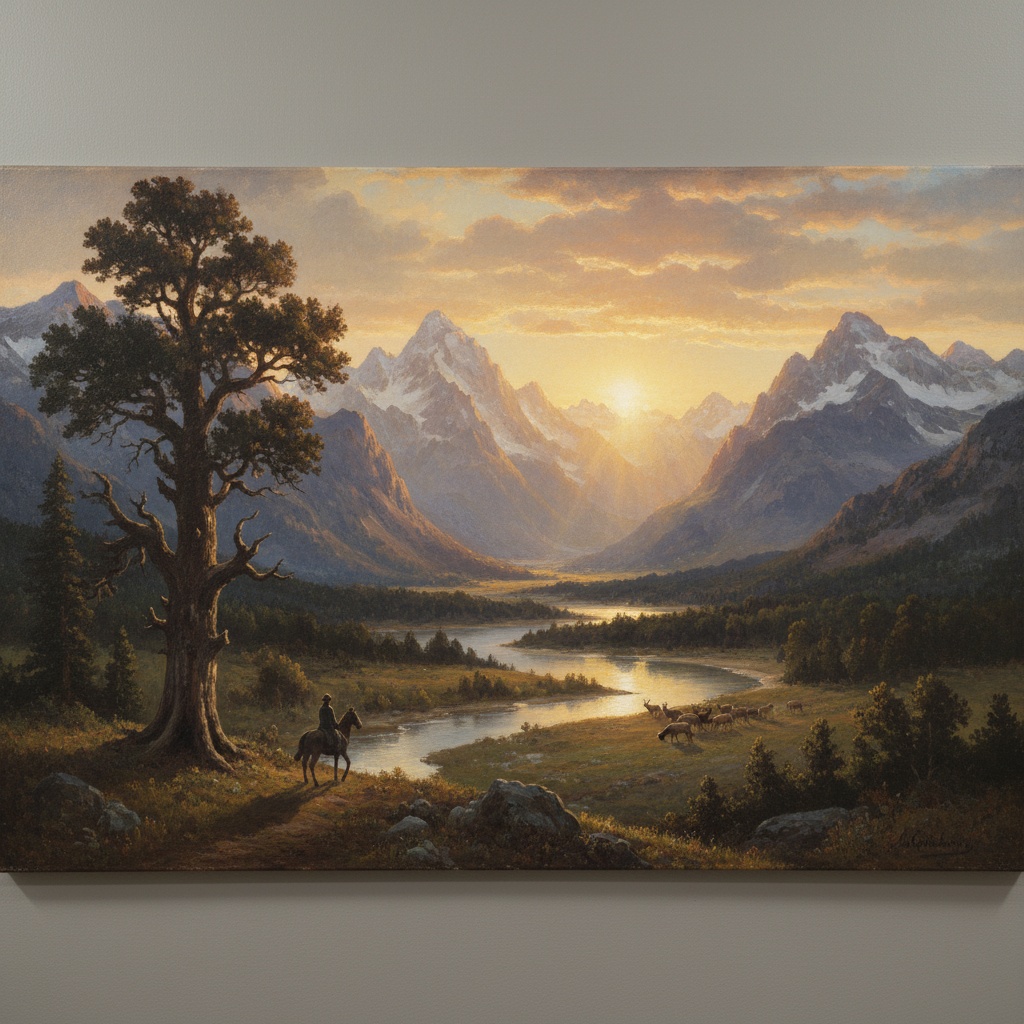
Early Life & Artistic Foundations: From Düsseldorf to the Hudson River
Albert Bierstadt’s journey to becoming one of America’s most celebrated landscape painters began not amidst the vast wilderness he would later immortalize, but in the refined artistic circles of Düsseldorf, Germany. Born in 1830 in Solingen, Prussia, his family’s early emigration to New Bedford, Massachusetts, instilled a nascent appreciation for the natural world, though it was his formal training abroad that truly ignited his passion and honed his technical skill. Returning from Europe in the mid-19th century, Bierstadt found himself drawn into the orbit of the Hudson River School, an informal yet influential group of artists captivated by the dramatic beauty of the American landscape. This wasn’t merely a stylistic adoption; it was a philosophical alignment with a burgeoning sense of national identity and a desire to capture the sublime power of nature – themes that would define his life's work.
The early influence of European Romanticism is palpable in Bierstadt’s initial works, characterized by carefully detailed renderings and a penchant for dramatic lighting. However, he quickly began to forge his own path, moving beyond imitation towards a uniquely American vision. His brother Edward’s pioneering work with stereoscopic photography also played an unexpected role, providing Bierstadt with a wealth of visual reference material that would later prove invaluable in recreating the grandeur of the West. This early period laid the groundwork for his signature style – one that blended meticulous observation with a distinctly romantic sensibility.
The Grand Tour Westward: Capturing the American Frontier
 Wikipedia: Albert Bierstadt
Albert Bierstadt (January 7, 1830 – February 18, 1902) was a German American painter best known for his lavish, sweeping landscapes of the American West. He joined several journeys of the westward expansion to paint the scenes. He was not the first a...
While Bierstadt wasn’t the first to depict scenes from the American West, he was arguably its most effective and popular chronicler. His expeditions, beginning in 1859 alongside surveyor Frederick W. Lander, were not simply artistic endeavors; they were immersive experiences that fundamentally shaped his understanding of the landscape. These journeys weren't about scientific accuracy but about capturing an *emotional* truth – the awe-inspiring scale, the untamed beauty, and the sense of limitless possibility that characterized the frontier.
The 1863 expedition with author Fitz Hugh Ludlow proved particularly pivotal, taking him deep into Yosemite Valley. This experience fueled a prolific period of painting, resulting in canvases of immense size and breathtaking detail. Bierstadt didn’t merely record what he saw; he synthesized his observations, memories, and artistic license to create idealized visions that resonated deeply with a nation grappling with its own identity and westward expansion. These paintings weren't just landscapes; they were statements about America’s destiny.
Luminism and the Bierstadt Style: Light, Detail, and Romantic Vision
Luminism is a style of American landscape painting from the 1850s to 1870s, characterized by effects of light in a landscape, through the use of aerial perspective and the concealing of visible brushstrokes. Luminist landscapes emphasize tranquility,...
Bierstadt is often associated with Luminism, an American landscape style characterized by its emphasis on atmospheric effects of light and a meticulous attention to detail. However, defining his work solely as Luminist overlooks the broader scope of his artistic vision. While he masterfully employed aerial perspective and concealed brushstrokes to create a sense of tranquility and depth, Bierstadt’s paintings are distinguished by their dramatic compositions, bold color palettes, and an undeniable romantic flair.
His technique involved layering glazes of oil paint to achieve luminous effects, creating a sense of atmospheric haze that softened edges and enhanced the feeling of distance. The light in his works isn't merely descriptive; it’s symbolic – representing divine presence, national promise, or simply the sheer majesty of nature. Artists like Thomas Worthington Whittredge and Alfred Thompson Bricher shared this fascination with light, but Bierstadt’s scale and ambition set him apart.
Bierstadt's Masterpieces: Iconic Landscapes and Their Impact
 Waterfall
Experience the grandeur of nature with Albert Bierstadt's 'Waterfall.' This stunning landscape captures the power and beauty of cascading water, rendered in exquisite detail – a timeless masterpiece for your home.
Waterfall, for example, exemplifies his ability to capture the raw power of nature while simultaneously imbuing it with a sense of serenity. The cascading water isn’t just depicted; it *feels* alive, its energy palpable even through the stillness of the canvas. Similarly, paintings like The Rocky Mountains, Lander's Peak, became instant sensations, captivating audiences with their immense scale and breathtaking detail.
These weren’t simply beautiful pictures; they were cultural touchstones that shaped public perception of the West. Bierstadt’s work fueled a sense of national pride and contributed to the growing movement for conservation. His paintings hung in prominent homes and galleries, becoming symbols of American ambition and progress. The sheer size of his canvases demanded attention, forcing viewers to confront the grandeur of the landscape and contemplate their place within it.
Critical Reception & Legacy: The Rise and Fall of a National Icon
Bierstadt’s popularity wasn't without its detractors. As artistic tastes shifted in the late 19th century, his romantic style fell out of favor with critics who favored more realistic or impressionistic approaches. Accusations of sentimentality and exaggeration were leveled against him, and his work was often dismissed as overly dramatic or lacking in subtlety. However, despite these criticisms, Bierstadt continued to paint prolifically, adapting his style somewhat to meet changing demands.
His legacy is complex. While he experienced a decline in critical acclaim during his lifetime, his paintings have enjoyed a resurgence in popularity in recent decades. Today, Albert Bierstadt is recognized as a pivotal figure in American art history – a master of landscape painting who captured the spirit of a nation on the cusp of greatness. His works continue to inspire awe and wonder, reminding us of the beauty and power of the natural world.
Collecting Albert Bierstadt Today: A Timeless Investment
For collectors, acquiring a work by Albert Bierstadt represents more than just owning a beautiful painting; it’s investing in a piece of American history. His paintings are highly sought after, commanding significant prices at auction and remaining consistently valuable over time. The enduring appeal of his luminous landscapes ensures their continued desirability.
Whether you're drawn to the dramatic scale of his iconic Western scenes or the serene beauty of his Hudson River Valley works, a Bierstadt painting is a timeless addition to any collection. ArtsDot.com offers high-quality reproductions of his masterpieces, allowing art enthusiasts to experience the grandeur of his vision firsthand. Explore our selection today and discover the enduring legacy of Albert Bierstadt – a true American icon.